

Blog 5 minutes read

Understanding Critical Control Points in Food Production

Explore how Critical Control Points (CCPs) ensure food safety in UK production and why HACCP training is essential for supervisors and employers.

IT

Isla Thompson

Published November 6, 2025

Understanding Critical Control Points in Food Production
arrow

In the UK food production world, every stage — from raw ingredients to ready-to-eat products — carries a potential safety risk.
That’s where Critical Control Points (CCPs) come in. They’re the backbone of your HACCP (Hazard Analysis and Critical Control Point) system, designed to stop contamination before it starts.

With foodborne illnesses costing the UK economy over £9 billion a year (FSA), understanding and managing CCPs isn’t just good practice — it’s the law.

If you oversee food safety in your workplace, completing a recognised qualification like the
Food Hygiene Level 3 Training (CPD Accredited) or the QLS Level 3 Certificate in Food Hygiene and Safety is essential for both compliance and career progression.

What Are Critical Control Points (CCPs)?

A Critical Control Point is a step in your food process where a hazard can be prevented, eliminated, or reduced to an acceptable level.

CCPs ensure that potential risks — such as bacteria, allergens, or chemical residues — are controlled before food reaches consumers.

Examples of CCPs in Food Production:

  • Cooking: Ensuring meat reaches a core temperature of at least 75 °C.
  • Cooling: Reducing food temperature from 60 °C to 5 °C within 90 minutes.
  • Storage: Keeping refrigerated foods below 5 °C.
  • Metal Detection: Checking for foreign objects before packaging.
  • Allergen Labelling: Preventing cross-contact and ensuring accurate information.

These points act as safety gates, protecting consumers and proving compliance to Environmental Health Officers (EHOs).

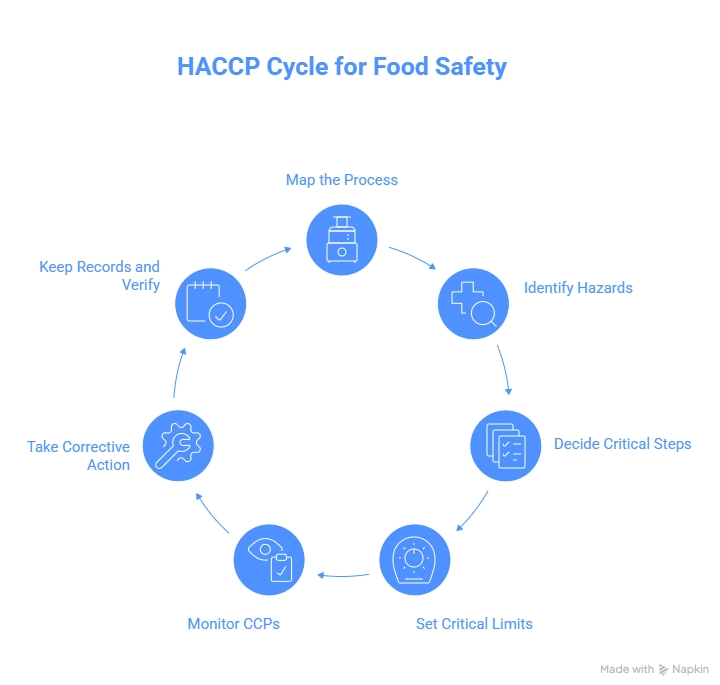
The 7 Steps to Identifying and Managing CCPs

  • Map the Process – List every step from receiving ingredients to serving customers.
  • Identify Potential Hazards – Look for biological, chemical, physical and allergenic risks.
  • Decide Which Steps Are Critical – Determine where control is essential for safety.
  • Set Critical Limits – Establish measurable targets (e.g. temperature, pH, time).
  • Monitor CCPs – Regularly check each point to stay within safe limits.
  • Take Corrective Action – Act immediately if a limit is breached (e.g. reheat or discard food).
  • Keep Records and Verify – Document checks and review the system frequently.

Each step supports the HACCP principles required by UK law.

Why CCPs Are Vital for Compliance

In the UK, the Food Hygiene (England) Regulations 2013 require every food business to have a documented HACCP-based system.
Properly managing CCPs helps you:

  • Prevent foodborne illnesses and contamination
  • Pass FSA and local authority inspections
  • Reduce waste and recalls
  • Build customer trust and a 5-star hygiene rating

Ignoring CCPs can lead to enforcement action, fines, or closure — something no employer can afford.

Training: The Key to Effective CCP Management

Even the best-written HACCP plan fails without trained staff.
Supervisors, managers, and business owners must understand how to identify, monitor, and document CCPs correctly.

Through the Food Hygiene Level 3 Training (CPD Accredited) and QLS Level 3 Certificate in Food Hygiene and Safety,
learners gain a practical understanding of HACCP principles and UK food law — essential for any lead role in the hospitality or manufacturing sector.

Fast-Track Your Compliance Qualification

Need to train quickly?
With Apex Learning’s Fast-Track Option, you can complete your Level 3 course in just 4–6 weeks, study 100 % online, and earn an accredited certificate that enhances your credibility and inspection readiness.

External Resources

Conclusion: Compliance Protects Your Business

Critical Control Points are the heart of food safety management. When monitored and maintained correctly, they protect your customers, staff, and reputation.

By understanding and applying CCPs through HACCP training, you don’t just meet UK compliance — you lead by example in safety and quality.

Take your next step toward compliance and career growth today:

Because when you control the points, you control the outcome.

FAQs

1. What are Critical Control Points in food production?

Critical Control Points (CCPs) are specific stages in the food process where potential hazards — such as bacteria, allergens, or chemical residues — can be prevented, eliminated, or reduced to safe levels. They form the foundation of a HACCP plan and are required by UK food safety law.

2. Why are CCPs important in food safety?

CCPs protect consumers by ensuring hazards are controlled before food reaches the customer. Monitoring CCPs helps prevent contamination, reduce waste, and demonstrate compliance during Food Standards Agency (FSA) inspections.

3. Who is responsible for monitoring Critical Control Points?

Supervisors, managers, and food business operators share responsibility for CCP monitoring. Staff must be trained to record, verify, and act when limits are breached. Completing a Level 3 Food Hygiene qualification equips managers with the skills to oversee CCPs effectively.
👉 Food Hygiene Level 3 Training (CPD Accredited)
👉 Certificate in Food Hygiene and Safety at QLS Level 3

4. What are examples of CCPs in a food business?

Common CCPs include:

  • Cooking food to at least 75 °C to kill harmful bacteria.
  • Cooling food rapidly from 60 °C to 5 °C within 90 minutes.
  • Storing chilled food below 5 °C.
  • Preventing allergen cross-contact.
  • Metal detection before packaging.

5. How do I identify Critical Control Points in my process?

Start by mapping your food process from service delivery. Identify hazards at each stage, assess where control is essential, and define measurable critical limits. Formal HACCP or Level 3 Food Hygiene training will guide you through this step-by-step process.

6. Is HACCP training mandatory in the UK?

Yes. The Food Hygiene (England) Regulations 2013 and retained EU Regulation (EC) No 852/2004 require every UK food business to have a HACCP-based safety system. Managers must be competent in HACCP principles, which can be achieved through accredited Level 3 courses.

7. How often should CCPs be reviewed?

Review CCPs at least annually or whenever there are changes to recipes, equipment, suppliers, or legislation. Regular reviews ensure your system stays compliant and effective.

8. Can I study CCP and HACCP training online?

Absolutely. Apex Learning offers fully online, accredited courses with tutor support and lifetime access:

Our Blogs

Latest blog posts

Personal Hygiene in Food Handling Best Practices for Staff" alt="Personal Hygiene in Food Handling: Best Practices for Staff" />

Discover the best practices for personal hygiene in food handling. Learn how to meet UK standards and protect customers through Level 3 Food Hygiene training.

HACCP Certification: What It Is and Why You Need It" alt="HACCP Certification: What It Is and Why You Need It" />

HACCP certification is vital for food safety compliance in the UK. Discover what it covers, who needs it, and how to get certified online.

The Role of HACCP in Preventing Foodborne Illness" alt="The Role of HACCP in Preventing Foodborne Illness" />

Learn how the HACCP system protects UK consumers by controlling food safety hazards — and why managers need Level 3 training to stay compliant.