



In the UK food industry, audits aren’t just a formality — they’re proof that your business operates safely and legally.
The Food Standards Agency (FSA) and local authorities use food safety audits to check if you’re following hygiene regulations, managing risks through HACCP, and maintaining proper records.
Whether you run a restaurant, café, or food manufacturing site, failing an audit can damage your reputation and even result in closure.
The good news? With the right preparation, documentation, and training, you can face every inspection with confidence.

What Is a Food Safety Audit?
A food safety audit is a systematic inspection of your business’s food handling, storage, and hygiene processes. It’s designed to verify compliance with UK food safety laws, including:
- The Food Hygiene (England) Regulations 2013
- Retained EU Regulation (EC) No 852/2004
Audits can be internal, external, or regulatory (by EHOs or FSA officers). They assess everything from HACCP implementation to temperature control, cleaning schedules, and staff training records.
Types of Food Safety Audits
- Internal Audits – Conducted by your own team to identify gaps before external inspections.
- Second-Party Audits – Carried out by suppliers or customers who require compliance proof.
- Third-Party Audits – Independent assessments for certifications or regulatory checks.
- Regulatory Audits – Conducted by FSA or local authorities to enforce legal standards.
How to Prepare for a Food Safety Audit
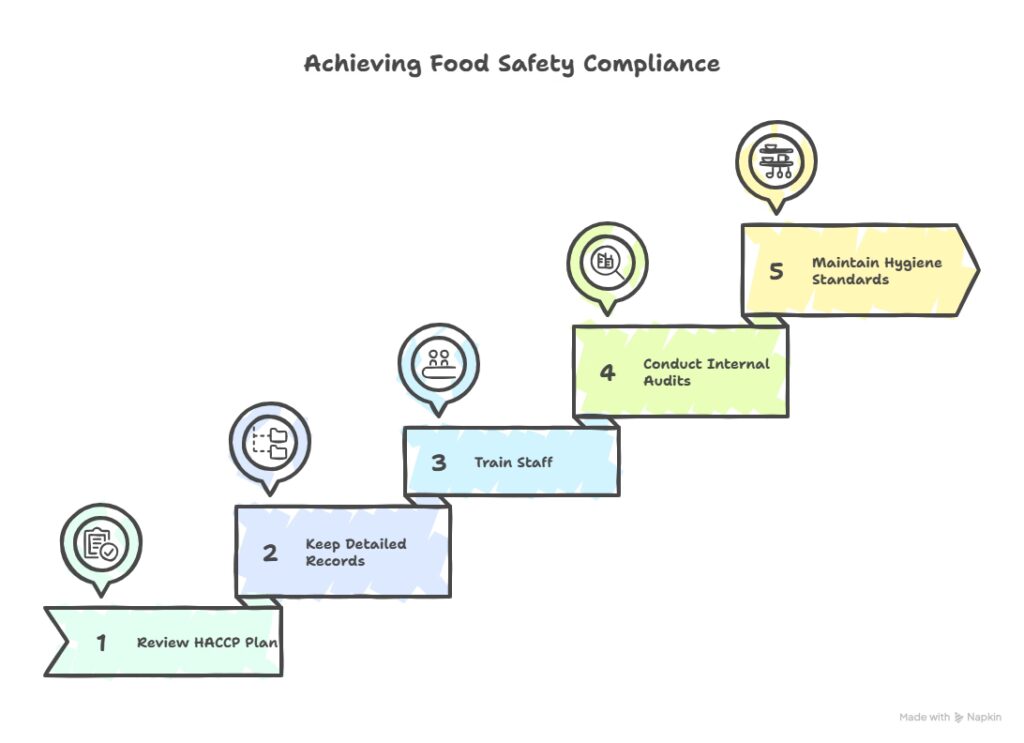
1. Review Your HACCP Plan
Your HACCP (Hazard Analysis and Critical Control Point) plan is at the heart of any audit. Make sure it’s up to date, covers all processes, and reflects any recent menu, supplier, or equipment changes.
👉 Learn how to build and manage a HACCP plan with the
Food Hygiene Level 3 Training (CPD Accredited) or
Certificate in Food Hygiene and Safety at QLS Level 3.
2. Keep Detailed Records
Auditors want evidence, not verbal assurances.
Maintain up-to-date documentation for:
- Temperature logs
- Cleaning and pest control schedules
- Equipment maintenance
- Staff training and certificates
- Delivery and storage checks
Accurate records prove due diligence — your legal defence in the event of non-compliance claims.
3. Train and Refresh Your Staff
Under UK food safety law, every food handler must receive training that matches the nature of their duties and level of responsibility. This ensures that everyone — from kitchen assistants to site managers — understands how to handle food safely, prevent contamination, and maintain high hygiene standards. Supervisors and managers, in particular, are legally expected to hold a Level 3 Food Hygiene certification, as they play a crucial role in implementing and monitoring HACCP procedures, leading audits, and training others effectively.
Well-trained employees demonstrate competence and confidence during inspections, which reassures auditors that your business operates with professionalism and control. Conversely, untrained or poorly informed staff can compromise compliance, increase the risk of foodborne illness, and damage your reputation. To remain compliant, refresher training should be completed every three years or whenever processes, menus, or equipment change — ensuring your entire team stays audit-ready.
4. Conduct Regular Internal Audits
Don’t wait until the Food Standards Agency (FSA) or local authority arrives — staying compliant starts with your own internal checks. Conduct monthly or quarterly internal audits to review your food safety systems, hygiene practices, and documentation. These self-assessments help you identify weaknesses early, correct non-conformities, and prevent small oversights from becoming major compliance issues.
Internal audits also reinforce your due diligence by proving that your business continually monitors and improves its processes. Review your HACCP plan, temperature logs, cleaning records, pest control documentation, and staff training certificates during each audit. Use your findings to update company policies, implement corrective actions, and retrain staff where necessary.
A consistent audit schedule demonstrates a proactive approach to safety, builds confidence among inspectors, and helps your business maintain a high FSA hygiene rating — protecting both your reputation and customers.
5. Maintain High Hygiene Standards Daily
Your premises should always be inspection-ready — not just before an audit.
- Keep storage clean and labelled.
- Separate raw and cooked foods.
- Monitor fridge/freezer temperatures.
- Enforce hand-washing and personal hygiene policies.
A clean, well-organised kitchen tells auditors your business takes food safety seriously.
Common Mistakes That Fail Food Safety Audits
- Outdated HACCP plans
- Missing or incomplete temperature logs
- Poor cleaning or pest control documentation
- Staff without valid hygiene training
- Ignoring allergen management procedures
Avoiding these errors is simple with continuous monitoring and refresher training.
Fast-Track Your Compliance Training
Apex Learning’s Fast-Track Option is ideal for professionals who want to achieve food safety compliance quickly without sacrificing quality. You can complete your Level 3 Food Hygiene course in just 4–6 weeks, studying entirely online at your own pace from anywhere in the UK.
This flexible pathway allows you to fit learning around work commitments while mastering the key elements of HACCP, UK food safety legislation, and audit preparation. You’ll benefit from lifetime access, interactive course content, and dedicated tutor support throughout your studies.
Upon completion, you’ll earn a CPD-Accredited or QLS-Endorsed certificate, recognised across the food industry and proof of your organisation’s commitment to safety and professionalism. Fast-track your compliance journey today and keep your business audit-ready with Apex Learning’s trusted training programmes.
✅ Related course: Certificate in Food Hygiene and Safety at QLS Level 3
External Resources for Reference
- Food Standards Agency – Food Business Guidance
- Gov.uk – Food Safety and Hygiene Regulations
- NHS – Food Safety Advice
Conclusion: Compliance Protects Your Business
Food safety audits don’t need to be stressful when your systems, people, and processes are in sync. By maintaining an up-to-date HACCP plan, keeping detailed audit records, and ensuring every team member is properly trained, your business will consistently meet inspection standards and inspire confidence among both customers and regulators.
Staying compliant is not a one-off task — it’s an ongoing commitment to excellence, professionalism, and public safety. With the right training and documentation in place, you can face any inspection knowing you’ve met and exceeded the UK’s strict food hygiene requirements.
Take control of your compliance today:
FAQs
1. What is a food safety audit?
A food safety audit is a structured inspection that checks whether your business complies with UK food hygiene laws. It examines your HACCP system, records, hygiene practices, and staff training to ensure food is safe for consumers. Audits are conducted by internal teams, customers, or Food Standards Agency (FSA) inspectors.
2. Why are food safety audits important in the UK?
Food safety audits protect public health and verify that food businesses meet the Food Hygiene (England) Regulations 2013 and retained EU Regulation (EC) No 852/2004.
Passing an audit demonstrates due diligence, builds trust with customers, and helps secure a strong FSA Food Hygiene Rating.
3. How can I prepare for a food safety audit?
You can prepare by:
- Reviewing and updating your HACCP plan.
- Keeping accurate temperature, cleaning, and pest control records.
- Ensuring all staff have valid Food Hygiene certificates.
- Conducting internal audits before official inspections.
4. What documents are required for a food safety audit?
Auditors typically request:
- HACCP plans and CCP monitoring logs
- Staff training certificates
- Cleaning schedules and pest control records
- Temperature and storage logs
- Supplier verification and traceability documents
5. How often should food safety audits be conducted?
Most UK food businesses perform internal audits every 3–6 months and undergo external audits annually or when required by customers, certification bodies, or local authorities. Regular audits help identify issues early and maintain continuous compliance.
6. What happens if I fail a food safety audit?
Depending on the severity, you may receive an improvement notice, fines, or a temporary closure. To avoid this, ensure staff are trained, your HACCP is current, and documentation is complete. Continuous refresher training keeps your business inspection-ready.
7. Is HACCP training required for audit compliance?
Yes. HACCP knowledge is mandatory for compliance in the UK. Supervisors and managers must understand how to identify and manage Critical Control Points (CCPs) within their food processes. Completing a Level 3 Food Hygiene course provides the required competency.
8. Can I study food safety audit preparation online?
Absolutely. Apex Learning offers fully online, accredited courses that cover HACCP principles, hygiene regulations, and audit preparation.
Choose from:
 " alt="The 6 Principles of Safeguarding: Protect Before Harm Happens" />
 " alt="Personal Development Goals: 5 Meaningful Examples That Work" />
 " alt="TILE in Manual Handling: Meaning, Checklist & Safer Lifting Guide" />