



Artificial intelligence (AI) and automation are no longer distant concepts — they are actively reshaping the UK job market. From chatbots handling customer queries to robotic process automation streamlining back-office tasks, technology is accelerating workplace transformation at an unprecedented pace. According to the World Economic Forum, an estimated 85 million jobs could be automated worldwide by 2025. In the UK alone, studies suggest that between 25% and 30% of current roles could be affected by automation by 2030.
While automation promises efficiency, cost savings, and productivity gains, it also poses significant challenges. Roles involving repetitive, routine, or predictable tasks — such as data entry, manufacturing line work, and basic administrative duties — face the highest risk of replacement. For example, advances in AI-powered analytics mean that tasks once requiring human oversight can now be performed more quickly and accurately by machines.
However, the story is not entirely one of job loss. Many roles remain resistant to automation, particularly those requiring human creativity, complex problem-solving, interpersonal skills, and emotional intelligence. Professions in healthcare, education, management, and creative industries are less likely to be fully automated soon. Additionally, AI is expected to create new job categories, especially in fields such as AI development, cybersecurity, digital marketing, and data ethics.
For individuals and businesses, understanding which jobs are most susceptible to automation — and which are likely to remain secure — is vital for long-term career planning. Proactive upskilling, retraining, and adopting a future-proof skillset can help workers adapt to these technological shifts. In this article, we examine the UK jobs most vulnerable to automation, the emerging opportunities in the digital economy, and the skills required to succeed in a rapidly evolving labour market.


Will AI Help or Hurt Society?
Artificial intelligence (AI) is sparking a global debate about its impact on society and the job market. Supporters argue that AI offers transformative benefits—boosting productivity, advancing medical research, and expanding access to quality education. For example, AI-driven diagnostic tools can help detect diseases earlier, while automated learning platforms make training more affordable and widely available.
However, concerns remain over its potential to disrupt employment. Many repetitive and manual roles—particularly in administration, manufacturing, and customer support—are increasingly vulnerable to automation. For workers in these sectors, the fear of job loss is real.
Yet, AI isn’t solely a threat—it’s also a driver of new opportunities. As businesses integrate AI systems, demand is growing for roles in AI engineering, data analysis, cybersecurity, and automation management. These emerging careers require specialised skills, opening new pathways for professionals willing to adapt and reskill.
Moreover, AI-powered technologies are already helping to solve complex challenges, from optimising supply chains to tackling climate change. When used responsibly, AI can enhance efficiency, improve decision-making, and make everyday life more convenient. The key lies in balancing innovation with workforce readiness, ensuring AI becomes a tool for progress rather than displacement.
Economic Impact of AI

The McKinsey Global Institute estimates that artificial intelligence could generate an additional $13 trillion in global economic activity by 2030. This growth represents around 16% higher cumulative GDP compared to current projections, with AI potentially contributing an extra 1.2% in GDP growth per year. The primary drivers behind this surge are automation, increased efficiency, and innovation in products and services.
By 2030, it is expected that around 70% of companies worldwide will have adopted at least one form of AI technology. However, fewer than half are predicted to fully integrate and leverage all categories of AI, such as machine learning, natural language processing, and advanced robotics. This indicates that there is still significant untapped potential for economic and productivity gains.
The benefits of AI adoption are expected to be far-reaching. Businesses can use AI to optimise supply chains, reduce operational costs, personalise customer experiences, and identify new market opportunities. In the public sector, AI can improve healthcare delivery, enhance education access, and streamline government services—boosting overall societal productivity.
However, alongside these opportunities come challenges. The economic benefits of AI may not be evenly distributed, leading to widening gaps between early adopters and lagging industries or regions. Moreover, the displacement of certain job categories could create transitional unemployment and require large-scale workforce reskilling initiatives.
Forbes has described AI as “one of the most disruptive technologies in history”, comparing its potential impact to that of the internet or electricity. Ultimately, AI’s economic influence will depend on how effectively businesses, governments, and individuals adapt to this transformative shift—embracing innovation while mitigating its disruptive effects.
How AI Will Affect Jobs in the UK
Goldman Sachs projects that AI could replace up to 300 million full-time jobs globally by 2030, yet this shift also has the potential to spark a productivity boom and create entirely new roles focused on AI development, oversight, and integration. According to research from McKinsey, approximately 14% of employees may need to transition into different careers as a result of AI, robotics, and digitisation.
In the UK, certain job roles are at a higher risk of automation due to AI’s capabilities in handling repetitive, rules-based tasks. These include:
- Customer Service Representatives – £24,000–£32,000
- Receptionists – £18,000–£40,000
- Accountants & Bookkeepers – £18,000–£38,000
- Sales Representatives – £23,000–£70,000
However, many roles remain less likely to be automated because they rely heavily on human judgment, creativity, emotional intelligence, and complex decision-making. Examples include:
- Teachers
- Surgeons
- Psychologists
- Lawyers
- HR Managers
- Creative Writers
- CEOs
While AI is poised to transform the UK labour market, its overall effect may be one of job transformation rather than job elimination. The focus will increasingly shift towards developing new skills, especially in areas such as AI system management, ethical governance, and human–AI collaboration. Workers who adapt early and upskill in relevant fields are likely to benefit most from the AI revolution, positioning themselves for opportunities in an economy where human expertise and technology work side by side.
Job Role | Entry-Level Salary (UK) | Mid-Level / Experienced Salary | Senior / Specialist Salary | |
Social Worker | £24,000–£30,000 | £31,000–£47,000 | £50,000–£60,000+ | |
Paralegal | £14,000–£25,000 | £25,000–£40,000 | £40,000–£60,000+ | |
Junior Web Developer | £21,073–£24,973 | £24,973–£30,072 | £30,072–£36,362+ | |
Associate Product Manager | £26,000–£36,746 | £36,746–£43,950 | £55,000–£60,000 | |
IT Technician | £24,648 | £24,000–£36,000 | N/A | |
Marketing Manager | £27,000–£35,000 | £35,000–£60,000+ | N/A | |
Sales Manager | £28,000–£35,000 | £40,000–£70,000+ | N/A | |
Software Developer | £30,000–£40,000 | £50,000–£85,000+ | N/A | |
Cybersecurity Specialist | £35,000–£45,000 | £60,000–£100,000+ | N/A | |
Cloud Solutions Architect | £50,000–£65,000 | £90,000–£130,000+ | N/A | |
Cybersecurity Analyst | £28,000–£35,000 | £40,000–£65,000 | £70,000+ | |
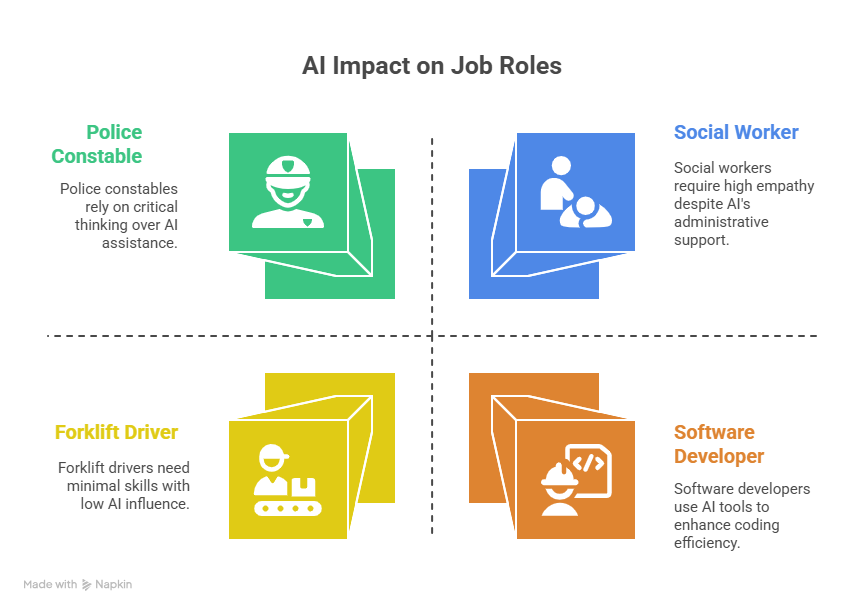
Police Constable | £24,000–£30,000 | £30,000–£40,000 | £40,000–£50,000+ | |
Forklift Driver | £22,000–£28,000 | £28,000–£35,000 | £35,000–£45,000+ | |
Tradesperson (Electrician, Plumber, etc.) | £25,000–£35,000 | £35,000–£50,000 | £50,000–£70,000+ | |
Software Developer (Senior / Lead) | £35,000–£45,000 | £45,000–£60,000 | £60,000–£80,000+ |
1. Social Worker
Salary Range (UK):
- Entry-level / Newly Qualified (NQSW): £24,000–£30,000
- Mid-level / Experienced: £31,000–£47,000
- Senior / Specialist Roles: £50,000–£60,000+
Social workers are at the forefront of delivering emotional, social, and legal assistance to those in need. From safeguarding children to supporting adults with complex challenges, the role is deeply rooted in human connection and ethical judgment. Though AI tools can assist with case tracking, documentation, and data management, they cannot replicate the empathy, intuition, or moral reasoning required in sensitive social contexts.
In England, the average council-employed social worker earned around £43,000 in 2023–24, although this figure has effectively declined in real terms due to inflation (Community Care). Salaries also vary regionally—London and the South East typically offer higher pay (up to £55,000+) to offset the cost of living, while mid-tier roles across the UK average between £28,000 and £45,000 (CampusCybercafe; Uniccm).
Despite rising demand, social workers face pressures such as high caseloads, unpaid overtime, and emotional burnout—especially in areas like child protection (Reddit Discussion).
In summary, while AI can support certain administrative functions, the essence of social work—compassion, adaptability, and ethical leadership—remains resolutely human. Technology serves as a tool to enhance efficiency, but the heart of the profession continues to rely on human judgment, empathy, and resilience.
2. Paralegal
Salary Range (UK):
Paralegals are an essential part of the legal profession, providing support to solicitors, barristers, and corporate legal teams. Their duties include conducting legal research, drafting contracts and documents, assisting in case preparation, and liaising with clients. While AI and automation tools can now streamline routine tasks such as document review, contract analysis, and basic legal research, the profession still requires human judgment, reasoning, and ethical decision-making. These qualities make paralegals less likely to be fully replaced by technology.
Salaries for paralegals in the UK vary depending on experience, location, and sector. Entry-level roles typically start at £20,000 per year, rising to £28,000 as professionals gain experience. Mid-level positions generally earn between £28,000 and £40,000, while senior or specialist paralegals—especially in corporate law or London-based firms—can command salaries up to £55,000 or more (CV-Library). Regional differences are significant: London and the South East often offer higher pay to reflect the cost of living and competitive legal markets.
Despite the rise of AI-assisted legal software, human skills remain central to the paralegal role. Skills such as interpreting complex legislation, managing client expectations, exercising professional judgment, and understanding nuanced legal contexts cannot be fully automated. AI can, however, enhance efficiency and accuracy by handling repetitive tasks, allowing paralegals to focus on high-value work that requires creativity and critical thinking.
Paralegals who embrace technology and continuously update their skills—both legal and digital—are likely to remain in high demand. With AI complementing their work rather than replacing it, the future of paralegal careers in the UK remains promising and resilient.
3. Junior Web Developer
Salary Range (UK):
Junior web developers are responsible for building and maintaining websites, coding applications, and supporting user interface and user experience (UI/UX) improvements. Their work involves programming languages such as HTML, CSS, JavaScript, and PHP, alongside using frameworks like React, Angular, or WordPress. While AI-assisted tools can automate some coding tasks, debug code, and optimise web performance, human creativity and problem-solving remain indispensable.
Salaries for junior web developers in the UK depend on experience, location, and company size. Entry-level developers typically earn between £25,000 and £35,000 annually, while mid-level developers can command £35,000–£50,000. Experienced developers, particularly those with specialist skills in front-end, back-end, or full-stack development, can earn £50,000–£65,000 or more, with London-based roles often exceeding this range due to higher living costs and demand for tech talent (CV-Library).
Despite automation tools, human web developers are essential for creating intuitive designs, solving complex coding challenges, and collaborating with designers, project managers, and clients. AI can enhance productivity by generating code snippets, automating testing, and assisting with repetitive tasks, but it cannot replace the judgment, creativity, and collaborative skills required in development projects.
Web developers who continuously upskill in emerging technologies, frameworks, and AI-assisted coding tools will remain highly competitive. By combining technical expertise with creative problem-solving, they can leverage AI to improve efficiency while delivering innovative digital solutions. This makes web development a resilient and forward-looking career in the evolving technology landscape.
4. Associate Product Manager
Salary Range (UK):
- Average Base Salary: ~£37,065 per year
- Glassdoor Average: ~£43,950 per year, with a typical range between £35,488 and £55,359
- PayScale Median: ~£36,746 per year, with a total compensation range from £26,000 to £60,000
Associate Product Managers (APMs) bridge junior roles and full Product Manager positions, contributing to product strategy, feature roadmaps, and cross-functional coordination. While AI tools assist with market analysis and data synthesis, the role demands human-centric skills like stakeholder management, prioritisation, and creative problem-solving.
UK salaries for APMs vary due to experience, skills, and location. Indeed reports an average base of £37,065, reflecting broad market compensation. Glassdoor’s data shows a slightly higher average of £43,950, with most APMs earning between £35,488 and £55,359. PayScale aligns with the lower end, showing a median base of £36,746, but noting total compensation may reach up to £60,000, especially when considering bonuses.
APMs in London or tech-heavy sectors can command top-tier salaries, while regional roles typically fall within the mid-range. Despite AI’s growth in analytics and automation, the APM role remains resilient. Human judgment is essential when balancing user empathy, business strategy, and market demands—areas where AI still falls short.
For those looking to excel, upskilling in product strategy, AI tools for product analysis, and cross-team collaboration is key. APMs who master these skills can effectively navigate product development landscapes alongside AI, contributing strategic insight rather than being sidelined by automation.
5. IT Technician
Salary Range (UK):
- Entry-level: ~£24,648 per year
- Mid-level / Experienced: £24,000–£36,000 per year
IT Technicians are the backbone of modern organisations, ensuring that hardware, software, and network systems run smoothly. Their responsibilities include diagnosing and fixing technical problems, maintaining computer systems, and providing both on-site and remote support to users. With the rise of AI-powered chatbots, automated troubleshooting tools, and self-healing systems, some routine help-desk tasks—like password resets or simple error fixes—can now be automated.
However, AI cannot replace the nuanced human judgment needed for complex problem-solving, system integrations, and situations that require critical thinking or interpersonal communication. For example, a network outage affecting multiple departments demands not just technical skills, but also quick decision-making, cross-team coordination, and the ability to explain solutions in non-technical terms to stakeholders.
According to Indeed UK, entry-level IT Technicians typically earn around £24,648 annually, while National Careers Service data shows experienced professionals earning up to £36,000 depending on the organisation, sector, and level of responsibility.
The future of IT support will likely involve more collaboration between human technicians and AI tools. To remain competitive and enhance career prospects, IT Technicians should broaden their expertise into high-demand areas such as cybersecurity, AI systems oversight, and cloud infrastructure management. These fields not only offer higher earning potential but also demand creativity, problem-solving, and adaptability—qualities that AI cannot fully replicate.
In short, while automation will change the nature of IT support, skilled IT Technicians will remain indispensable in keeping technology and business operations running seamlessly.
6. Marketing Manager
Salary Range (UK):
Marketing Managers play a pivotal role in shaping how a company connects with its audience. They are responsible for developing marketing strategies, overseeing campaigns, managing budgets, and coordinating with creative, sales, and digital teams to ensure consistent brand messaging. Their work often involves market research, competitor analysis, and leveraging both online and offline channels to maximise engagement and revenue.
In the modern business landscape, AI has transformed many aspects of marketing. Tools powered by AI can automate tasks such as ad targeting, data analysis, and email segmentation, allowing campaigns to be more precise and efficient. However, while AI provides data-driven insights and predictive analytics, it cannot replicate the creativity, emotional intelligence, and brand vision that human marketing managers bring to the table.
For example, AI might suggest the best time to launch a campaign or predict customer behaviour, but it is the Marketing Manager who crafts the narrative, defines the brand voice, and ensures messaging resonates with the intended audience.
Salaries for Marketing Managers vary depending on industry, location, and experience. According to Indeed UK, entry-level roles typically offer between £27,000 and £35,000 annually, while experienced professionals, especially in high-demand industries like technology, finance, or luxury retail, can earn £60,000+ per year. Senior positions with performance bonuses and profit-sharing can push earnings even higher.
To remain competitive, Marketing Managers should develop skills in AI marketing tools, data-driven strategy, and personalised content creation, blending technology with human creativity for maximum impact.
7. Sales Manager
Salary Range (UK):
- Entry-level: ~£28,000–£35,000 per year
- Experienced / Senior: £40,000–£70,000+ per year
Sales Managers are responsible for driving a company’s revenue by leading and motivating sales teams, setting performance targets, building client relationships, and identifying new market opportunities. They often work closely with marketing, operations, and product development teams to ensure sales strategies align with broader business goals.
The role demands strong leadership, negotiation, and communication skills, as well as the ability to analyse market trends and adapt strategies to changing conditions. Sales Managers also play a crucial part in developing sales training programmes, ensuring their teams are equipped with the knowledge and tools to meet targets.
In today’s digital-first environment, AI tools have become an essential part of sales management. AI-powered CRM systems can track leads, forecast sales, and automate follow-ups, enabling Sales Managers to focus on relationship-building and strategic decision-making. While AI can highlight high-value prospects and predict purchasing behaviour, human judgment is still vital for closing complex deals and navigating nuanced client relationships.
Salaries vary widely depending on the industry, company size, and location. In high-growth sectors like tech, pharmaceuticals, and financial services, Sales Managers can earn £70,000+, often with performance-based bonuses and commission structures significantly boosting total earnings.
To excel in this role, Sales Managers should combine data-driven decision-making with emotional intelligence, leveraging AI analytics to support—but not replace—the human touch that builds lasting business relationships.
8. Software Developer
Salary Range (UK):
- Entry-level: ~£30,000–£40,000 per year
- Experienced / Senior: £50,000–£85,000+ per year
Software Developers design, build, test, and maintain applications, systems, and websites. They are the problem-solvers of the digital world, turning business needs into functional software solutions. This role often involves working with multiple programming languages, frameworks, and databases, as well as collaborating with designers, project managers, and QA testers to deliver high-quality products.
In addition to technical skills, successful developers need analytical thinking, creativity, and adaptability. They must be able to troubleshoot issues, optimise performance, and implement security best practices. Many developers also contribute to ongoing product improvements based on user feedback and market demands.
AI is reshaping the role of Software Developers. Tools like GitHub Copilot and ChatGPT Code Interpreter can generate code snippets, detect bugs, and even suggest architectural improvements. While these tools speed up development, human expertise remains crucial for designing scalable systems, ensuring ethical AI use, and making architectural decisions that align with long-term business goals.
Developers specialising in high-demand areas such as AI/ML engineering, cybersecurity, fintech, and blockchain often command the highest salaries. In addition, many companies offer hybrid or fully remote working options, which expand opportunities across different regions without requiring relocation.
With businesses increasingly relying on technology, Software Development remains one of the most future-proof careers, offering strong salaries, career progression, and the chance to work on innovative, impactful projects.
9. Cybersecurity Specialist
Salary Range (UK):
- Entry-level: ~£35,000–£45,000 per year
- Experienced / Senior: £60,000–£100,000+ per year
Cybersecurity Specialists protect organisations from digital threats such as hacking, malware, phishing, and ransomware. Their responsibilities include monitoring networks, detecting vulnerabilities, implementing security measures, and responding to incidents to minimise damage and prevent data breaches.
This role requires in-depth knowledge of firewalls, intrusion detection systems, encryption methods, and risk management frameworks. Strong problem-solving skills, attention to detail, and the ability to stay ahead of evolving cyber threats are essential.
AI is playing a growing role in cybersecurity by enabling faster threat detection, automating routine security checks, and analysing vast datasets for suspicious activity. However, human expertise is vital for interpreting AI findings, handling complex incidents, and designing proactive security strategies.
Specialists who focus on high-demand areas such as ethical hacking (penetration testing), cloud security, digital forensics, and AI-driven threat analysis often command premium salaries. Many also earn industry-recognised certifications like CISSP, CEH, or CompTIA Security+, which can significantly boost earning potential.
With cybercrime on the rise and regulations like GDPR enforcing stricter data protection standards, demand for skilled cybersecurity professionals in the UK is soaring. Companies across finance, healthcare, government, and tech are investing heavily in security talent, making this one of the most lucrative and secure career paths in the technology sector.
10. Cloud Solutions Architect
Salary Range (UK):
- Entry-level: ~£50,000–£65,000 per year
- Experienced / Senior: £90,000–£130,000+ per year
Cloud Solutions Architects design, implement, and manage cloud-based infrastructure for businesses, ensuring systems are secure, scalable, cost-effective, and aligned with organisational goals. They work with platforms like Amazon Web Services (AWS), Microsoft Azure, and Google Cloud Platform (GCP) to create solutions that support business applications, data storage, and analytics.
Responsibilities often include migrating legacy systems to the cloud, optimising performance, managing costs, ensuring compliance, and integrating AI-powered services such as predictive analytics, machine learning models, and automation tools.
The role demands expertise in networking, security protocols, DevOps practices, and containerisation technologies like Docker and Kubernetes. Strong communication skills are equally important, as Cloud Architects collaborate with executives, IT teams, and developers to deliver tailored solutions.
AI is becoming a key part of cloud architecture, enabling real-time data processing, intelligent automation, and predictive scaling to handle fluctuating workloads. Architects who specialise in AI integration, hybrid cloud strategies, and multi-cloud management are in especially high demand.
With nearly every UK industry accelerating its move to the cloud, the demand for skilled Cloud Solutions Architects continues to outpace supply. High salaries, opportunities to work on innovative projects, and the potential for remote or hybrid roles make this one of the most attractive and future-proof careers in the tech sector.
11. Cybersecurity Analyst
Salary Range (UK):
- Entry-level: £28,000–£35,000 per year
- Mid-level / Experienced: £40,000–£65,000 per year
- Senior / Lead Roles: £70,000+ per year
Cybersecurity Analysts protect organisations from digital threats, monitoring networks, identifying vulnerabilities, and responding to security incidents. Their role is critical as businesses increasingly rely on digital infrastructure, cloud platforms, and AI-powered applications.
While some repetitive monitoring tasks can be automated using AI and machine learning, human expertise remains essential for incident response, threat hunting, policy development, and ethical decision-making. Analysts must evaluate complex attack patterns, anticipate potential breaches, and implement strategies that automated systems alone cannot handle.
Entry-level analysts in the UK typically earn around £28,000–£35,000, with mid-level roles reaching £40,000–£65,000 depending on experience, certifications, and sector. Senior positions, particularly in finance or large corporations, can exceed £70,000 per year.
To enhance career prospects, analysts are encouraged to pursue certifications like CISSP, CISM, or CompTIA Security+, and develop skills in penetration testing, risk management, and AI-driven threat detection.
With cybercrime increasing globally, cybersecurity professionals are in high demand. This career offers job stability, high earning potential, and opportunities to work on cutting-edge technologies, making it both a secure and dynamic choice for technology professionals in the UK.
12. Police Constable
Salary Range (UK):
- Entry-level / Newly Qualified: £24,000–£30,000 per year
- Mid-level / Experienced: £30,000–£40,000 per year
- Senior / Specialist Roles: £40,000–£50,000+ per year
Police Constables are responsible for maintaining law and order, investigating crimes, and protecting communities across the UK. Their role combines physical presence, investigative skills, and community engagement, making it a career that relies heavily on human judgment and decision-making.
Although AI and automated tools are increasingly used in law enforcement—such as predictive policing software, CCTV monitoring, and administrative systems—these technologies support rather than replace officers. Critical thinking, ethical judgment, and the ability to de-escalate complex situations are aspects of policing that cannot be fully automated.
Entry-level Police Constables earn around £24,000–£30,000 annually, with mid-level officers reaching £30,000–£40,000 depending on experience and responsibilities. Senior officers or those in specialist units, such as detective roles, can earn £40,000–£50,000+. Regional variations exist, with London-based officers typically receiving higher pay due to the cost of living.
Career progression often includes roles in detective services, traffic policing, or leadership positions, offering higher salaries and increased responsibilities.
For those considering a policing career, combining physical fitness, community engagement, investigative skills, and technology literacy is essential to thrive in an evolving environment where AI assists but does not replace the human element.
This role remains secure and highly respected, emphasising public service, ethical responsibility, and problem-solving skills.
13. Forklift Driver
Salary Range (UK):
- Entry-level: £22,000–£28,000 per year
- Mid-level / Experienced: £28,000–£35,000 per year
- Senior / Specialist Roles: £35,000–£45,000+ per year
Forklift drivers play a vital role in warehouses, factories, and logistics operations, handling the safe movement of goods and materials. The role demands precision, safety awareness, and real-time decision-making, which makes it partially resistant to full automation.
While AI and robotics have introduced automated guided vehicles (AGVs) and warehouse robots that can transport and stack items, human operators are still needed for complex tasks, unusual cargo handling, and emergencies. These machines are tools to increase efficiency, but cannot fully replicate human judgment in dynamic environments.
Entry-level forklift drivers in the UK earn around £22,000–£28,000 annually. Those with experience, certifications, or specialised skills—such as operating high-capacity machinery—can earn £28,000–£35,000. Senior operators or those managing logistics teams can earn £35,000–£45,000+, depending on location and sector.
Training and certifications, including forklift licenses, health and safety compliance, and warehouse management skills, enhance employability and job security.
As warehouses become increasingly automated, forklift drivers who combine traditional driving expertise with technical skills in robotics supervision, inventory management software, and AI-assisted logistics systems will remain in high demand.
This career remains practical and essential, particularly in sectors where flexibility, safety, and hands-on decision-making are critical. Automation supports rather than replaces skilled operators, making it a sustainable long-term profession.
14. Tradesperson (Electrician, Plumber, etc.)
Salary Range (UK):
- Entry-level: £25,000–£35,000 per year
- Mid-level / Experienced: £35,000–£50,000 per year
- Senior / Specialist Roles: £50,000–£70,000+ per year
Tradespeople, including electricians, plumbers, and carpenters, are essential for maintaining and improving residential, commercial, and industrial infrastructure. These roles require hands-on skills, problem-solving, and adaptability, which are difficult for AI or robots to replicate fully.
Although some automation exists—like smart diagnostic tools, automated measurement devices, or AI-assisted planning—most trades tasks still rely heavily on human expertise, judgment, and dexterity. For example, electricians need to navigate unique building layouts, troubleshoot unexpected wiring issues, and comply with strict safety regulations, which cannot be fully automated.
Entry-level tradespeople typically earn £25,000–£35,000 per year. With experience and additional certifications, mid-level professionals can earn £35,000–£50,000, while senior specialists or business-owning tradespeople may earn £50,000–£70,000+ annually. Salaries vary depending on the region, with London and the South East offering higher compensation to offset living costs.
Upskilling in emerging technologies—such as smart home installation, energy-efficient systems, and IoT devices—can make tradespeople more competitive and future-proof their careers.
Overall, trades remain a highly resilient career path, where human skills are irreplaceable, and AI tools serve as assistants rather than substitutes. This makes tradesperson roles a sustainable and valuable choice in an increasingly automated world.
15. Software Developer
Salary Range (UK):
- Entry-level / Junior Developer: £35,000–£45,000 per year
- Mid-level / Experienced: £45,000–£60,000 per year
- Senior / Lead Developer: £60,000–£80,000+ per year
Software developers are at the forefront of creating, maintaining, and improving digital solutions, applications, and systems that power businesses and daily life. While AI can assist in automating certain coding tasks, bug detection, and testing, the creative and problem-solving skills of human developers remain essential.
Entry-level developers in the UK typically earn between £35,000 and £45,000, depending on the region and type of company. Mid-level or experienced developers earn £45,000–£60,000 annually, with senior or lead developers commanding salaries of £60,000–£80,000+ per year, particularly in London or high-demand sectors like fintech, AI, and cybersecurity.
The role requires a strong understanding of programming languages, software architecture, and algorithmic thinking, alongside adaptability to new technologies. Developers who gain expertise in AI, machine learning, cloud computing, and DevOps are increasingly in demand and less likely to be displaced by automation.
In essence, software development combines technical expertise with creative problem-solving, making it a highly resilient and future-proof career. While AI tools can enhance productivity, human judgment, innovation, and strategic thinking remain irreplaceable in delivering complex and effective software solutions.
This makes software development one of the top career paths for those seeking growth, stability, and opportunities in the AI-driven economy.
FAQs
- Will AI replace all human jobs?
No. AI will automate routine and repetitive tasks, but jobs requiring creativity, emotional intelligence, and complex decision-making are less likely to be replaced. - Which jobs are most at risk of automation in the UK?
Roles like customer service representatives, receptionists, bookkeepers, and some administrative positions are more susceptible to automation. - Can AI create new job opportunities?
Yes. AI is creating new careers in AI development, data science, cybersecurity, robotics management, and other tech-driven fields. - How can I future-proof my career against automation?
Focus on developing skills that complement AI: critical thinking, creativity, leadership, emotional intelligence, and tech literacy in areas like AI, cloud computing, and cybersecurity. - 5. How much can I earn in AI-resistant roles?
Salaries vary by profession. For example, social workers earn £28,000–£55,000, software developers £35,000–£80,000+, and IT technicians £24,000–£36,000 per year, depending on experience and location.
Conclusion
Artificial intelligence and automation are reshaping the UK workforce, creating both challenges and opportunities. While certain roles, such as customer service representatives, receptionists, and routine administrative jobs, are at higher risk of automation, professions requiring creativity, emotional intelligence, and strategic judgment—like social workers, teachers, and software developers—remain largely human-driven.
AI will not just replace jobs; it will create new opportunities in fields such as AI development, cybersecurity, data science, and automation management. Upskilling and embracing lifelong learning are critical for future-proofing careers. By understanding which roles are most susceptible to automation and acquiring skills that complement AI, individuals can navigate the evolving job market effectively.
For employers, adopting AI responsibly means enhancing productivity and innovation without compromising the human touch in critical roles. For employees, it emphasises adaptability, continuous learning, and leveraging technology to augment, rather than replace, human capability.
Ultimately, AI is a tool to empower society—when integrated thoughtfully, it can boost economic growth, improve efficiency, and elevate the quality of human-centred work.
 " alt="The 6 Principles of Safeguarding: Protect Before Harm Happens" />
 " alt="Personal Development Goals: 5 Meaningful Examples That Work" />
 " alt="TILE in Manual Handling: Meaning, Checklist & Safer Lifting Guide" />