



A patient’s weight might look healthy, but that does not always mean their nutritional risk is low. Recent weight loss, illness and changes in food intake can reveal concerns that weight alone might miss.
The MUST score helps healthcare professionals identify adults at risk of malnutrition. It is calculated by adding three components: body mass index (BMI), unplanned weight loss and the acute disease effect.
A total MUST score of 0 indicates low risk, 1 indicates medium risk, and 2 or more indicates high risk. Below, we explain how to calculate each component, add the scores together, and interpret the results using practical examples.
Start Your Nursing Journey Today
Build your knowledge of nursing care, nutrition and patient support with flexible online CPD learning, anytime, anywhere.
Also explore: Adult Nursing & Social Care Training
Nursing: Nurse Training Level 4
100% online • Study at your own pace
View Details Adult Nursing CourseWhat Is the MUST Score?
MUST stands for Malnutrition Universal Screening Tool. Developed by the British Association for Parenteral and Enteral Nutrition (BAPEN), it is a five-step screening tool used to identify adults who are malnourished, at risk of malnutrition or obese.
The assessment considers three factors:
- Body mass index (BMI): The relationship between a person’s weight and height.
- Unplanned weight loss: How much weight someone has unintentionally lost over the previous three to six months.
- Acute disease effect: Whether an acute illness has prevented, or is likely to prevent, nutritional intake for more than five days.
The individual scores are added together to determine the overall risk category.
For those preparing for a healthcare career, nutritional screening is one of many patient-care topics worth becoming familiar with. If you’re considering the nursing associate route, our guide to applying for a nursing associate apprenticeship explains the training pathway.
You can refer to BAPEN’s official MUST guidance for the complete screening process.
Nutritional awareness is also an important part of general care knowledge. For learners developing this foundation, Apex Learning’s Care Certificate Course covers nutrition, hydration and other essential care topics through online study.
How to Calculate a MUST Score: The Five Steps
Calculating a MUST score involves three scoring components, followed by identifying the overall risk and determining appropriate next steps.
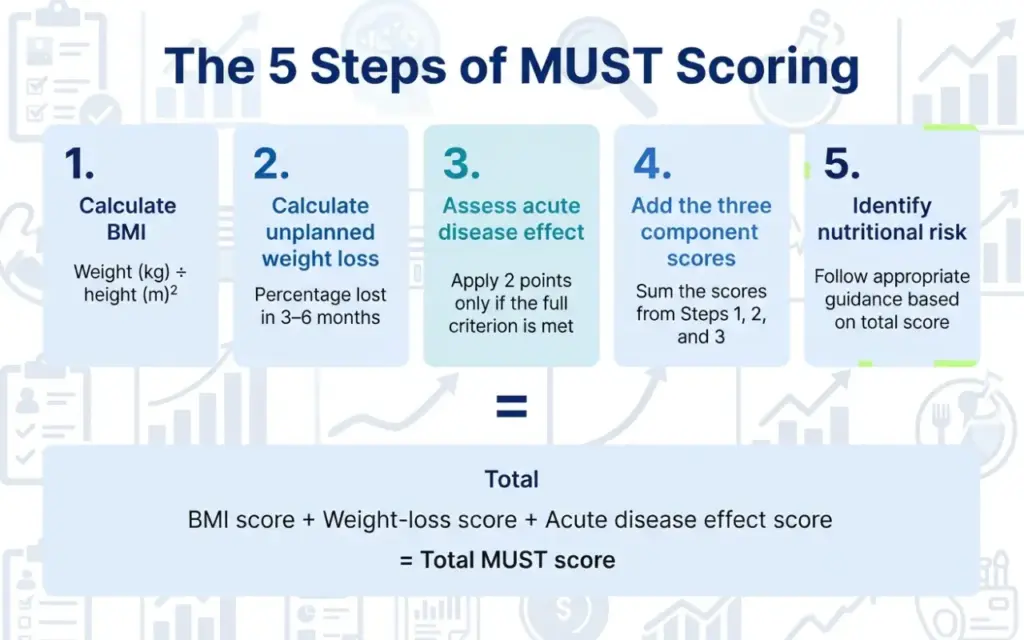
Step 1: Calculate the BMI Score
BMI compares a person’s weight with their height. To calculate it, divide their weight in kilograms by their height in metres squared.
BMI formula:
BMI=Weight(kg)Height(m)2
For example, a patient weighs 70 kg and is 1.70 m tall.
BMI = 70 ÷ (1.70 × 1.70) = 24.2 kg/m²
The patient’s BMI is approximately 24.2, giving them a MUST BMI score of 0.
Use the following scoring thresholds:
| BMI (kg/m²) | MUST points |
|---|---|
| Above 20 | 0 |
| 18.5–20 | 1 |
| Below 18.5 | 2 |
A BMI of exactly 20 receives 1 point, as does a BMI of exactly 18.5. Use the unrounded calculation when checking borderline results.
BMI is only one part of nutritional screening. Someone can have a BMI above 20 and still receive a high overall MUST score if they have experienced significant unplanned weight loss.
Step 2: Calculate Unplanned Weight Loss
The next step considers how much weight a person has lost unintentionally during the previous three to six months.
Percentage weight-loss formula:
Previousweight-CurrentweightPreviousweight100
Suppose a patient weighed 64 kg three months ago and now weighs 60 kg.
Percentage weight loss = (64 − 60) ÷ 64 × 100 = 6.25%
The patient has lost 6.25% of their previous body weight.
| Unplanned weight loss | MUST points |
|---|---|
| Less than 5% | 0 |
| 5–10% | 1 |
| More than 10% | 2 |
In this example, the weight-loss score is 1 point.
The distinction between planned and unplanned weight loss matters. MUST assesses unintentional changes rather than deliberate weight reduction.
Staff should use reliable previous measurements wherever possible. Recording dates and measurements accurately also helps identify changes over time.
Nutritional observations may sit alongside other monitoring responsibilities, including recording a patient’s fluid intake.
Step 3: Assess the Acute Disease Effect
The acute disease effect considers whether a person is acutely ill and has had, or is likely to have, no nutritional intake for more than five days.
- 0 points: The acute disease effect criterion does not apply.
- 2 points: The person is acutely ill and the specified absence of nutritional intake applies.
For example, a hospital patient experiencing an acute illness who is expected to receive no nutritional intake for more than five days may receive 2 points.
Simply eating less than usual does not automatically qualify someone for this score.
BAPEN notes that the acute disease effect is unlikely to apply outside hospital settings.
Step 4: Add the Three Scores Together
Once the individual scores are established, add them together.
Total MUST score = BMI score + weight-loss score + acute disease effect score
For example:
- BMI score: 1
- Unplanned weight-loss score: 2
- Acute disease effect score: 0
Total MUST score = 1 + 2 + 0 = 3
A total score of 3 indicates high malnutrition risk.
Step 5: Identify the Risk Category and Next Steps
The final step is to interpret the total score and determine appropriate follow-up.
| Total MUST Score | Risk Category | General Response |
|---|---|---|
| 0 | Low | Routine clinical care |
| 1 | Medium | Observe and monitor |
| 2 or more | High | Further assessment and appropriate intervention |
The result should be recorded and considered alongside the person’s condition, dietary intake and existing care plan.
A MUST score should never replace clinical judgement or local nutritional care procedures.
MUST Score Calculation Examples
These three hypothetical examples show how different measurements produce low, medium and high risk results.

Example 1: Low Risk – MUST Score 0
A patient has the following measurements:
- Current weight: 70 kg
- Height: 1.70 m
- BMI: 24.2
- Unplanned weight loss: None
- Acute disease effect: Absent
Calculation:
BMI score 0 + weight-loss score 0 + acute disease effect score 0 = 0
Result: Low malnutrition risk.
The patient would generally continue receiving routine care and appropriate repeat screening.
Example 2: Medium Risk – MUST Score 1
A patient weighs 60 kg, having previously weighed 64 kg. Their height is 1.70 m.
BMI = 60 ÷ 2.89 = 20.8
Percentage weight loss = (64 − 60) ÷ 64 × 100 = 6.25%
Their scores are:
- BMI: 0
- Unplanned weight loss: 1
- Acute disease effect: 0
Total MUST score: 1 — medium risk.
Their food intake may need closer observation, with follow-up determined by the care setting and clinical circumstances.
Example 3: High Risk – MUST Score 3
A patient weighs 52 kg, previously weighed 60 kg and is 1.65 m tall.
BMI = 52 ÷ (1.65 × 1.65) = 19.1
Percentage weight loss = (60 − 52) ÷ 60 × 100 = 13.3%
Their scores are:
- BMI: 1
- Unplanned weight loss: 2
- Acute disease effect: 0
Total MUST score: 3 — high risk.
This result requires appropriate nutritional assessment and follow-up according to clinical judgement and local procedures.
These examples demonstrate how BMI and recent weight changes work together. You can also check calculations using BAPEN’s MUST calculator.
What Do MUST Scores of 0, 1 and 2+ Mean?
Calculating the score is only the beginning. Understanding the result helps staff recognise when routine care, observation or further support is appropriate.
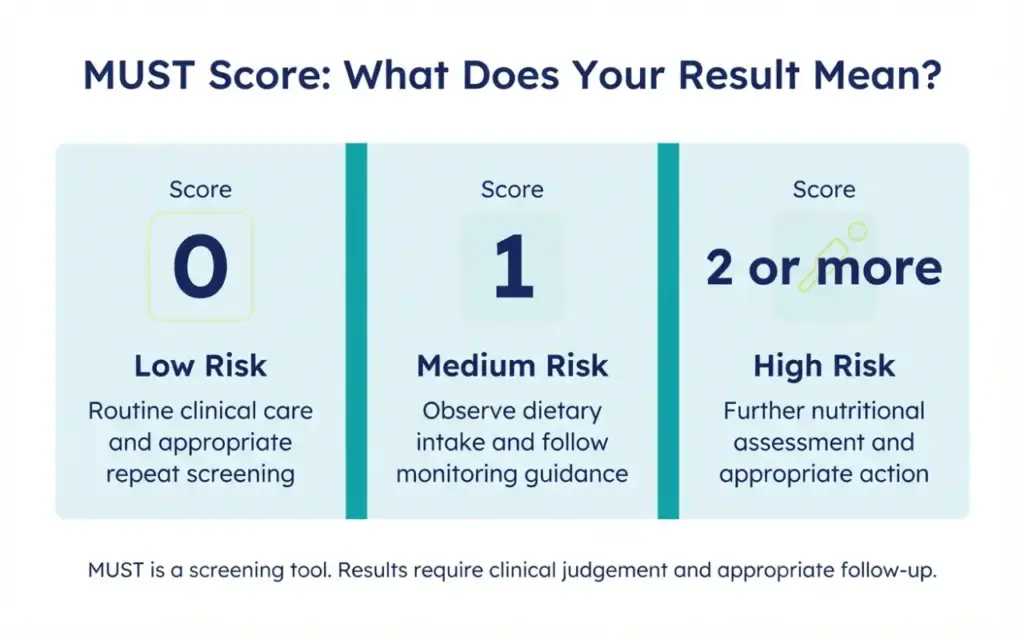
MUST Score 0: Low Risk
A score of 0 indicates low malnutrition risk at the time of screening.
Routine clinical care should continue, with repeat screening according to the setting and individual needs.
Low risk does not mean that nutritional concerns can never develop. Changes in weight, appetite or health may require reassessment.
MUST Score 1: Medium Risk
A score of 1 indicates medium malnutrition risk.
BAPEN recommends observing dietary intake for three days. Depending on the results, staff may need to repeat screening, provide appropriate dietary support or seek advice.
MUST Score 2 or More: High Risk
A score of 2 or above indicates high malnutrition risk.
The person may require further nutritional assessment, a documented care plan and referral to an appropriate clinician or dietitian.
Staff should follow local procedures rather than starting nutritional treatment independently.
According to BAPEN’s risk-management guidance, management should account for the person’s clinical condition and circumstances.
High-risk results should be communicated promptly to the responsible healthcare professional.
What If Weight or Height Cannot Be Measured?
Not everyone can stand on scales or have their height measured easily. Reduced mobility, illness and other physical difficulties may affect routine measurements.

BAPEN describes alternative approaches, including:
- Ulna length: Measuring the forearm bone to estimate height.
- Mid-upper arm circumference (MUAC): Measuring the upper arm to help estimate BMI category.
- Subjective criteria: Using available clinical information to estimate nutritional risk when reliable measurements cannot be obtained.
MUAC does not directly produce an exact MUST score. Similarly, subjective criteria may help establish a risk category without generating a numerical score.
Fluid retention or oedema can also affect weight accuracy. This is one reason accurate fluid intake and output records may be relevant to wider patient monitoring.
Where measurements are uncertain, staff should document the limitations and follow appropriate clinical guidance.
Common MUST Scoring Mistakes to Avoid
Small calculation errors can change the final risk category.
Common mistakes include:
- Using the wrong weight in the formula. Percentage weight loss must be calculated using the previous weight as the denominator.
- Including intentional weight loss. MUST specifically considers unplanned weight loss.
- Relying only on BMI. Significant recent weight loss can indicate nutritional risk even when BMI is above 20.
- Misapplying the acute disease effect. Reduced appetite alone does not meet the full criterion.
- Ignoring unreliable measurements. Fluid retention and estimated measurements may affect interpretation.
- Treating screening as diagnosis. MUST identifies risk and supports further clinical decisions.
Accurate nutritional screening is one part of providing safe, consistent care. Healthcare staff may also need to develop practical knowledge of other responsibilities, such as safe catheter care practices, while working within their training and competence.
Using MUST in UK Care Settings
MUST is used in hospitals, care homes and community healthcare to support nutritional screening.
Nutritional screening also forms part of wider patient care, making it useful for learners interested in nursing associates’ assessment responsibilities.
NICE guidance on nutrition support for adults recommends screening in appropriate clinical circumstances and by staff with suitable skills and training.
In England, CQC Regulation 14 requires relevant care providers to meet people’s nutritional and hydration needs. However, it does not require MUST to be the only screening method.
Staff should understand their responsibilities, record findings and escalate concerns through appropriate channels. Nutritional screening sits alongside other safety practices, including falls prevention in care.
Its online learning content supports theoretical knowledge but does not replace workplace competency assessment or professional registration.
Start Your Nursing Journey Today
Build your knowledge of nursing care, nutrition and patient support with flexible online CPD learning, anytime, anywhere.
Also explore: Adult Nursing & Social Care Training
Nursing: Nurse Training Level 4
100% online • Study at your own pace
View Details Adult Nursing CourseConclusion
Calculating a MUST score helps identify malnutrition risk using BMI, unplanned weight loss and acute disease effect: accurate measurements, appropriate interpretation and timely follow-up support safer, more consistent nutritional care.
For further theoretical learning, Apex Learning also offers Adult Nursing & Social Care Training and Nursing: Nurse Training Level 4, covering broader nursing-care knowledge, nutrition and patient support. These online courses provide CPD learning rather than professional nursing registration.
Frequently Asked Questions About MUST Scores
Is a MUST Score of 2 High?
Yes. A MUST score of 2 or more indicates high malnutrition risk. Further assessment, appropriate monitoring and clinical follow-up may be required.
How Often Should a MUST Assessment Be Repeated?
BAPEN recommends repeat screening according to the care setting and risk category. For routine low-risk screening, examples include weekly in hospitals and monthly in care homes. Additional screening may be needed when a person’s condition changes.
Can Someone Have a Normal BMI and Still Be at Nutritional Risk?
Yes. Significant unplanned weight loss or the acute disease effect can produce an elevated MUST score even when the person’s BMI is above 20.
Can Care Assistants Carry Out MUST Assessments?
Care assistants may contribute to nutritional screening when appropriately trained and working within their competence and employer’s procedures. Clinical interpretation, delegation and follow-up responsibilities must be clear.
How Do You Calculate Percentage Weight Loss for a MUST Score?
Subtract the current weight from the previous weight, divide by the previous weight, and multiply by 100. For example, a decrease from 80 kg to 72 kg represents 10% weight loss. Unplanned weight loss of 5–10% scores 1 point, while more than 10% scores 2 points.
What Is the Difference Between MUST and MNA?
MUST (Malnutrition Universal Screening Tool) assesses adult malnutrition risk using BMI, unplanned weight loss and acute disease effect. MNA (Mini Nutritional Assessment) is designed primarily for older adults and considers additional factors such as dietary intake, mobility and general health. Both are screening tools, but they use different scoring systems.
What Should You Do If a Patient Has a High MUST Score?
A MUST score of 2 or more indicates high malnutrition risk. Staff should record the result, inform the responsible healthcare professional and follow local nutritional care procedures. Further assessment, dietary monitoring and referral to a dietitian may be needed, depending on the patient’s condition.
 " alt="A Realistic 90 Days Plan: How to Start With a YouTube Channel" />
 " alt="Intentional Rounding: What It Is & How It Works" />