



A care worker arrives to help a resident get ready for the day. The resident has a urinary catheter, but the drainage bag contains less urine than expected. Is this normal, or does somebody need to check it?
Situations like this show why catheter care involves more than keeping equipment clean. Care staff need to recognise changes, protect the person’s dignity and know when to request clinical help. This guide covers routine support for UK care staff, not specialist catheter procedures.
What does catheter care involve?
Catheter care involves supporting personal hygiene, maintaining safe urine drainage, checking visible equipment and observing the person’s comfort. Staff should follow an individual care plan, work within their training and authorisation, recognise possible complications, and record and report concerns promptly. Clinical procedures require appropriate competence and oversight.
Level 3 Diploma in Nursing Assistant Complete Training
Table of Contents
What Is a Urinary Catheter, and Who Provides Care?
A urinary catheter is a flexible tube that drains urine from the bladder. The NHS guide to urinary catheter types explains the main arrangements:
- Indwelling urethral catheter: stays in the bladder through the urethra; a Foley catheter is a common example.
- Suprapubic catheter: enters the bladder through an opening in the lower abdomen.
- Intermittent catheter: is inserted to empty the bladder, then removed.
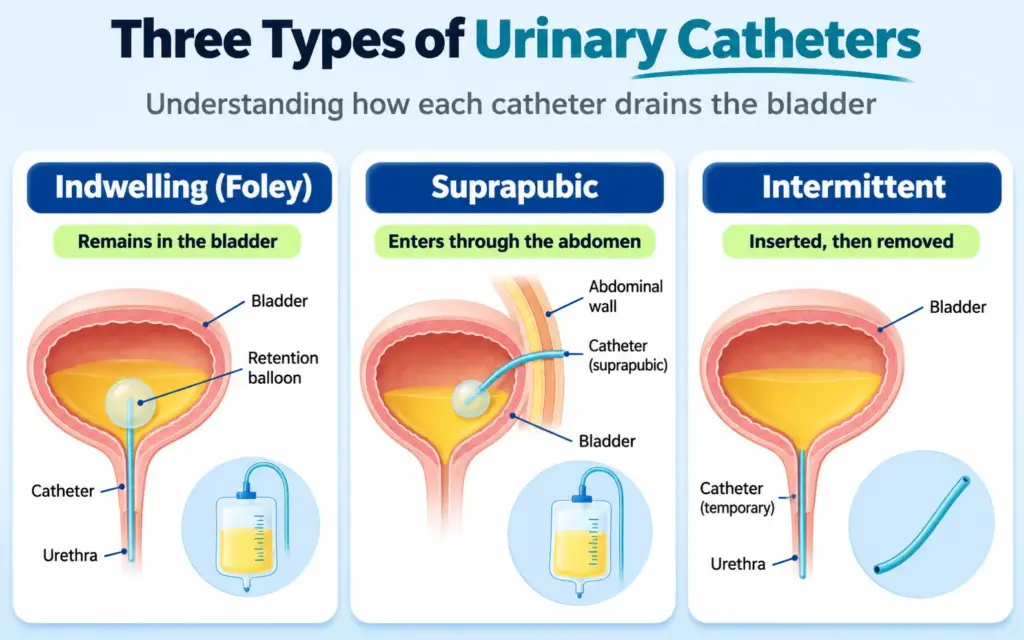
These steps concern mainly indwelling catheters. Other types require specific instructions.
Some people manage their catheters independently; others need professional or carer support. Registered nurses, nursing associates and healthcare assistants have different responsibilities. Apex Learning’s explanation of nursing associate responsibilities covers the wider professional role without changing what an individual carer is authorised to do.
Catheter Care Responsibilities for UK Care Staff
Follow the Care Plan and Respect the Person
Check the individual’s care plan before offering help. Identify their catheter type, preferred routine, authorised tasks, relevant observations and named contact for problems. Explain the care, obtain consent, provide privacy and encourage independence wherever possible.
A resident who usually empties their own bag may only want help positioning it. Someone with limited mobility may need more assistance. Neither permits unauthorised equipment disconnection or replacement.
Know Your Competence and When to Ask
The NMC Code requires registered professionals to delegate appropriately and consider the competence of those receiving tasks. Care assistants are not automatically NMC registrants; their activities depend on training, assessed competence, authorisation, local procedures and the person’s needs.
Insertion, removal, bladder washouts and specialist troubleshooting must not be attempted without the relevant competence and clinical authority. If an instruction is unclear, ask the responsible clinician before proceeding. General care knowledge is valuable, but it does not establish independent procedural competence.
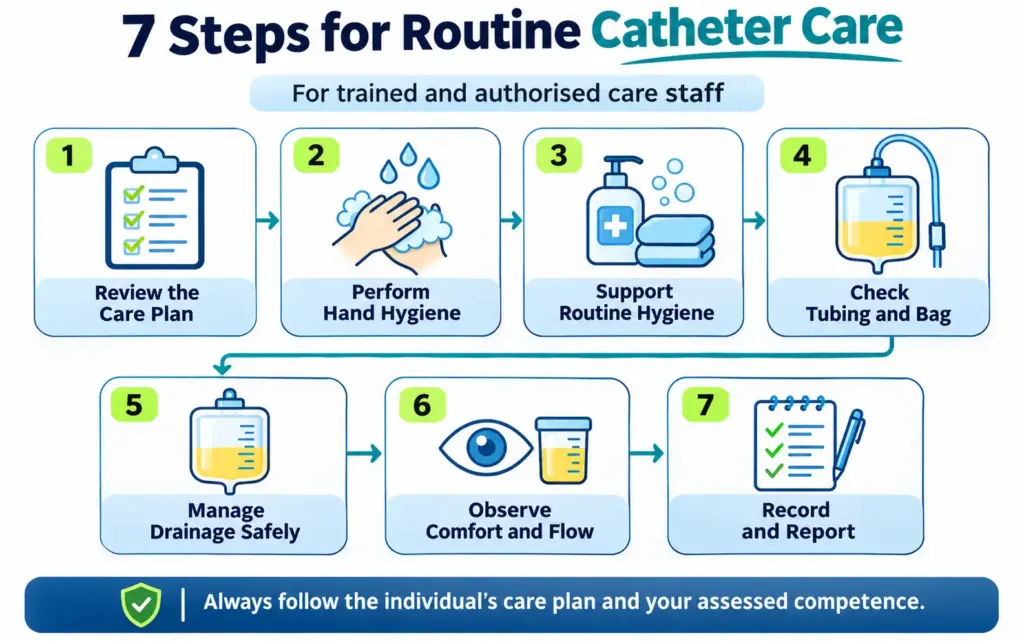
Daily Catheter Care: Seven Practical Steps
These steps describe everyday observations and care within authorised responsibilities. They are not a substitute for a clinician’s instructions or workplace procedures.
Step 1 — Review the Care Plan and Explain the Care
Ask how the person feels and whether they have noticed discomfort, leakage or a change in urine drainage. Check the approved equipment and what help they want today. Explain each activity before starting and protect privacy during personal care.
Do not assume everyone with a catheter needs identical support. A recent catheter change, new abdominal wound or individual clinical restriction may alter the appropriate routine. If the person’s condition differs from the care plan, seek advice rather than improvising.
Step 2 — Perform Hand Hygiene and Use Appropriate PPE
Clean your hands before and after catheter-related care, using the hand hygiene method specified by your employer. Wear gloves and an apron when indicated by the task and local infection-control policy. Gloves never replace handwashing.
Avoid touching unnecessary surfaces, change protective equipment when required and dispose of used items correctly. Take particular care before handling a drainage outlet, since contamination can introduce microorganisms into the system. Only carry out equipment handling you have been trained and authorised to perform.
Step 3 — Support Routine Catheter Hygiene
Help the person wash the skin around a urethral catheter gently using mild soap and water as part of daily personal hygiene. Avoid pulling, twisting or scrubbing the tube. Observe the skin for redness, soreness, discharge or pressure from securing equipment.
A suprapubic catheter has an abdominal insertion site and may need different instructions, particularly soon after insertion. Follow its specific site-care plan. Do not introduce antiseptics, creams or dressings unless clinically instructed. If the person reports new pain or the site looks different, document the concern and contact the appropriate professional.
Step 4 — Check Tubing and Drainage Equipment
Look for obvious tubing kinks, bends, pulling or equipment that is poorly positioned. The urine collection bag should remain below bladder level and off the floor. Make sure supports are positioned according to the care plan so movement does not place tension on the catheter.

The NICE catheter maintenance recommendations advise maintaining a closed drainage system, with disconnection only for good clinical reasons. Do not separate connections simply to investigate a problem. If equipment appears displaced or damaged, follow the escalation plan and seek clinical advice.
Step 5 — Support Safe Drainage Bag Management
The NHS advises emptying a drainage bag before it is full, generally when it reaches around half to three-quarters of its capacity. The individual plan, equipment instructions and local procedure determine what staff should do.
If trained and authorised to empty a bag, use approved clean collection arrangements, avoid contaminating the outlet, close it securely and measure output when instructed. Never let the outlet touch an unclean surface. Do not change bags or disconnect tubing for convenience; replacement schedules depend on clinical and manufacturer instructions.
Check whether the person can move comfortably without trapping or tugging the tubing. Ensure the equipment is accessible to authorised staff while preserving dignity and independence.
Step 6 — Check Comfort, Urine Flow and Visible Changes
Notice whether urine is draining as expected for that person. Ask about bladder discomfort, new leakage or pulling sensations. Watch for unexpectedly reduced output, blood or clots, new tenderness and unusual changes in urine appearance.
An empty bag does not necessarily mean a blockage, but unexpectedly absent drainage needs attention, especially with pain or a distended abdomen. Never independently diagnose the cause, flush the catheter or remove it. Seek prompt clinical advice if drainage has stopped or the person feels unwell.
Step 7 — Record Care and Report Concerns
Record the care provided and any meaningful changes using the employer’s approved system. Note what the person said, what you observed, when it happened and whom you contacted. Report concerns promptly rather than waiting until a routine handover.
Good records distinguish facts from assumptions. For example, “urine output lower than usual” describes an observation; “catheter blocked” is a diagnosis that requires appropriate assessment. The next worker needs a clear record.
How to Prevent Catheter-Associated Infections
A catheter can provide a route for microorganisms to enter the urinary tract. The principles behind prevention are straightforward: minimise contamination, preserve the closed drainage system, maintain appropriate routine hygiene and identify equipment problems early. Repeated handling or unnecessary disconnection can undermine these precautions.
NICE advises that bladder instillations or washouts should not be used to prevent catheter-associated infection. Such procedures are not everyday tasks for general care workers.
Understand CAUTI and Bacteria Without Symptoms
A catheter-associated urinary tract infection, or CAUTI, involves symptomatic infection requiring clinical assessment. Bacteria may also be present in catheterised urine without causing symptoms, known as asymptomatic bacteriuria. Cloudiness alone does not confirm an infection.
NICE guidance on catheter-associated UTI says antibiotics are not routinely needed for asymptomatic bacteriuria in someone with a catheter; clinical exceptions must be assessed by the appropriate professional. Staff should recognise changes and report symptoms, not decide whether antibiotics or urine tests are necessary.
Catheter Problems and Warning Signs: When to Seek Help
Care workers are often first to notice a change. Possible concerns include leakage around the catheter, reduced drainage, new lower abdominal pain, significant bleeding or unusual discomfort. Leakage can occur with bladder spasms, but it may also indicate blockage. The NHS guidance on catheter risks advises seeking medical advice as soon as possible if blockage is suspected or clots are present.
Recognise Possible Infection or Deterioration
Fever, shivering, lower abdominal pain and new confusion may signal illness needing prompt assessment. The NHS explanation of urinary tract infection symptoms highlights that symptoms may vary, particularly in older or frail people. Do not diagnose an infection from urine colour or smell alone.
| What You Notice | Appropriate Response |
|---|---|
| Usual drainage and comfort | Continue the prescribed care and observations. |
| New leakage, discomfort or unexpected drainage changes | Report promptly and seek appropriate clinical advice. |
| Catheter apparently blocked or no longer draining | Contact the responsible or community nurse promptly; use NHS 111 or the local urgent-care pathway if unavailable. |
| Fever, shivering, new confusion or marked deterioration | Arrange urgent clinical assessment through the agreed pathway. |
| Collapse, severe breathing difficulty or another life-threatening emergency | Call 999 and follow emergency procedures. |
The person’s condition, care plan, clinical assessment and local escalation procedures take priority over this general reference table.
What If a Catheter Appears Blocked?
Do not flush, remove, replace or disconnect the catheter to investigate unless specifically trained, assessed as competent and clinically authorised. Contact the responsible or community nurse promptly, especially if urine has stopped draining or the person has pain. If that clinician cannot be reached, follow the urgent-care plan or contact NHS 111. Call 999 for life-threatening symptoms.
When escalating, describe the last known normal drainage, current observations, symptoms and actions already taken. An unexpectedly low amount of urine can have several explanations and needs assessment in context.
Recording Catheter Care and Monitoring Urine Output
Document relevant observations, care provided, symptoms reported, actions taken and the time and recipient of any escalation. Do not replace an approved care record with informal notes.

Example fictional care note:
“During morning personal care, the resident reported new lower abdominal discomfort. Urine drainage appeared lower than usual. The responsible nurse was contacted promptly; instructions and follow-up were documented in the care record.”
This is useful because it records a reported symptom, an observable change and communication, without claiming that a blockage or infection has been diagnosed.
Some people require measured urine output as part of an individual monitoring plan. Staff should use approved equipment and record amounts accurately. Apex Learning explains how to complete a fluid balance chart separately, so there is no need to repeat calculations here.
Catheter Care at Home and in Residential Care
The same core principles apply across settings, but access to clinical support may differ. Residential care staff often work within an established team, while domiciliary care workers may need to contact a community nurse from a person’s home.
Before a visit, know the individual’s routine, the equipment arrangements and whom to call if something changes. Encourage independence, respect personal preferences and record concerns clearly for the next worker. A person living alone may need an agreed method to obtain help between scheduled visits.
For broader context on day-to-day professional responsibilities, Apex Learning’s care assistant duties guide explains how observation and communication fit into supporting people across care settings.
Training and Competence for Catheter Care Staff
Knowledge of infection prevention, personal care, communication and documentation can strengthen everyday support. Apex Learning’s Level 3 Diploma in Nursing Assistant Complete Training offers broader online healthcare learning. It is CPD-accredited, not an Ofqual-regulated nursing qualification or a route to independent catheter procedure authorisation.
Specialist tasks require relevant practical instruction, competence assessment, authorisation and clinical oversight. Those considering wider professional development can read about the nursing associate apprenticeship, but that career route is separate from this daily catheter-care guide.
Safe Catheter Care Starts With the Right Routine
Good catheter care combines respectful personal support, careful observations and reliable communication. The person should remain involved. Follow their individual plan, work within your competence, document meaningful changes and request clinical support without delay when concerns arise, particularly when new symptoms develop. These habits help care teams provide consistent support while keeping clinical decisions with appropriately qualified professionals.
Frequently Asked Questions About Catheter Care
How Often Should a Urinary Catheter Be Cleaned?
The area where a urethral catheter enters the body should generally be washed daily with mild soap and water as part of normal personal hygiene, and after soiling when needed. Follow specific clinical instructions for suprapubic sites or recent procedures. Do not use routine antiseptic solutions unless instructed by the clinical team.
Can a Healthcare Assistant Provide Catheter Care?
Yes, healthcare assistants may provide appropriate routine support when trained, competent and authorised. The person’s care plan and employer procedures determine which tasks they may undertake. Insertion, removal and specialist interventions are different from hygiene assistance and observation; they require appropriate practical competence and clinical authorisation.
Can Someone Shower With a Urinary Catheter?
Many people can shower with a catheter, but individual advice depends on catheter type, insertion site, whether it was recently inserted and the person’s condition. Follow nursing instructions and any dressing requirements. The NHS guidance on living with a urinary catheter explains everyday care and activities; ask the clinical team when instructions are unclear.
How Often Should a Catheter Drainage Bag Be Changed?
According to NHS guidance, leg drainage bags are generally changed every seven days. Night bags may have different instructions depending on whether they are reusable or single-use. Care staff must follow the individual’s care plan, equipment instructions and local procedures. Bag changes should only be performed by someone appropriately trained and authorised.
What Should Care Staff Do if Urine Leaks Around a Catheter?
Urine leaking around a catheter, known as bypassing, may occur because of bladder spasms or a blockage. Care staff should observe the person’s comfort and report the problem promptly. The NHS advises contacting the community nurse immediately if leakage occurs, or NHS 111 if the nurse cannot be reached. Do not attempt to flush or replace the catheter without appropriate competence and authorisation.
Does Cloudy Urine Always Mean a Catheter Infection?
No. Cloudy urine by itself does not establish a symptomatic infection. Bacteria can be present in catheterised urine without symptoms. Report new changes and associated concerns such as fever, pain or confusion so an appropriate professional can assess the person’s condition and decide whether any investigation or treatment is needed.
 " alt="Fluid Balance Chart: How to Complete It Correctly" />
 " alt="Nursing Associate Apprenticeship: NHS Entry Guide" />