





Introduction
In 2025-2026, mechanical engineering remains one of the most lucrative and future-proof careers worldwide. With rapid advancements in technology and growing demand in sectors such as electric vehicles, robotics, aerospace, and sustainable energy, mechanical engineers are more essential than ever. From designing high-performance automotive powertrains to building opto-mechanical systems for medical devices and satellites, these professionals are driving innovation at every level.
As companies compete for top talent, salaries for mechanical engineers are rising steadily — with many specialist roles offering six-figure incomes even at mid-career level. According to data from sources like the U.S. Bureau of Labour Statistics, Glassdoor, and ZipRecruiter, roles such as Opto-Mechanical Engineer, Powertrain Engineer, and Corrosion Engineer are among the highest-paying mechanical engineering jobs in the U.S. today.
Whether you’re a recent graduate planning your future or a mid-career professional considering your next move, understanding where the best opportunities lie is key to long-term success. In this guide, we’ll explore the top 15 highest-paying mechanical engineering jobs in 2025 —2026 including verified salary data, career insights, and the skills you’ll need to succeed.
Why Mechanical Engineering Is a Top-Paying Career in 2025-2026
Mechanical engineers remain at the forefront of innovation, responsible for designing and maintaining systems that power nearly every modern industry — from automotive and aerospace to robotics and renewable energy.
According to the Bureau of Labour Statistics (BLS), mechanical engineering roles are projected to grow 10% between 2022 and 2032, with 19,200 openings expected annually. The combination of high demand, innovation, and technical complexity makes mechanical engineering one of the most lucrative and stable career paths today.
Top 15 Highest Paying Mechanical Engineering Jobs in 2025-2026
Rank | Role | Average Salary (USD) | |
1 | Opto-Mechanical Engineer | ||
2 | Powertrain Engineer | ||
3 | Corrosion Engineer | ||
4 | Instrumentation Engineer | ||
5 | Mechatronics Engineer | ||
6 | Research & Development Engineer | ||
7 | Automation Engineer | ||
8 | Process Engineer | ||
9 | Systems Engineer | ||
10 | Design Engineer | ||
11 | Biomedical Engineer | ||
12 | HVAC Systems Engineer | ||
13 | Manufacturing Engineer | ||
14 | Marine Engineer | ||
15 | Aerospace Mechanical Engineer |
1. Opto-Mechanical Engineer
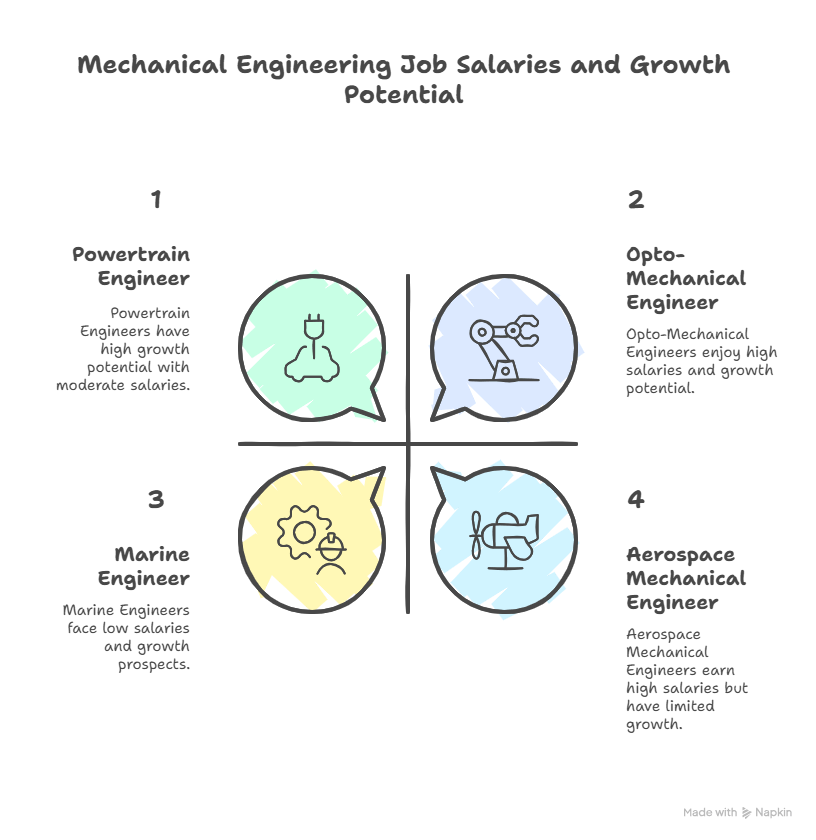
An Opto-Mechanical Engineer is a highly specialised professional who combines mechanical engineering expertise with optics to design precision equipment and complex systems used in industries such as aerospace, medical technology, defence, and semiconductors. This role involves developing and integrating optical components (like lenses, lasers, and sensors) with mechanical structures, ensuring alignment, vibration control, and thermal stability in high-performance applications.
These engineers play a vital role in designing medical imaging devices, laser-based diagnostic tools, satellite imaging systems, and semiconductor lithography equipment. They work with CAD tools for optical alignment and mechanical modelling, and often simulate thermal, mechanical, and optical interactions using software such as Zemax, SolidWorks, or COMSOL Multiphysics.
The demand for opto-mechanical engineers is soaring due to the increasing reliance on precision optics in autonomous vehicles, space exploration, and high-resolution imaging systems. As a result, salaries for these roles are well above the engineering average. According to ZipRecruiter, the average annual salary for an Opto-Mechanical Engineer in the U.S. is $150,000, with top professionals in Silicon Valley and Boston exceeding $170,000.
To qualify, most engineers hold at least a Bachelor’s or Master’s degree in Mechanical Engineering, Optical Engineering, or Physics, and have strong experience in precision design, optical alignment, and thermal analysis. Certifications in optics or advanced training in laser systems can further enhance career prospects.
This is one of the highest-paying mechanical engineering jobs in (2025-2026) — and ideal for those with both analytical skills and design creativity.


2. Powertrain Engineer
A Powertrain Engineer plays a crucial role in the automotive and transportation sectors, focusing on the design, development, and integration of systems that generate and deliver power to vehicles. This includes internal combustion engines, hybrid systems, electric drivetrains, transmissions, axles, and related components.
Powertrain engineers ensure that these systems are not only powerful and efficient but also compliant with environmental and fuel economy standards. With the global shift towards electric vehicles (EVs) and sustainable mobility, the demand for engineers skilled in EV architecture, battery management systems (BMS), and hybrid integration has surged.
Their work involves simulations, testing, data analysis, and fine-tuning engine performance, torque delivery, and fuel consumption. Employers often require familiarity with tools such as MATLAB/Simulink, AVL, CATIA, and CAD software, and a deep understanding of thermodynamics, material science, and mechanical control systems.
According to Glassdoor, the average annual salary for a Powertrain Engineer in the U.S. is $112,890, with salaries often exceeding $120,000 at companies like Tesla, Ford, GM, and Rivian.
A Bachelor’s or Master’s degree in Mechanical or Automotive Engineering is typically required, and expertise in electrification systems is a significant advantage. This is one of the fastest-growing and best-paying mechanical engineering careers, especially in the context of the ongoing EV revolution.
3. Corrosion Engineer
A Corrosion Engineer specialises in the prevention, analysis, and mitigation of corrosion — a natural but damaging process affecting metals and materials used in infrastructure, energy systems, and industrial machinery. Their work is crucial in the oil and gas, maritime, aerospace, nuclear, and construction industries, where structural integrity is vital.
These professionals conduct risk assessments, inspect pipelines, offshore platforms, and storage tanks, and develop protective solutions such as coatings, cathodic protection systems, and corrosion-resistant materials. Corrosion engineers also investigate failure mechanisms, use non-destructive testing (NDT) methods, and ensure systems meet safety and environmental standards.
The profession requires strong foundations in materials science, chemistry, fluid mechanics, and electrochemistry, along with practical experience in industrial environments. Engineers often collaborate with maintenance teams, project managers, and regulatory authorities.
As per Payscale, the average salary for a Corrosion Engineer in the U.S. is $110,586, with top professionals in the oil & gas and defence sectors earning well over $125,000.
Qualifications typically include a degree in Mechanical, Chemical, or Materials Engineering, and certifications like NACE CP (Cathodic Protection) or Coating Inspector certifications can significantly boost employability and salary prospects.
In 2025, corrosion engineering is more relevant than ever, particularly with the ageing of global infrastructure and the push toward green hydrogen pipelines and offshore wind projects, making it one of the most secure and high-paying specialisations in mechanical engineering.
4. Instrumentation Engineer
An Instrumentation Engineer is responsible for designing, developing, and maintaining instruments and control systems that monitor and regulate engineering processes. These professionals are vital in high-stakes industries such as aerospace, pharmaceuticals, oil and gas, and advanced manufacturing, where precision and system reliability are critical.
Their work involves integrating sensors, transmitters, controllers, actuators, and programmable logic controllers (PLCs) into complex systems. The primary goal is to ensure accurate measurement and automated control of variables like temperature, pressure, flow, and chemical composition.
In modern manufacturing environments, instrumentation engineers contribute to Industry 4.0 initiatives, involving real-time data monitoring, predictive maintenance, and smart factory automation. They often use tools like LabVIEW, MATLAB, and SCADA systems, and collaborate closely with software, electrical, and mechanical engineers.
According to Indeed, the average salary for an Instrumentation Engineer in the U.S. is $107,171 per year, with top earners surpassing $120,000, especially in pharmaceuticals and aerospace manufacturing.
To qualify, a Bachelor’s degree in Mechanical, Electrical, or Control Engineering is typically required, along with industry certifications (e.g., ISA Certified Automation Professional). A background in sensor calibration, data acquisition, and regulatory compliance (GMP/FDA in pharma) is highly desirable.
Instrumentation engineers are increasingly in demand due to the ongoing shift towards automation and precision-driven industries, making this a highly rewarding and future-focused mechanical engineering career.
5. Mechatronics Engineer
A Mechatronics Engineer combines mechanical, electrical, computer, and control engineering to design and maintain smart systems, such as robotic arms, automated manufacturing lines, drones, and autonomous vehicles. This interdisciplinary role is essential in sectors like automotive, aerospace, medical devices, industrial automation, and consumer electronics.
Their daily responsibilities include conceptual design, prototyping, control systems integration, and performance testing. Mechatronics engineers need to be proficient in mechanical design (CAD/CAE), circuit design, and software programming (e.g., Python, C++, ROS). They also frequently work with PLC systems, embedded systems, and machine vision technologies.
With the global emphasis on automation, robotics, and intelligent manufacturing systems, the demand for mechatronics engineers has skyrocketed. These professionals bridge the gap between traditional mechanical engineering and modern digital technologies, playing a pivotal role in smart factories and autonomous product development.
According to Salary.com, the average annual salary for a Mechatronics Engineer in the U.S. is $105,000, with professionals in high-tech hubs and R&D roles often exceeding $115,000.
A Bachelor’s or Master’s degree in Mechatronics, Mechanical Engineering, or Electrical Engineering is typically required. Those with robotics certifications, AI/machine learning experience, or advanced automation skills can command even higher salaries.
In 2025-2026, mechatronics is at the forefront of innovation, making this role one of the most future-ready and high-paying in the mechanical engineering landscape.
6. Research & Development (R&D) Engineer
A Research and Development (R&D) Engineer is responsible for innovating, designing, and improving new products, processes, and technologies. These professionals operate at the cutting edge of aerospace, automotive, biotechnology, and medical device industries, transforming creative concepts into viable engineering solutions.
R&D engineers conduct technical feasibility studies, prototype development, testing, and validation, often collaborating with cross-functional teams that include scientists, software developers, and manufacturing engineers. Their work directly impacts product quality, safety, performance, and market success.
To excel in this role, engineers must be adept in 3D modelling (e.g., SolidWorks, CATIA), materials analysis, and simulation tools like ANSYS or COMSOL. They often work under strict timelines and industry regulations (e.g., FDA, ISO), especially in sectors like healthcare and aerospace.
According to Payscale, the average salary for an R&D Engineer in the U.S. is $104,150, with those in senior or specialised roles earning well above $120,000 annually.
A Bachelor’s or Master’s degree in Mechanical Engineering or related fields is essential, while additional qualifications in materials science, computational engineering, or product design give candidates a competitive edge.
In 2025, the demand for R&D engineers is booming as companies race to create smarter, greener, and more efficient products, making this one of the most intellectually rewarding and highest-paying jobs in the mechanical engineering field.
7. Automation Engineer
An Automation Engineer designs and implements automated systems that increase efficiency, reduce human error, and streamline production in manufacturing and industrial settings. These engineers play a vital role in Industry 4.0, enabling smart factories through the integration of robotics, control systems, and data-driven automation.
Their tasks involve developing PLC code, configuring SCADA systems, integrating robotic arms, and implementing sensor-driven feedback loops for precision control. Common industries employing automation engineers include automotive, pharmaceuticals, food processing, and logistics.
Automation Engineers often work closely with mechanical, electrical, and software engineers to ensure systems run smoothly, comply with safety standards, and remain scalable. Mastery of tools like Siemens TIA Portal, Allen-Bradley RSLogix, LabVIEW, and Python is crucial.
According to ZipRecruiter, the average annual salary for Automation Engineers in the U.S. is $97,768, with salaries rising above $110,000 for professionals in advanced manufacturing or robotics.
A degree in Mechanical, Electrical, or Control Engineering is standard, and certifications like Certified Automation Professional (CAP) or training in robotic programming can significantly boost career prospects.
With automation at the core of future manufacturing, this role offers outstanding opportunities for career growth, innovation, and financial reward in 2025 and beyond.
8. Process Engineer
A Process Engineer focuses on analysing, designing, and optimising manufacturing processes to ensure efficiency, safety, and cost-effectiveness. These professionals are integral to industries such as semiconductors, pharmaceuticals, food and beverage, chemicals, and energy production.
Key responsibilities include performing process simulations, identifying production bottlenecks, and improving workflow, heat transfer, and chemical reaction conditions. They also design equipment layouts and ensure compliance with industry regulations such as OSHA, FDA, or ISO standards.
Process engineers work with tools like Aspen Plus, MATLAB, and AutoCAD P&ID, often collaborating with quality assurance, maintenance, and operations teams to ensure seamless integration of processes within large-scale production environments.
According to Indeed, the average annual salary for a Process Engineer in the U.S. is $91,035, with top performers in sectors like semiconductors and petrochemicals earning upwards of $105,000.
A Bachelor’s degree in Mechanical, Chemical, or Industrial Engineering is the typical entry point. However, professionals with Six Sigma or Lean Manufacturing certifications, or a Master’s in Process Engineering, are often preferred for senior roles.
As manufacturing becomes more data-driven and efficiency-focused, process engineers are in high demand, making this a financially rewarding and impactful career path in 2025.
9. Systems Engineer
A Systems Engineer ensures that all components of a complex mechanical system work harmoniously together. This multidisciplinary role involves planning, modelling, integrating, testing, and optimising systems in high-stakes industries like aerospace, defence, automotive, and telecommunications.
In mechanical engineering, systems engineers often coordinate between design, hardware, software, and manufacturing teams, ensuring the final product meets both functional requirements and safety standards. Their responsibilities also include requirement analysis, risk management, systems validation, and troubleshooting interoperability issues.
Industries like aerospace and defence particularly rely on systems engineers to develop mission-critical systems such as aircraft control networks, missile guidance systems, and communication platforms — where failure is not an option.
According to Glassdoor, the average salary for a Systems Engineer in the U.S. is $89,360, with top professionals in defence and aviation earning over $105,000 per year.
To succeed, engineers typically need a Bachelor’s degree in Mechanical, Electrical, or Systems Engineering, and are often expected to be proficient with tools like MATLAB, SysML, and simulation software. Experience with Agile or V-Model development processes is also a strong asset.
As the complexity of engineered products increases — especially in autonomous systems and next-gen aerospace — systems engineers are becoming essential, making this a well-paying and high-impact role in the mechanical engineering field in 2025.
10. Design Engineer
A Design Engineer is responsible for translating concepts into precise mechanical structures and products through Computer-Aided Design (CAD) and Computer-Aided Engineering (CAE) tools. Their role is foundational in industries like automotive, aerospace, manufacturing, and robotics, where accurate design is critical for performance and safety.
Design engineers create 3D models, blueprints, and engineering drawings used for product development, prototyping, and manufacturing. They focus on structural integrity, manufacturability, performance, and cost-efficiency of designs. Many also conduct simulations for stress, heat, vibration, and fatigue using tools like SolidWorks, AutoCAD, CATIA, and ANSYS.
According to ZipRecruiter, the average annual salary for a Design Engineer in the U.S. is $85,581, with senior professionals or those working in aerospace and advanced R&D centres earning upwards of $95,000.
Typically, a Bachelor’s degree in Mechanical Engineering or a related field is required. Mastery in CAD/CAE tools, GD&T (Geometric Dimensioning and Tolerancing), and product lifecycle management (PLM) software is often sought after. Additional certifications, such as Certified SolidWorks Professional (CSWP), can give candidates a competitive edge.
In 2025-2026, with rapid advances in 3D printing, lightweight materials, and sustainable design, the demand for highly skilled design engineers continues to rise, offering a promising and rewarding pathway for mechanical engineering professionals.
11. Biomedical Engineer
A Biomedical Engineer merges mechanical engineering expertise with biology and medical sciences to develop life-changing technologies. Their work spans designing prosthetic limbs, diagnostic imaging systems, surgical robots, rehabilitation devices, and implantable electronics — all aimed at improving patient outcomes.
These engineers collaborate with doctors, researchers, and manufacturers to create solutions that are not only innovative but also safe, functional, and regulatory-compliant. Biomedical engineers work extensively with materials that are biocompatible and focus on human-centred design to ensure usability and comfort for patients.
They typically use SolidWorks, MATLAB, LabVIEW, and often contribute to clinical trials, device testing, and FDA submissions. With rapid innovation in healthcare technology, wearable health monitors, and AI-assisted diagnostics, biomedical engineers are in high demand.
According to the U.S. Bureau of Labour Statistics (BLS), the median annual salary for Biomedical Engineers is $95,000, with those in R&D or private healthcare companies earning significantly more.
A Bachelor’s or Master’s degree in Biomedical Engineering or Mechanical Engineering with a biomedical focus is typically required. Additional training in regulatory affairs, tissue engineering, or biomaterials can enhance employability and earnings.
As healthcare systems globally continue to prioritise technology-driven innovation, biomedical engineering stands out as one of the most impactful and well-compensated career options within the mechanical engineering space in 2025-2026.
12. HVAC Systems Engineer
An HVAC Systems Engineer designs and implements energy-efficient heating, ventilation, and air conditioning systems for commercial, industrial, and residential buildings. Their work is critical in creating sustainable environments that meet modern energy standards, reduce carbon emissions, and enhance indoor air quality.
HVAC engineers evaluate building blueprints, perform thermal load calculations, select appropriate equipment, and create systems that regulate temperature, humidity, and airflow efficiently. Increasingly, they integrate smart HVAC technologies, such as IoT-based climate control and variable refrigerant flow (VRF) systems.
As governments and industries prioritise green building standards and net-zero energy goals, demand for HVAC engineers has risen significantly — particularly in sectors like commercial construction, healthcare, and high-performance data centres.
According to Salary.com, the average salary for HVAC Engineers in the U.S. is $84,900, with experienced professionals or those holding LEED accreditation earning more than $95,000.
To succeed, professionals typically hold a Bachelor’s degree in Mechanical Engineering, along with knowledge of software tools like Revit MEP, TRACE 700, AutoCAD, and HAP. LEED certification and familiarity with ASHRAE standards can greatly enhance employability.
With the world pushing toward eco-conscious infrastructure, HVAC engineers are in high demand, offering both career stability and an opportunity to contribute to sustainability and environmental innovation in 2025.
13. Manufacturing Engineer
A Manufacturing Engineer is responsible for developing and improving manufacturing processes, systems, and layouts to boost efficiency, productivity, and quality in factory and production environments. These engineers are integral in sectors like automotive, aerospace, electronics, and consumer goods.
Their key duties include process optimisation, lean manufacturing implementation, automation integration, and quality control systems design. They also collaborate with design engineers to ensure that products are designed for manufacturability (DFM) and cost-efficiency.
Tools like AutoCAD, SolidWorks, Six Sigma, and ERP systems are commonly used in this role. Engineers also use statistical methods (e.g., SPC, DOE) to identify inefficiencies, reduce waste, and drive continuous improvement initiatives.
According to Payscale, the average salary for Manufacturing Engineers in the U.S. is $82,850, with those in aerospace or high-volume electronics manufacturing earning well over $95,000 per year.
A Bachelor’s degree in Mechanical, Manufacturing, or Industrial Engineering is typically required. Certifications like Certified Manufacturing Technologist (CMfgT) or Lean Six Sigma can significantly enhance career prospects.
In 2025, as smart factories become the norm and companies strive to localise and automate their production processes, manufacturing engineers play a vital role — ensuring sustainable growth, cost control, and technological innovation across the global supply chain.
14. Marine Engineer
A Marine Engineer designs, builds, and maintains the mechanical systems of ships, submarines, offshore platforms, and other watercraft. Their primary focus includes engines, propulsion systems, pumps, HVAC units, and other systems required for vessel operation.
These engineers work on a wide array of projects ranging from naval defence and cargo ships to luxury yachts and renewable energy platforms like offshore wind turbines. They also evaluate fuel systems, stability performance, structural integrity, and ensure compliance with IMO, MARPOL, and SOLAS regulations.
Marine engineers collaborate with naval architects, mechanical designers, and electrical engineers throughout the lifecycle of a vessel — from conceptual design and sea trials to maintenance and retrofitting.
According to the U.S. Bureau of Labour Statistics (BLS), the average annual salary for Marine Engineers is $80,500, with professionals in defence or offshore energy sectors earning upwards of $100,000.
To enter the field, a Bachelor’s degree in Marine Engineering or Mechanical Engineering is required. Additional certifications, such as a Merchant Mariner Credential (MMC) or DP (Dynamic Positioning) training, can increase job opportunities in offshore work.
With maritime transport and ocean energy infrastructure growing steadily, marine engineering presents a stable and lucrative pathway within mechanical engineering careers in 2025-2026.
15. Aerospace Mechanical Engineer
An Aerospace Mechanical Engineer works on the mechanical components of aircraft, spacecraft, satellites, and defence systems — including propulsion, aerodynamics, structural design, and materials analysis.
They contribute to the development of next-generation aerospace technologies such as hypersonic aircraft, reusable rockets, electric propulsion, and composite materials. Aerospace engineers conduct simulations, design critical subsystems, and run performance, thermal, and vibration tests using tools like ANSYS, MATLAB, CATIA, and CFD software.
Their expertise is essential in both commercial and defence aviation. From NASA and SpaceX to Boeing and Lockheed Martin, aerospace engineers help push the boundaries of flight, efficiency, and space exploration.
According to the BLS, the median salary for Aerospace Engineers was $130,000 in 2023, with professionals in high-clearance or R&D positions earning $150,000+ annually.
A Bachelor’s degree in Aerospace or Mechanical Engineering is essential, while Master’s or Ph.D. qualifications are often required for specialised or research-heavy roles. Security clearance, experience in avionics, or space systems engineering can open doors to some of the highest-paying mechanical engineering jobs.
In 2025, aerospace remains one of the most prestigious and high-paying branches of mechanical engineering — ideal for those passionate about aviation, space, and advanced technology.
Future-Proof Your Career in Mechanical Engineering
The mechanical engineering sector offers some of the highest-paying jobs in the tech and industrial world. By 2025-2026, specialised roles such as opto-mechanical, powertrain, and R&D engineers will continue to dominate the salary charts.
To maximise your earning potential:
- Consider upskilling in automation, robotics, and sustainable technologies
- Pursue certifications (e.g., PE, PMP, Six Sigma) or advanced degrees (MSc, MBA)
- Keep up with industry trends across EVs, aerospace, AI integration, and clean energy
To learn and strengthen these skills, consider taking industry-recognised courses that explore best practices in Mechanical Engineering.
Conclusion
In 2025-2026, the mechanical engineering landscape continues to evolve with advanced technologies, automation, and sustainability driving demand across a range of high-paying specialisations. From opto-mechanical engineers shaping next-gen imaging systems to aerospace engineers pushing the boundaries of flight, the profession offers lucrative paths for those with technical skill, innovation, and adaptability.
With salaries ranging from $80,000 to over $150,000 per year, mechanical engineers can position themselves at the forefront of emerging industries such as renewable energy, space exploration, robotics, and smart manufacturing. High-paying roles often require not just a strong foundation in mechanical engineering, but also cross-disciplinary expertise in fields like software, electronics, materials science, or biomedical systems.
Whether you’re an aspiring engineer or a seasoned professional aiming to upskill, investing in advanced certifications, specialised training, and soft skills like project management and communication can help unlock greater earning potential and job satisfaction.
Now is the perfect time to pursue a mechanical engineering career that aligns with your passion and long-term financial goals. Explore these top career paths and tailor your education and experience to match future industry trends.
FAQs
Q.What is the highest-paying mechanical engineering job in 2025-2026?
The highest-paying job in 2025 is Opto-Mechanical Engineer, with an average annual salary of $150,000. This role combines optics, mechanical design, and precision engineering for use in aerospace, medical, and semiconductor industries.
Q.Are mechanical engineers still in demand in 2025-2026?
Yes. According to the Bureau of Labour Statistics, mechanical engineering roles are projected to grow by 10% from 2022 to 2032, with 19,000+ openings annually. Emerging industries like clean energy, EVs, and automation are major drivers of demand.
Q.Which industries pay mechanical engineers the most?
Top-paying industries include aerospace, automotive, robotics, defence, biomedical devices, and high-tech manufacturing. Engineers working in R&D, oil and gas, or medical instrumentation often earn well above the median salary.
Q.What qualifications do I need for high-paying mechanical engineering jobs?
A Bachelor’s degree in Mechanical Engineering is essential. Many high-paying roles prefer or require a Master’s degree, PE license, or certifications like Six Sigma, SolidWorks, or ASME credentials. Specialisation in high-demand fields like mechatronics, aerospace, or automation also boosts earnings.
Q.Can mechanical engineers transition into management roles?
Absolutely. Many engineers pursue an MBA or Project Management certifications to transition into engineering management, operations leadership, or executive roles. This can significantly increase earning potential and expand career options.
 " alt="The 6 Principles of Safeguarding: Protect Before Harm Happens" />
 " alt="Personal Development Goals: 5 Meaningful Examples That Work" />
 " alt="TILE in Manual Handling: Meaning, Checklist & Safer Lifting Guide" />