





Introduction
In 2025-2026, international relations will remain one of the UK’s most prestigious and globally connected career fields, offering a unique blend of high earning potential, professional influence, and worldwide impact. With the UK playing a central role in diplomacy, global trade negotiations, humanitarian aid, climate policy, and international security, professionals in this sector are in greater demand than ever before.
From positions in the Foreign, Commonwealth & Development Office (FCDO) and the United Nations to policy think tanks, multinational corporations, and top NGOs, international relations careers in the UK provide access to influential decision-making platforms. These roles not only require expertise in political science, law, and economics but also strong cultural awareness, negotiation skills, and strategic thinking — qualities that employers are increasingly willing to reward with top-tier salaries.
With global challenges such as geopolitical tensions, economic shifts, climate change, and human rights issues dominating the international agenda, the UK needs highly skilled professionals who can navigate complex political landscapes and represent its interests on the world stage.
In this guide, we’ll explore the Top 15 Highest-Paying International Relations Jobs in the UK for 2025-2026, complete with average salaries, career growth prospects, and potential employers. Whether you’re a graduate exploring your first step into the field, a mid-career professional seeking advancement, or an experienced diplomat looking for your next challenge, this list will help you understand where the best opportunities lie — and how to position yourself for success in a competitive and impactful industry.
Recommended Courses to Start a High-Income Career
Many of the highest-paying roles require recognised training. These online courses provide practical skills to help you move into high-demand careers faster.
High demand • Practical skills • Flexible online study


Why Cyber Security Careers Are Booming in the UK
Cybersecurity has rapidly evolved from a niche IT specialism to one of the UK’s most vital and fastest-growing career sectors. With zero unemployment rates and an expected job growth of 35% or more by 2031, the demand for skilled cybersecurity professionals is reaching unprecedented levels. As cyber threats, ransomware attacks, and data breaches become more sophisticated, UK businesses, government departments, and financial institutions are investing heavily in top-tier talent to defend sensitive data, secure critical infrastructure, and maintain public trust.
The UK’s digital economy — spanning banking, healthcare, defence, retail, and tech — depends on robust cyber defences. With the rise of AI-driven cybercrime, state-sponsored hacking, and cloud vulnerabilities, organisations are offering six-figure salaries, flexible working arrangements, and fast career progression to attract experts in network security, penetration testing, digital forensics, and incident response.
One of the biggest drivers of this boom is the UK government’s National Cyber Strategy, which prioritises cyber resilience and funds both public and private sector initiatives. This has created opportunities not only in traditional tech hubs like London, Manchester, and Birmingham but also in emerging regional cyber clusters.
Whether you are a graduate with a passion for technology, an IT professional looking to upskill, or a career changer seeking stability and purpose, cybersecurity offers unmatched job security, competitive salaries, and the chance to make a tangible impact. In an increasingly connected world, those who can stay ahead of cyber threats will remain among the most valuable professionals in the UK workforce.


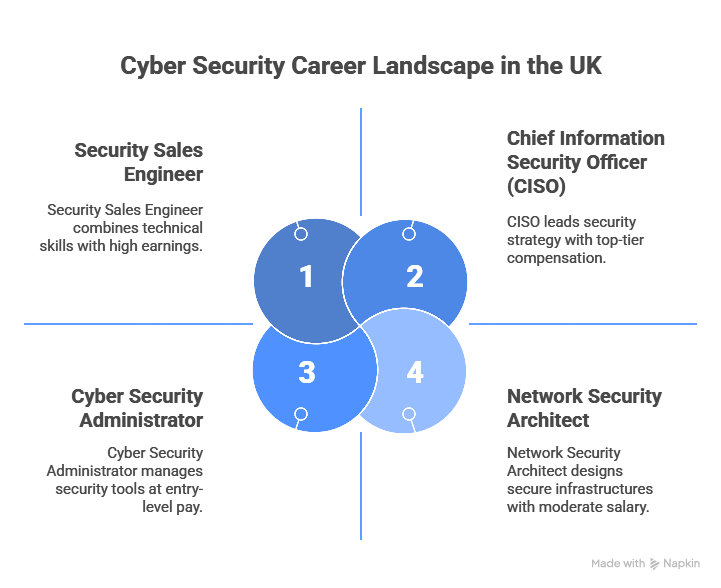
1. Chief Information Security Officer (CISO)
The Chief Information Security Officer (CISO) is the most senior cybersecurity role in an organisation, typically found in large enterprises, financial institutions, and government bodies across the UK. CISOs are responsible for designing, leading, and implementing comprehensive information security strategies that protect an organisation’s data, networks, and critical infrastructure from cyber threats. They oversee security governance, risk management, compliance with regulatory frameworks such as GDPR, and the alignment of security initiatives with business objectives.
CISOs manage cross-functional security teams and coordinate with other C-suite executives to ensure that cybersecurity is a core business priority. Their role requires a strong blend of technical expertise, leadership skills, and business acumen. They often guide incident response, oversee vulnerability management, and maintain relationships with external partners and regulatory bodies. Salaries for CISOs in the UK vary based on company size, sector, and location, but typically range between £150,000 and £250,000 annually, with some executive positions exceeding this range in London and the financial sector. According to MorganMcKinley.com, the demand for CISOs continues to rise sharply due to increasing cyberattacks and stricter data protection laws.
If you aspire to become a CISO, acquiring certifications such as CISSP, CISM, or CISA, along with extensive cybersecurity and leadership experience, will significantly improve your chances. Many CISOs also hold advanced degrees, like an MBA to complement their technical background.
2. Network Security Architect
Network Security Architects are vital cybersecurity professionals who design and implement secure network infrastructures for organisations across the UK. Their primary role is to develop robust security architectures that protect enterprise networks from external and internal cyber threats. This involves selecting appropriate technologies such as firewalls, intrusion detection systems, and encryption tools, and ensuring these components work cohesively to secure sensitive data and critical applications.
A Network Security Architect conducts thorough risk assessments to identify vulnerabilities within existing network setups. Based on these assessments, they develop security policies and strategies aligned with industry standards and regulatory requirements such as GDPR and ISO 27001. These architects collaborate closely with IT teams, security engineers, and stakeholders to ensure network solutions are scalable, resilient, and adaptable to evolving cyber threats.
Salary ranges for Network Security Architects in the UK typically fall between £75,000 and £95,000 annually. Salaries can vary depending on the industry, company size, and geographic location, with London-based roles often commanding higher compensation. According to ITJobsWatch.co.uk, demand for Network Security Architects remains strong as organisations accelerate digital transformation and cloud adoption.
To succeed as a Network Security Architect, professionals need a deep understanding of networking protocols, security frameworks, and hands-on experience with tools like VPNs, IDS/IPS, and firewalls. Certifications such as CISSP, CCSP, and Cisco’s CCNP Security can help boost employability and salary prospects in this highly competitive field.
3. Security Sales Engineer
Security Sales Engineers play a unique role in the cybersecurity ecosystem, blending technical expertise with sales acumen to help businesses identify and implement the right security solutions. These professionals act as trusted advisors and consultants, working closely with potential clients to understand their cybersecurity challenges and recommend products or services that effectively mitigate risks.
In the UK, Security Sales Engineers are highly sought after in industries such as finance, healthcare, and technology, where robust cybersecurity measures are critical. They must be well-versed in a variety of cybersecurity technologies, including firewalls, endpoint protection, encryption, and cloud security platforms. Their technical knowledge enables them to demonstrate product features, conduct proof-of-concept trials, and address complex client questions.
The salary range for Security Sales Engineers in the UK typically sits between £100,000 and £130,000 annually. This figure can include commission and bonuses, which often significantly boost total earnings. According to Payscale UK, the growing demand for cybersecurity solutions is driving strong compensation packages for sales engineers who can combine technical skills with excellent communication and negotiation abilities.
To excel in this role, candidates usually have a background in computer science or information security, coupled with sales experience. Industry certifications such as CISSP, CEH, or vendor-specific certifications (e.g., Cisco, Palo Alto Networks) are highly valuable. Security Sales Engineers must also stay current with emerging threats and technologies to provide cutting-edge advice and solutions.
4. Penetration Tester (Ethical Hacker)
Penetration Testers, also known as “ethical hackers,” are cybersecurity specialists hired to probe an organisation’s systems, networks, and applications for vulnerabilities. By simulating real-world cyberattacks, they identify security weaknesses before malicious actors can exploit them. In the UK, Penetration Testers play a pivotal role across various industries, including finance, government, defence, and technology. Their work involves planning and executing security assessments, documenting findings, and recommending remediation strategies. Tasks often include testing web applications, performing network scans, exploiting vulnerabilities in controlled environments, and assessing wireless or IoT device security.
The typical salary range for Penetration Testers in the UK is between £55,000 and £95,000 per year, according to Payscale UK. Senior professionals with advanced certifications and experience in high-stakes sectors, such as critical infrastructure, can command salaries at the upper end of this spectrum or higher.
To excel in this role, Penetration Testers often hold certifications like OSCP (Offensive Security Certified Professional), CREST Registered Penetration Tester, or CEH (Certified Ethical Hacker). Strong knowledge of scripting languages (Python, Bash, PowerShell), networking protocols, and operating systems is essential.
Demand for Penetration Testers is surging as cyberattacks grow more sophisticated, making this one of the most secure and rewarding cybersecurity careers in 2025. With UK businesses prioritising proactive security measures, skilled penetration testers are likely to see consistent salary growth and opportunities to work on cutting-edge security projects.
5. Cloud Security Engineer
As organisations across the UK increasingly migrate to cloud computing platforms like AWS, Azure, and Google Cloud, the role of a Cloud Security Engineer has become essential. These specialists focus on securing cloud environments by designing, implementing, and maintaining security controls that protect data, applications, and infrastructure hosted on cloud services.
Cloud Security Engineers are responsible for identifying potential vulnerabilities unique to cloud architectures and devising strategies to mitigate risks such as data breaches, insecure APIs, and misconfigured cloud settings. They implement best practices around identity and access management (IAM), encryption, threat detection, and incident response tailored specifically for cloud infrastructures.
Salaries for Cloud Security Engineers in the UK typically range from £65,000 to £85,000 annually, according to Glassdoor UK. London-based positions and those requiring expertise in multi-cloud environments often offer salaries at the higher end of this scale.
To succeed in this role, candidates should have strong experience with cloud platforms, a solid understanding of networking and security protocols, and relevant certifications such as AWS Certified Security – Speciality, Microsoft Certified: Azure Security Engineer Associate, or Google Professional Cloud Security Engineer.
Cloud Security Engineers are critical to supporting the UK’s digital transformation initiatives, safeguarding sensitive information in sectors like finance, healthcare, and government. Their expertise helps businesses maintain compliance with regulations such as GDPR while enabling secure cloud innovation.
6. Network Security Engineer
Network Security Engineers are essential frontline defenders who design, implement, and maintain security solutions to protect an organisation’s computer networks from cyber threats. In the UK, these professionals work across various sectors, including finance, technology, government, and healthcare, ensuring that networks remain secure, resilient, and compliant with industry standards like ISO 27001 and GDPR.
A Network Security Engineer’s day-to-day responsibilities include configuring and managing firewalls, intrusion detection/prevention systems (IDS/IPS), virtual private networks (VPNs), and security information and event management (SIEM) tools. They continuously monitor network traffic for suspicious activity and respond swiftly to security incidents, mitigating potential breaches.
The typical salary range for Network Security Engineers in the UK is between £45,000 and £65,000 per year, based on data from Indeed UK. Factors such as location, experience, and industry sector can influence this range, with London-based roles and those in financial services tending to offer higher pay.
To thrive in this role, candidates should have a strong understanding of networking protocols, cybersecurity frameworks, and practical experience with security technologies like Cisco ASA, Palo Alto, or Fortinet. Certifications such as Cisco CCNA Security, CompTIA Security+, and Certified Ethical Hacker (CEH) are valuable additions to boost employability.
With cyber threats growing in complexity, Network Security Engineers remain in high demand, making it a stable and rewarding career path within the UK’s expanding cybersecurity job market.
7. Application Security Engineer
Application Security Engineers play a critical role in protecting software applications from cyber threats by integrating security practices throughout the software development lifecycle (SDLC). In the UK, these professionals work closely with development teams, quality assurance, and IT security to identify and mitigate vulnerabilities in web, mobile, and desktop applications.
Their responsibilities include conducting threat modelling, code reviews, security testing (including static and dynamic analysis), and implementing secure coding guidelines. They also help develop tools and automation scripts to streamline security testing and ensure compliance with industry standards such as OWASP Top Ten and GDPR.
Salaries for Application Security Engineers in the UK typically range from £50,000 to £75,000 annually, according to LinkedIn Salary Insights UK. More experienced engineers or those working in London and high-tech sectors may earn toward the higher end of this range.
Key skills for success in this role include strong programming knowledge in languages like Java, Python, or C#, a deep understanding of security vulnerabilities and mitigation techniques, and familiarity with tools such as Burp Suite, Fortify, or Checkmarx. Relevant certifications like the Certified Application Security Engineer (CASE) or Offensive Security Web Expert (OSWE) are highly regarded.
As cyberattacks targeting applications grow more frequent and sophisticated, Application Security Engineers remain essential to safeguarding sensitive data and maintaining customer trust, making this an increasingly lucrative and impactful career choice in the UK’s cybersecurity landscape.
8. Malware Analyst
Malware Analysts specialise in identifying, dissecting, and neutralising malicious software designed to infiltrate or damage computer systems. In the UK, they play a crucial role in cybersecurity teams across sectors such as government, finance, healthcare, and critical infrastructure, helping to defend organisations from increasingly sophisticated malware threats.
A Malware Analyst’s job involves analysing suspicious files and code samples to understand how malware operates, spreads, and communicates with command and control servers. Using tools like sandbox environments, reverse engineering software, and forensic techniques, they develop detection and removal methods, enabling security teams to strengthen defences.
According to the UK’s National Cyber Security Centre (NCSC), Malware Analysts typically earn between £45,000 and £70,000 annually. Salary depends on experience, sector, and location, with roles in London or high-risk industries often commanding higher pay.
Key skills include strong programming knowledge (e.g., C++, Python, Assembly), deep understanding of operating system internals, and proficiency in reverse engineering tools such as IDA Pro or Ghidra. Certifications like GIAC Reverse Engineering Malware (GREM) or Certified Malware Analyst (CMA) enhance job prospects.
Malware Analysts are vital in the ongoing fight against cybercrime, cyber espionage, and ransomware attacks. With cyber threats evolving rapidly, their expertise ensures that UK organisations can detect and respond swiftly to malware incidents, protecting sensitive data and maintaining business continuity.
9. Information Security Analyst
Information Security Analysts serve as the first line of defence for many UK organisations, monitoring and safeguarding their digital assets from cyber threats. Their primary role is to identify vulnerabilities, analyse security risks, and implement measures that protect an organisation’s information systems from unauthorised access and attacks.
Typical responsibilities include managing firewalls, intrusion detection systems, and encryption protocols, as well as conducting regular security audits and compliance checks to ensure adherence to standards such as GDPR and ISO 27001. They investigate security breaches, perform risk assessments, and educate staff on security best practices.
According to TotalJobs UK, Information Security Analysts earn between £40,000 and £65,000 annually in the UK, depending on factors such as experience, industry, and location. Positions in London and high-demand sectors such as finance tend to offer salaries at the upper end of this scale.
Strong analytical skills, attention to detail, and knowledge of network protocols, operating systems, and security tools are essential for success. Relevant certifications such as CompTIA Security+, Certified Information Systems Security Professional (CISSP), or Certified Information Security Manager (CISM) are highly regarded.
As cyber threats grow in frequency and sophistication, Information Security Analysts play an increasingly critical role in ensuring the confidentiality, integrity, and availability of data. Their proactive efforts help organisations mitigate risks, respond to incidents effectively, and maintain customer trust in a digitally connected world.
10. Cyber Security Administrator
Security Administrators are crucial for maintaining an organisation’s cybersecurity infrastructure and ensuring that security policies and procedures are properly implemented. In the UK, they are often found working within IT teams to manage security tools, monitor system activity, and respond to potential threats.
Their responsibilities include configuring and managing firewalls, antivirus software, and intrusion detection systems, as well as overseeing user access controls and managing security updates and patches. Cyber Security Administrators also support incident response teams by providing detailed logs and reports during investigations.
According to CWJobs UK, salaries for Cyber Security Administrators typically range from £35,000 to £55,000 per year, depending on location, experience, and industry. Roles based in London and the financial sectors generally offer salaries at the higher end.
Successful Cyber Security Administrators have strong technical knowledge of operating systems, networking, and security frameworks such as ISO 27001. They must be detail-oriented and able to work well under pressure, especially during security incidents. Certifications like CompTIA Security+, Certified Information Systems Security Professional (CISSP), or Microsoft Certified: Security Administrator Associate can significantly enhance career prospects.
As cyber threats evolve, Cyber Security Administrators play a vital part in the ongoing defence against attacks by ensuring that security controls remain effective and up to date. This role offers excellent entry points for professionals looking to advance in the UK’s cybersecurity job market.
11. Bug Bounty Specialist
Bug Bounty Specialists are cybersecurity experts who hunt for vulnerabilities in software and systems on behalf of organisations, often through structured bug bounty programs. In the UK, this role has gained popularity as companies increasingly crowdsource security testing to discover flaws that internal teams might miss.
These specialists conduct ethical hacking exercises to identify security weaknesses and report them responsibly to help organisations patch vulnerabilities before they can be exploited by malicious hackers. Bug bounty hunting requires in-depth knowledge of penetration testing, coding, and various hacking tools.
According to HackerOne Reports, UK-based Bug Bounty Specialists earn between £30,000 and £60,000 annually, though earnings can be highly variable due to the commission-based nature of bounty payments. Skilled hunters who discover critical bugs in popular platforms can earn considerably more.
Success as a Bug Bounty Specialist demands advanced technical skills in areas like web application security, network protocols, and cryptography. Certifications such as Offensive Security Certified Professional (OSCP) or Certified Ethical Hacker (CEH) are beneficial, but practical experience and persistence are equally important.
This role offers flexibility, allowing specialists to work freelance or as part of cybersecurity teams. With cyber threats becoming more complex, organisations rely heavily on bug bounty programs, making this career path both financially rewarding and impactful in improving digital security across the UK.
12. Incident Response Manager
Incident Response Managers are critical leaders responsible for overseeing how organisations respond to cybersecurity incidents, such as data breaches, ransomware attacks, or network intrusions. In the UK, these professionals coordinate the technical teams that investigate incidents, mitigate damage, and develop plans to prevent future attacks.
Their duties include managing incident detection and analysis, leading containment and eradication efforts, and communicating with stakeholders, including management, legal teams, and external agencies. They also conduct post-incident reviews to improve response strategies and compliance with regulations such as GDPR.
According to Robert Half UK’s Salary Guide, Incident Response Managers earn between £60,000 and £90,000 annually in the UK. Salaries tend to be higher in London and within sectors such as finance, healthcare, and government, where security breaches have significant consequences.
Key skills for success include leadership, crisis management, forensic analysis, and a strong understanding of cyber threat landscapes. Incident Response Managers should be adept at coordinating cross-functional teams and maintaining composure under pressure. Certifications such as GIAC Certified Incident Handler (GCIH), Certified Information Systems Security Professional (CISSP), or Certified Information Security Manager (CISM) are highly valued.
With cyberattacks increasing in volume and sophistication, Incident Response Managers are indispensable for protecting organisations, minimising downtime, and safeguarding sensitive information, making it a rewarding and high-impact career choice in the UK.
13. Cyber Security Project Manager
Cyber Security Project Managers oversee the planning, execution, and delivery of cybersecurity projects within organisations. In the UK, they are responsible for coordinating teams, managing budgets, and ensuring that cybersecurity initiatives meet deadlines and compliance requirements.
These managers work closely with IT, security specialists, vendors, and stakeholders to implement security measures such as software updates, security audits, risk assessments, and new system deployments. Their role requires excellent organisational skills, a deep understanding of cybersecurity principles, and the ability to communicate technical concepts to non-technical stakeholders.
According to the Project Management Institute (PMI), Cyber Security Project Managers in the UK earn between £50,000 and £80,000 annually, depending on experience, industry, and location. London-based roles and those in finance or technology often command higher salaries.
Key qualifications for this role include project management certifications like PMP (Project Management Professional) and an understanding of cybersecurity frameworks such as NIST or ISO 27001. Experience in risk management and regulatory compliance is also important.
With cybersecurity projects becoming more complex, Cyber Security Project Managers play a vital role in ensuring successful implementation while managing risks and aligning security initiatives with business goals. This makes it a promising career path for professionals with both cybersecurity knowledge and project management expertise.
14. Forensic Computer Analyst
Forensic Computer Analysts investigate cybercrimes by collecting, analysing, and preserving digital evidence from computers, networks, and other digital devices. In the UK, these specialists often work for law enforcement agencies, private investigation firms, or cybersecurity consultancies, helping to solve crimes such as data breaches, fraud, and hacking incidents.
Their role involves retrieving data from compromised systems, reconstructing timelines of cyber incidents, and preparing reports that can be used in legal proceedings. They use specialised software tools and forensic methodologies to ensure that evidence is admissible in court.
According to the UK Government Cyber Roles, Forensic Computer Analysts in the UK earn between £40,000 and £70,000 annually. Salaries vary based on experience, sector, and location, with higher pay common in London and specialised private sector roles.
Key skills include knowledge of digital forensics tools such as EnCase, FTK, and X-Ways, a strong understanding of operating systems and networks, and attention to detail. Certifications like Certified Computer Forensics Examiner (CCFE) and GIAC Certified Forensic Analyst (GCFA) enhance employability.
As cybercrime continues to rise, Forensic Computer Analysts are increasingly vital for identifying perpetrators and supporting justice. This role offers a unique blend of technology, investigation, and legal work, making it a rewarding career choice in the UK’s growing cybersecurity landscape.
15. Security Awareness Trainer
Security Awareness Trainers play a vital role in improving an organisation’s cybersecurity posture by educating employees on best practices, potential threats, and how to avoid cyber risks. In the UK, these trainers work across various industries, including finance, healthcare, government, and education, helping organisations reduce the risk of human error—the leading cause of cyber incidents. Their responsibilities include designing and delivering training programs, creating engaging materials such as workshops, e-learning modules, and phishing simulations. They also assess the effectiveness of training initiatives and tailor content to meet specific organisational needs and compliance requirements such as GDPR.
According to Jobs.ac.UK, Security Awareness Trainers earn between £30,000 and £50,000 annually, with salaries depending on experience, sector, and location. London-based roles and those in larger corporations often offer higher pay.
Effective trainers possess strong communication and interpersonal skills, a thorough understanding of cybersecurity threats, and the ability to simplify complex technical concepts for diverse audiences. Certifications like Certified Security Awareness Practitioner (CSAP) or SANS Security Awareness Professional are beneficial for career growth.
With cyberattacks increasingly targeting people through social engineering, Security Awareness Trainers help organisations build a security-conscious culture, making them a critical part of the UK’s cybersecurity strategy and a rewarding career path for professionals passionate about education and technology.
How to Land a High-Paying Cyber Security Job in the UK
To break into these top-paying cyber roles, you’ll need a mix of technical expertise, recognised certifications, and hands-on experience. Employers value:
- Certifications like CISSP, CISM, CEH, CompTIA Security+, and AWS Security.
- Practical skills in ethical hacking, cloud security, incident response, and forensics.
- Soft skills such as communication, problem-solving, and adaptability.
Conclusion
Cybersecurity in the UK is far more than just a job—it’s a future-proof career path brimming with opportunities, strong demand, and rewarding salaries. As cyber threats continue to evolve and affect every sector, organisations are urgently seeking skilled professionals to protect their digital assets, networks, and sensitive data. This high demand means cybersecurity roles come with excellent job security and competitive compensation. Whether your ambition is to become an ethical hacker uncovering vulnerabilities, a Malware Analyst neutralising threats, or the Chief Information Security Officer (CISO) leading company-wide security strategies, the UK market offers diverse roles that match different skills and career goals. The dynamic nature of this field also means continuous learning and development, making it ideal for those who thrive on challenges and innovation.
To kickstart your journey, consider enrolling in our Fundamentals of Cyber Security online course. This course provides you with essential knowledge and skills, helping you build a solid foundation to enter the cybersecurity industry confidently. For those aiming higher, pursuing advanced certifications and qualifications can accelerate your path into senior and leadership positions, such as Incident Response Manager or Cyber Security Project Manager. By investing in your cybersecurity education and gaining hands-on experience, you position yourself at the forefront of a booming industry with vast career potential. The future of cybersecurity is bright—and your career can be too.
Apex Learning offers comprehensive, CPD-certified training for every stage of your Cyber Security career:
FAQs
1. What is the highest-paying cybersecurity job in the UK?
The Chief Information Security Officer (CISO) is typically the highest-paid cybersecurity role in the UK, earning £200,000+ annually. This senior executive position oversees the organisation’s entire information security strategy, risk management, and compliance.
2. Do I need a degree for a cybersecurity career in the UK?
While many UK employers prefer candidates with a bachelor’s degree in Computer Science, Cyber Security, or IT, it’s possible to enter the field without one if you have relevant certifications and hands-on experience. Some professionals transition from IT support, networking, or software development.
3. Which cybersecurity certifications are most valued by UK employers?
The most in-demand certifications in the UK include:
- CISSP (Certified Information Systems Security Professional)
- CISM (Certified Information Security Manager)
- CEH (Certified Ethical Hacker)
- CompTIA Security+
- AWS Certified Security – Speciality credentials significantly boost your employability and salary potential.
4. Are cybersecurity jobs in high demand in the UK?
Yes — cyber security roles in the UK are experiencing record-high demand due to the rise in cyberattacks targeting businesses, government agencies, healthcare providers, and financial institutions. Industry experts predict continued job growth through 2030 and beyond.
5. How much can entry-level cybersecurity jobs pay in the UK?
Entry-level roles such as Junior Penetration Tester or Cyber Security Analyst can pay between £35,000 and £50,000 per year. With 2–5 years of experience and specialist certifications, salaries can quickly exceed £70,000.
6. What skills do I need to earn a high salary in cybersecurity?
High-paying cyber roles require a mix of technical and soft skills, including:
- Technical: Ethical hacking, cloud security, malware analysis, penetration testing.
- Soft skills: Communication, problem-solving, critical thinking, and adaptability.
- Specialised skills: Threat intelligence, incident response, and digital forensics.
7. Which UK industries pay cyber security professionals the most?
The finance, government, healthcare, defence, and technology sectors tend to offer the highest salaries due to the sensitivity and volume of data they handle.
8. How can I start a cybersecurity career in the UK?
Start by gaining a foundational understanding through online courses like our Fundamentals of Cyber Security. Then, pursue an entry-level role such as IT support or network technician while working toward industry-recognised certifications.
 " alt="The 6 Principles of Safeguarding: Protect Before Harm Happens" />
 " alt="Personal Development Goals: 5 Meaningful Examples That Work" />
 " alt="TILE in Manual Handling: Meaning, Checklist & Safer Lifting Guide" />