

Blog 14 minutes read

Childcare Ratios UK: Staff-to-Child Rules for Nursery Staff

Starting work in a nursery? Learn how staff-to-child ratios differ across the UK, who can count as qualified staff and what to do when a team is short of adults.

AG

Arabella Grace

Published November 27, 2026

Two nursery practitioners supervise preschool children during a play session.
arrow

Childcare ratios set the minimum number of staff needed to care for a group of children. In England, the usual nursery ratios are one adult to three babies, one to five two-year-olds and one to eight older preschool children. A different rule can apply when a suitably qualified teacher works with the older group.

These rules matter when you start a nursery job. A colleague on a break or a new child arriving can change the staffing needs of your team. The age of the children and the skills of the adults also matter.

Ask about both during your induction.

Rules differ across the four UK nations. The figures below reflect the position checked in November 2026. If you are searching for childcare ratios 2026 updates, start with the rules for your own nation.

Early Years Practitioner

Starting Out in a Nursery? Build Your Early Years Skills

  • Child development & welfare
  • Supporting additional needs
  • CPD QS accredited certificate
£21.99£419Save 95%
Enrol Now for £21.99 →

✓ CPD QS accredited • 24/7 online access

Why childcare ratios matter during your shift

Childcare ratios describe how many children one member of staff can care for under a set of rules. It gives you a way to check whether enough adults are available. It is not a target that every nursery must reach or a promise that a group is safe.

Think about lunch time. One child needs help with food, another has spilled a drink and a third is upset. Your team needs enough people to respond without leaving anyone unsupervised. A smaller group may still need extra help if several children have complex needs.

Good staffing also allows time for play, conversation and care. A child who has just joined may need more time with a familiar adult. Knowing the key person responsibilities helps you see why a headcount alone is not enough.

Treat the legal minimum as a starting point, not the end of your checks.

England: EYFS staff-to-child ratios by age

The Early Years Foundation Stage, or EYFS, sets rules for learning and care in England. The September 2026 statutory framework for group and school-based providers gives the following minimum ratios for registered early years provision. Read the qualification conditions alongside the figures.

Children’s age and settingStaff-to-child ratio
Under two1:3
Two years old1:5
Three and over, without the specified teacher status in direct care1:8
Three and over, with the specified teacher status in direct care1:13

The higher preschool ratio has conditions. The teacher must have the relevant status, and another staff member must meet the Level 3 rule. School-based settings have their own detailed provisions. Childminders follow a separate framework, so do not use the table to work out their capacity.

For children under two, the team needs suitable baby-care training and experience too. Your room leader should know which colleagues meet these conditions.

If you are returning to childcare after a break, check the DfE summary of changes from September 2026. An old training handout may not reflect the current rules. The Apex Learning Introduction to Early Years Foundation Stage course can help you learn about child development and the framework.

Childcare ratios across the UK nations

There is no single UK-wide nursery ratio.

A rule that applies in England may differ from one in Wales. If you move to a new job across a national border, ask which standards apply to the setting before you start counting staff. Searches for “staff-to-child ratios UK” can lead to guidance intended for a different nation.

Scotland

The Care Inspectorate’s guidance on adult-to-child ratios expects ratios of 1:3 for under-twos, 1:5 for two-year-olds and 1:8 from age three to under eight. For children aged three and over attending for fewer than four hours a day, 1:10 can apply. Staffing must still meet children’s needs.

Wales

Under the Welsh Government’s current day care staffing standards, the ratios are 1:3 for under-twos, 1:4 for two-year-olds and 1:8 for ages three to seven. At least two staff must be on duty.

Notice that Wales uses a different ratio for two-year-olds from England.

Northern Ireland

The Department of Health’s May 2026 announcement made temporary group day care ratios permanent. For under-twos, the ratio is 1:3; for two-year-olds, 1:5; and for three-year-olds, 1:8. Each room needs at least two staff on duty at all times.

These are selected early years rules, not a full list of all childcare settings. Ask your employer about the exact type of provision and any extra conditions on its registration.

Which staff can count towards nursery staff ratios?

You cannot count every adult who enters a nursery as qualified staff. The provider must check the role, suitability, training and award held by each person. In England, the required mix of Level 2 and Level 3 staff depends on the age group and type of setting.

Use the DfE early years qualification requirements and standards to check which awards count. Some staff can gain approval at Level 3 through an experience-based route. That route has limits and is not automatic.

A trainee or volunteer may count in certain cases. Your manager needs to check the relevant rules first.

Someone employed to clean the building cannot simply be added to the list because they happen to be nearby.

Nursery room leader checks a fictional staff rota and training record.

If you plan to become a qualified practitioner, compare routes towards early years educator level 3 before you pay for a course. The Early Years Practitioner course offers CPD in child development, welfare and early years teaching. CPD alone does not give you approved Level 3 staffing status.

How to calculate childcare ratios during a shift

Start with the number of children and their ages. Divide the number in each separate age group by the relevant number of children per adult. Round up any fraction to a whole adult. Then check the staff’s qualifications and whether they are available for direct care.

Example 1: Eleven two-year-olds

Imagine you work in an English nursery with eleven two-year-olds. Two staff can care for up to ten children under the usual rule. The eleventh child means you need a third member of staff. The team must also meet the qualification rules.

Example 2: Two separate age groups

Your nursery has six babies in one room and nine two-year-olds in another.

The baby group needs two adults. The toddler group also needs two. In this simple example, you plan for four adults in total, with the right mix of skills in each group.

These examples assume separate groups, ordinary ratios and no special conditions. England’s rules apply across the provision, not just by room. For mixed-age groups or shared staffing, ask your manager to check the layout, age mix and actual supervision arrangements rather than averaging the ratios.

Keeping enough staff during breaks and absences

A rota can look correct on paper but fail when someone steps away.

Check who is with the children now, not just who is in the building. Plan cover before lunch breaks, meetings and tasks that take adults away from direct care.

Imagine a team of three looking after fifteen two-year-olds in England. One staff member needs to leave the room to speak to a parent. The other two cannot provide the usual ratio for all fifteen on their own. A suitable replacement must be available unless a valid exceptional arrangement applies.

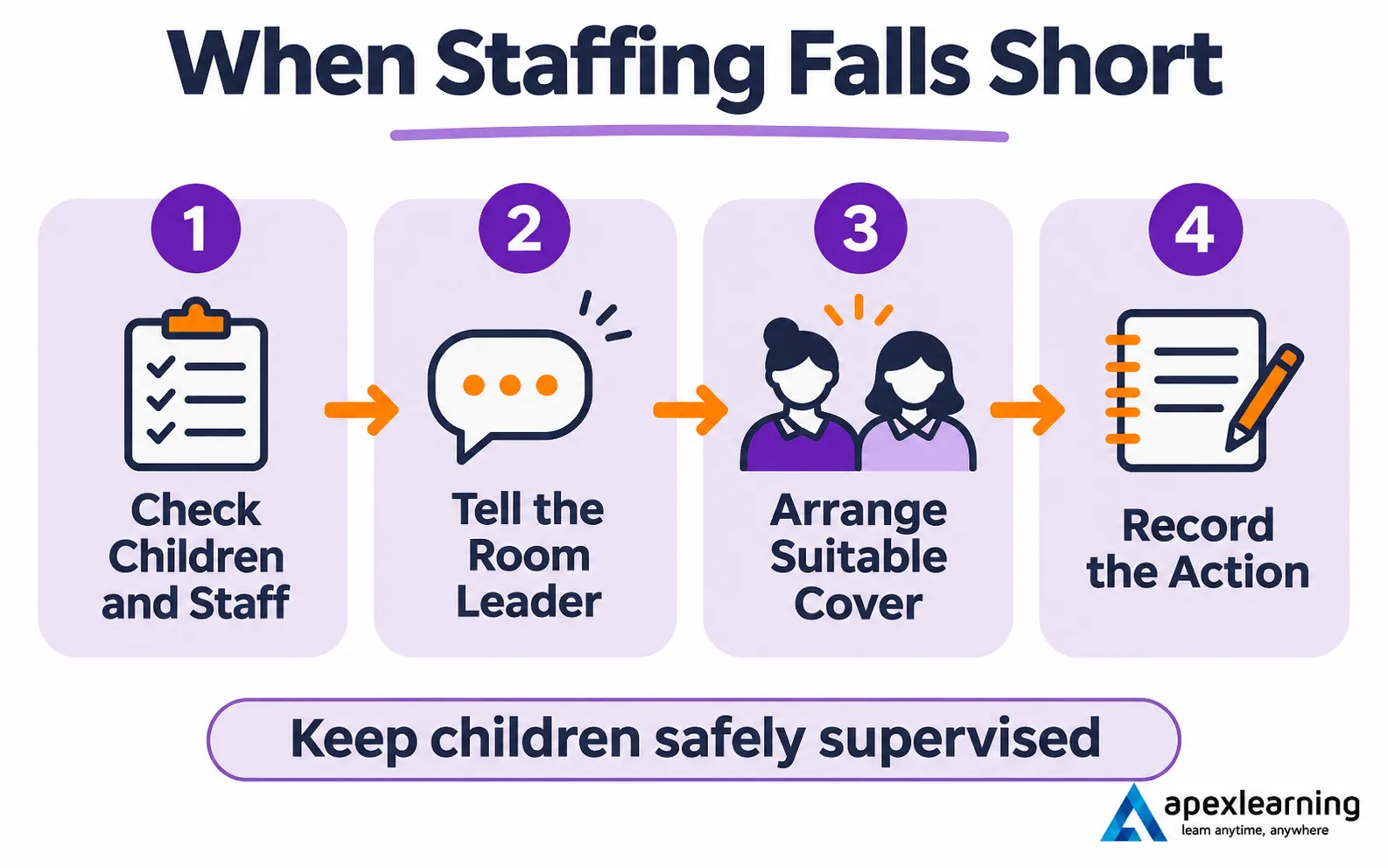
Four-step process for responding to a nursery staffing shortage.

Check the cover plan at the start of your shift. A sudden change should prompt a fresh count and a discussion with your room leader. Never assume a colleague will return before another child arrives.

What to do when staffing falls below the required level

Tell the room leader or manager straight away. Keep children under safe supervision while the team arranges cover. Do not leave children alone to find another adult, and do not change the attendance record to make the figures look right.

A shortage may need a change to planned activities. For example, postpone a trip outside the nursery until enough suitable adults are available.

If a child needs urgent help, follow the emergency plan and alert colleagues.

Deputy nursery manager and practitioner discuss a staffing plan during a handover.

Your nursery manager should decide how to restore safe staffing and whether reporting to the regulator is needed. If a concern is not addressed, use the setting’s safeguarding or whistleblowing procedure. Keep a factual record of what happened and who you told.

The Child Safeguarding and Protection course covers risk checks, reporting concerns and record keeping. These are useful areas to study as you build your knowledge of children’s welfare.

Build your confidence in early years care

Apex Learning’s Early Years Practitioner course covers early years development, welfare, teaching methods and support for children with additional needs. Study online at your own pace and work towards a CPD QS Accredited Certificate on successful completion.

Early Years Practitioner

Ready to Grow Your Early Years Career?

  • Child development & welfare
  • Supporting additional needs
  • CPD QS accredited certificate
£21.99£419Save 95%
Enrol Now for £21.99 →

✓ CPD QS accredited • 24/7 online access

Frequently asked questions

What is the staff ratio for 3-year-olds?

In England, the usual nursery ratio for three-year-olds is one adult to eight children. A ratio of one to thirteen may apply in some settings. A person with the specified teacher status must work directly with children, and other conditions apply. Different rules apply across the devolved nations and some school settings.

Yes, in some circumstances, staff without an approved childcare qualification can count towards the overall staffing numbers in England. The nursery must still meet the required mix of qualified staff and check suitability. An unqualified worker cannot automatically take the place of a required Level 3 practitioner.

The number of staff a nursery needs depends on the ages and number of children, the type of setting and the applicable national rules. For example, a group of ten two-year-olds in an English nursery normally needs at least two eligible adults. The team may need extra staff for safe care.

Approved EYFS qualifications are awards that meet the Department for Education’s rules for counting staff at the relevant level in England. Check the exact award, date and any extra conditions through official qualification guidance. Remember to check the award itself. A course title or a CPD certificate alone does not establish that an award is approved.

In an English nursery, the usual minimum is one eligible member of staff for every five two-year-olds. These adults do not all need to be qualified teachers. The setting must meet the required childcare qualification mix, and school-based provision may have extra rules about the supervision of staff.

Our Blogs

Latest blog posts

A nursery job applicant talks with a manager during an interview." alt="20 Nursery Nurse Interview Questions With Model Answers" />

Prepare for your next nursery interview with 20 adaptable model answers, realistic childcare scenarios and a simple way to show your skills, even if you are new to the sector.

A nursery key person talks gently with a young child at the child's eye level." alt="Key Person Approach: What It Means for Your Nursery Role" />

Being a key person means more than keeping records. Discover how to build trusting relationships, tailor daily care and work with families as an early years practitioner.

A toddler pushes a colourful activity walker across a nursery play mat." alt="Schemas in Play: 9 Types You Can Spot in Your Nursery" />

Why do children carry toys, spin wheels or line up blocks again and again? Discover nine common play schemas and learn how to respond to these patterns in your nursery.