
Schemas in play are repeated patterns of action that children use to explore their world. You might see a child carry toys across a room or spin the wheels of a toy car. These actions can give you clues about what the child wants to find out.
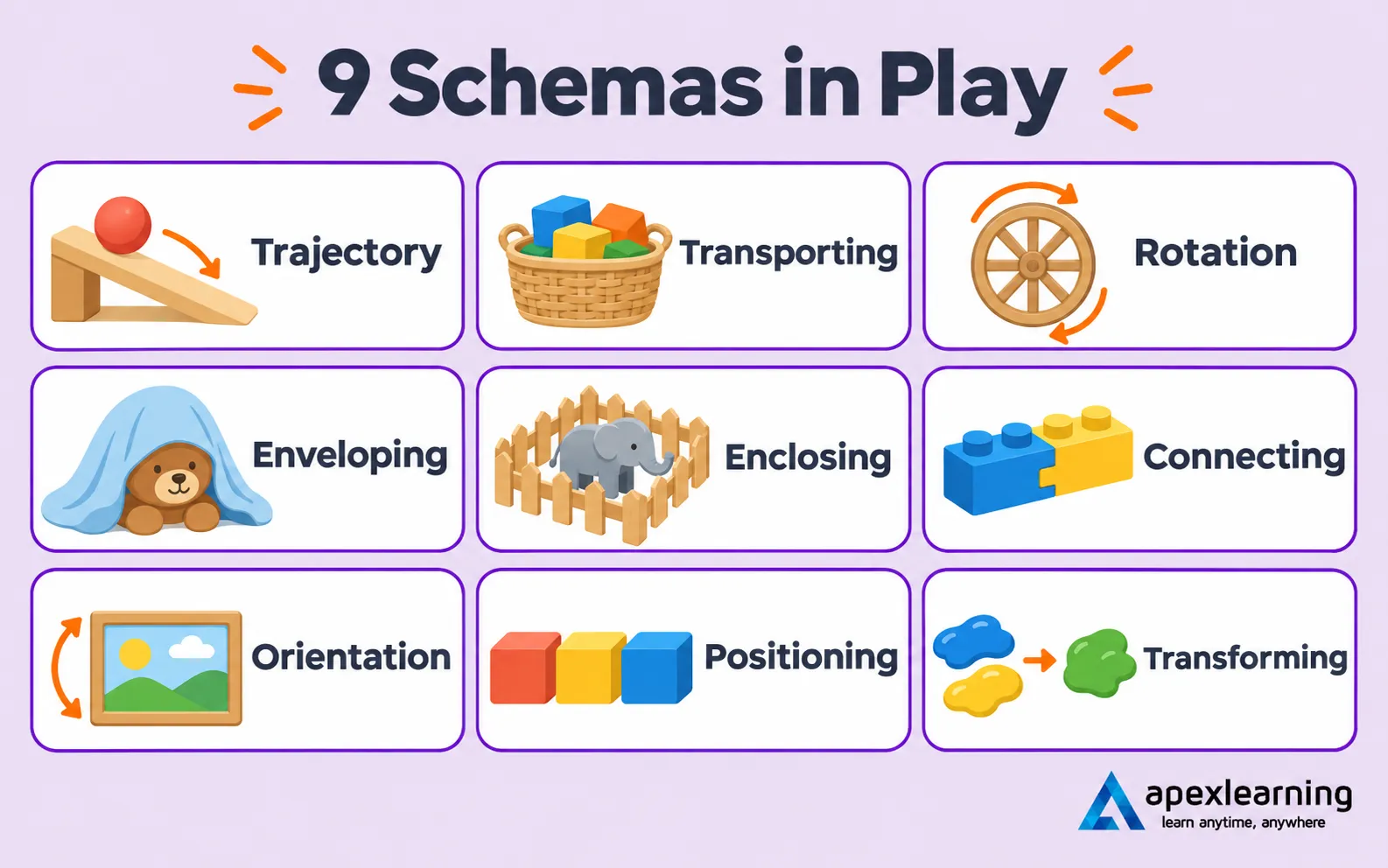
Nine common patterns are trajectory, transporting, rotation, enveloping, enclosing, connecting, orientation, positioning and transforming. There are other patterns too. You can use these nine as a starting point rather than a fixed list of skills to test.
If you are new to nursery work, learning to spot these patterns can help you plan play around children’s interests.
Want to Understand Children’s Play Better?
- EYFS teaching techniques
- Promoting learning & development
- CPD QS accredited certificate
Why do schemas in play matter?
Repeated play can help children test ideas and notice what happens when they change something. It also gives you a useful way to choose materials. Instead of asking a child to stop filling and emptying a basket, you might offer a larger basket and see what they do next.
The Open University describes how Chris Athey built on earlier work by Jean Piaget to study repeated actions in children’s play. A child may explore the same idea with different toys or in different places.
For instance, a child might roll a ball along a path. Later, they may send a toy train down a slope. Both actions could reflect an interest in movement.
Look at what the child chooses to do, not just the toy they choose. When you study schemas in play, early years practitioners can help you spot patterns you might otherwise miss. Discuss schemas in play with your mentor after a session.
In England, the Early Years Foundation Stage is known as the EYFS. You can use EYFS play schemas as a way to think about learning through play. They are not a separate statutory checklist. If you are working towards an early years educator level 3, practise discussing observations with your mentor.
The 9 types of schemas in play
The following examples are fictional but reflect actions you may see in nursery. The University of South Wales notes that there are many ways to describe these patterns. Treat the 9 schemas of play below as a useful working set.
1. Trajectory
This pattern is about movement along a path. A child may roll balls down a ramp, drop large blocks into a tray or watch water flow.
Try offering a low, stable ramp and large soft balls. Talk about whether the ball goes fast or slow. Give the child time to change the slope safely and see what happens.
If they throw hard toys, offer a safe place to throw soft ones instead.
2. Transporting
A child moves items from one place to another. They might carry large fabric squares from a shelf to a basket across the room.
Offer light bags, baskets or a sturdy toy trolley. Use words such as full, empty, near and far. Keep paths clear and let the child decide where to take the items. Avoid filling the trolley so heavily that it becomes hard to move.
3. Rotation
The child explores things that turn or move in circles. You may notice them turning a large toy wheel or making round marks on paper.
Provide chunky rolling pins, securely fitted toy wheels or thick crayons. Watch whether the child changes the speed or direction.
You can model words such as round and turn without asking them to copy you.
4. Enveloping
This pattern involves covering or wrapping objects. A child might hide a toy bear under a cloth and then lift the cloth to find it again.
Offer short, light pieces of fabric and large soft toys. Keep fabric away from faces and necks. Ask where the bear has gone, then wait for the child to show you. They may want to repeat the game many times.
5. Enclosing
Enclosing means making a boundary around something. A child may build a fence around a toy animal or draw a circle around a picture.
Provide large blocks or wide pieces of card to create borders. Introduce words such as inside, outside and around. Unlike enveloping, the focus here is on making a space or boundary rather than covering an object.
6. Connecting
Children may join things together and pull them apart again. Look for repeated linking of large construction blocks or joining sections of a toy train track.
Offer age-appropriate construction pieces that fit easily together. Let the child try different ways to join them. If a bridge falls down, give them a chance to rebuild before you step in. Talk about what stays together and what comes apart.
7. Orientation
This pattern is about seeing things from different angles. A child might turn a picture upside down or look at a toy from floor level.
Place large pictures at different safe heights. Offer objects the child can turn in their hands. You do not need to encourage climbing or risky positions. The child can explore a new view from a stable seat or the floor.
8. Positioning
Children may arrange items in a line, a group or a pattern. A child could place large toy animals in a row and change their order several times.
Offer a clear mat and a set of large toys. Notice the choices rather than correcting the order. Ask whether the child wants another animal.
There is no need to turn the play into a counting task unless the child shows an interest.
9. Transforming
Transforming involves exploring change. A child might mix two paint colours, press a shape into dough or add water to sand.
Use suitable, non-toxic materials with close supervision. Offer a small tray and let the child choose what to mix. Talk about the change in colour, shape or feel. Check allergies and avoid materials that are unsafe for children who put objects in their mouths.
How to recognise and support schemas in play
Start by watching what a child does over time. Notice whether the same action appears with different materials. Then offer one small change that builds on their interest. You can review how they respond without expecting a particular result or asking them to finish a set task.
The Froebel Trust stresses the value of listening and paying attention to children’s ideas during play. For example, if a child keeps moving large objects between trays, try placing a third tray nearby.
Heuristic play can give children space to explore safe everyday objects. You may spot more than one pattern in the same session.
You can also offer loose parts play using materials that children can move and join in different ways. Choose items that suit each child’s age and needs.
Apex Learning’s Early Years Practitioner course includes EYFS Teaching Techniques and Promoting Learning and Development. These topics can help you build background knowledge before practising with a mentor.
Recording observations without labelling children
Write down what you saw before you decide what it might mean. A short note can help your team plan the next activity. The Early Years Alliance encourages practitioners to look for patterns in children’s actions. One action alone does not establish a pattern.
Here is an illustrative observation you could adapt to your setting’s recording system.
| Observation field | Example entry |
|---|---|
| What happened | Child moved large blocks into a basket and carried them to a mat. |
| Repeated action | Returned to collect more blocks several times. |
| Possible interest | Moving objects between places. |
| Next step | Offer a second light basket and observe the response. |
Check the pattern again on another day. Ask a parent whether they see similar actions at home. Keep notes private and follow your setting’s rules for storing records.
The Nursery Teacher Training Course – Level 3 covers observation and learning activity planning. It is an option for further CPD study.
Common mistakes when supporting schemas in play
Avoid turning a possible interest into a fixed label. A child who likes spinning wheels can also enjoy stories, painting and outdoor play. Schematic play in early years is a way to understand interests, not a tool for diagnosing a condition.
Try these checks before you plan an activity:
- Choose large, safe resources that fit the child’s stage of development.
- Allow enough space and time for the child to explore.
- Offer a choice rather than making the child repeat an action.
- Observe whether the new material interests the child.
- Stop or adapt activities when safety or wellbeing is at risk.
If the child does not enjoy a new activity, that is useful information too. Try something different rather than pushing them to finish.
The EYFS Teaching Diploma covers teaching techniques and support for children with additional needs. These CPD courses do not replace an approved early years qualification.
Develop your early years observation skills
Apex Learning’s Early Years Practitioner course covers Importance of Early Years in Development, EYFS Teaching Techniques and Promoting Learning and Development. Study online at your own pace and work towards a CPD QS Accredited Certificate on successful completion.
Ready to Grow Your Early Years Career?
- EYFS teaching techniques
- Promoting learning & development
- CPD QS accredited certificate
Frequently asked questions
What are the 9 main play schemas?
The nine commonly described play schemas are trajectory, transporting, rotation, enveloping, enclosing, connecting, orientation, positioning and transforming. Each describes a possible pattern in children’s actions. There are other ways to group these patterns, so the nine schemas of play are not a formal list that every child must complete.
What is Piaget's concept of schema?
Jean Piaget used the concept of schema to describe organised ways of understanding and acting on the world. Children build and adjust these mental patterns through experience. In early years practice, repeated actions can offer clues to the ideas a child is exploring as they play with different materials.
What is an example of a schema?
A transporting schema may appear when a child repeatedly carries large toys from a shelf to a basket. Other schema play examples include turning wheels and covering a teddy with fabric. You would look for similar actions over time before deciding that the child may have a particular interest.
Who invented play schemas?
There is no single inventor of play schemas. Jean Piaget developed influential ideas about how children organise their knowledge. Chris Athey later extended this work through research into young children’s repeated actions. Other early years researchers have developed these ideas to help practitioners understand children’s interests and plan suitable play.
What is Chris Athey's theory of schema play?
Chris Athey described schemas as patterns of repeated behaviour through which children take in and organise new experiences. Her work helps adults notice links between actions that may look unrelated. For example, drawing circles and turning a toy wheel may both suggest an interest in things that go round.
" alt="20 Nursery Nurse Interview Questions With Model Answers" />

" alt="Key Person Approach: What It Means for Your Nursery Role" />
" alt="Schemas in Play: 9 Types You Can Spot in Your Nursery" />