



A fluid balance chart helps healthcare professionals track how much fluid a patient takes in and passes out. Recording these amounts accurately is an important part of patient monitoring in hospitals, nursing homes and other care settings.
To complete a fluid balance chart correctly, measure and record fluid intake and output in millilitres (mL), add the totals separately, then subtract output from intake. Check each entry and report any concerns according to your workplace procedures.
Whether you are a healthcare assistant, care worker or nursing student, this guide explains what to record, how to calculate fluid balance and how to complete the chart using a practical example.
Level 3 Diploma in Nursing Assistant Complete Training
Table of Contents
What Is a Fluid Balance Chart?
A fluid balance chart is a healthcare record used to monitor the amount of fluid entering and leaving a patient’s body over a specified period, often 24 hours.
It helps healthcare teams identify changes in fluid intake and output that may require further assessment.
A typical fluid balance chart includes:
- Patient identification and recording date.
- Time and type of fluid intake.
- Amount of fluid consumed or administered.
- Measured urine and other fluid output.
- Running totals and overall fluid balance.
- Staff identification where required.
Fluid balance monitoring is particularly relevant when patients need closer observation because of illness, surgery or changes in their fluid intake.
Accurate fluid monitoring is one of the practical responsibilities of nursing assistants, alongside supporting patients with everyday care.
Recording intake and output is also included in the NMC standards for nursing associates. These responsibilities form part of wider nursing associate duties, alongside patient observation, communication and care support.
What Counts as Fluid Intake and Output?
Understanding what belongs in each section of the chart is essential for accurate recording.
What Counts as Fluid Intake?
Fluid intake includes fluids that a patient drinks or receives through prescribed healthcare interventions.
Common examples include:
- Water, tea, coffee, milk and fruit juice.
- Soup, jelly and other fluid-rich foods are included by local recording guidance.
- Oral nutritional supplements.
- Enteral feeding fluids.
- Intravenous (IV) fluids, recorded according to the patient’s monitoring arrangements.
Always record the amount actually consumed, rather than the amount offered.
For example, if a patient receives 200 mL of water but leaves 50 mL, their recorded intake is 150 mL.
Supporting patients with drinks can also involve attention to oral comfort and appropriate mouth care for patients, particularly when eating or drinking is difficult.

Use the organisation’s approved method for recording drinks and fluid-rich foods. Monitoring fluid intake is different from screening for malnutrition risk, which involves assessing nutritional status using tools such as the MUST score.
What Counts as Fluid Output?
Fluid output refers to measurable fluid leaving the body.
Examples include urine, vomit, liquid stool, stoma output and fluid collected from surgical drains.
Urine can be measured using a suitable collection container or catheter drainage system. Measuring urine collected through a drainage system is an important part of safe catheter care practices.
Some care settings use approved methods for estimating urine output from incontinence pads.
The body also loses fluid through breathing and sweating. These are called insensible losses and are not normally measured directly on routine fluid balance charts.
Where measurements are uncertain, follow your organisation’s recording procedures.
How to Complete a Fluid Balance Chart Step by Step
Although chart layouts vary between healthcare organisations, the basic process remains similar.
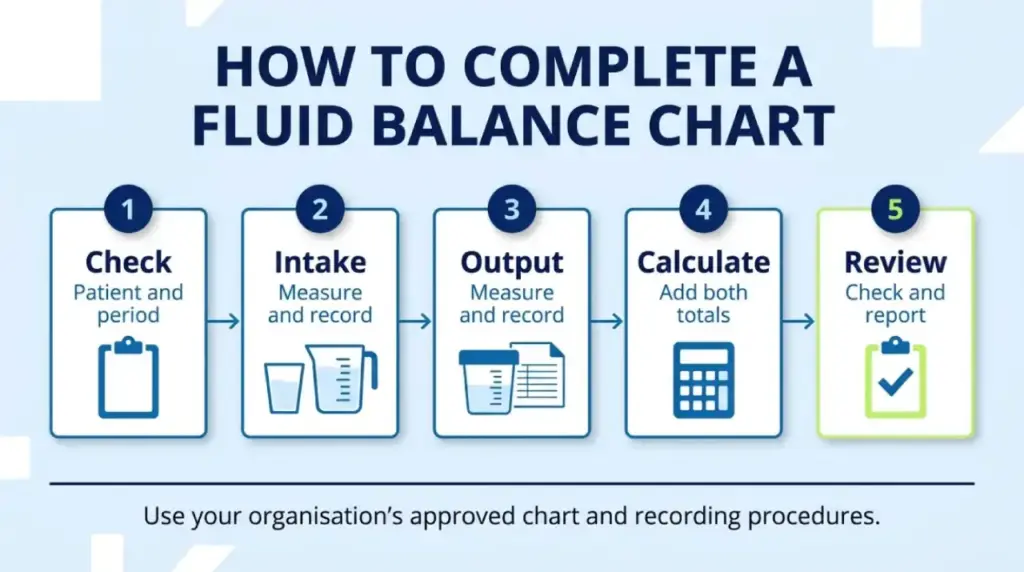
Step 1: Check the Patient and Recording Period
Before starting, confirm that you have the correct patient’s chart.
Check their identification details, recording date and monitoring instructions. Make sure you know whether the chart covers a particular shift or a full 24-hour period.
Review any instructions about recording frequency or additional measurements.
Step 2: Measure and Record Fluid Intake
Use a measuring jug, calibrated cup or container with a known capacity.
For each intake, record:
- The time the fluid was consumed or administered.
- The type of fluid.
- The quantity in millilitres.
For example, if someone drinks 180 mL of tea at 09:30, record 180 mL against that time.
If the patient leaves some of their drink, measure the remaining amount and subtract it from the original volume.
Where IV or enteral fluids are involved, ensure that the appropriate authorised staff record them according to the patient’s monitoring plan.
Step 3: Measure and Record Fluid Output
Measure urine and other relevant output using appropriate equipment.
Record the time, type of output and measured amount in the correct chart section.
For example, if a patient passes 300 mL of urine at 11:00, enter 300 mL under output.
If urine or another output cannot be measured accurately, document what happened using the organisation’s approved method and inform the responsible staff member.
Where an approved estimation method is used, identify the value as estimated rather than presenting it as an exact measurement.
Step 4: Calculate the Intake and Output Totals
At the required intervals, add all recorded intake amounts together.
Calculate the output total separately.
Check that each measurement uses millilitres and belongs to the correct recording period.
Some charts require running totals throughout a shift, while others include a cumulative 24-hour balance.
Step 5: Check, Document and Report
Subtract the total output from the total intake to calculate the fluid balance.
Check the chart for missing entries, duplicated measurements or calculation errors.
Complete any required staff identification and communicate relevant information during handover or routine patient checks.
The NMC Code’s record-keeping standards require registered professionals to maintain clear, accurate records relevant to their practice.
Healthcare support staff should follow their organisation’s documentation and delegation procedures.
Staff interested in developing broader healthcare support skills may consider the TQUK Level 3 Diploma in Healthcare Support Services (RQF), which offers a regulated qualification pathway in healthcare support services.
Fluid Balance Chart Example: How to Calculate the Total
A worked example can help you see how fluid intake and output are recorded during a shift.
Imagine you are monitoring a patient in a hospital. Throughout the morning, you record what they drink and how much urine they pass.
Example of a Completed Fluid Balance Chart
Here is what the patient’s fluid record looks like:
- At 08:00: The patient drinks 150 mL of tea. Record 150 mL under fluid intake.
- At 10:00: The patient drinks 200 mL of water and passes 250 mL of urine. Record 200 mL under intake and 250 mL under output.
- At 12:00, the patient has 200 mL of soup. Record 200 mL under fluid intake.
- At 14:00, the patient drinks another 150 mL of water and passes 300 mL of urine. Record 150 mL under intake and 300 mL under output.
Now, add the amounts separately.
Total fluid intake:
150 + 200 + 200 + 150 = 700 mL
Total fluid output:
250 + 300 = 550 mL
To calculate the fluid balance, subtract the total output from the total intake:
700 mL − 550 mL = +150 mL
This means the patient has a positive fluid balance of 150 mL during the recorded period. In simple terms, the recorded fluid intake was 150 mL greater than the recorded output.
This example covers only part of a shift. In practice, continue recording all relevant intake and measurable output throughout the required monitoring period, using your organisation’s approved fluid balance chart.
How to Calculate Fluid Balance
Use the following formula:
Fluid Balance = Total Fluid Intake − Total Fluid Output
First, add the intake:
150 + 200 + 200 + 150 = 700 mL
Next, add the output:
250 + 300 = 550 mL
Now subtract the output from the intake:
700 − 550 = +150 mL
The patient has a recorded positive fluid balance of 150 mL during this period.
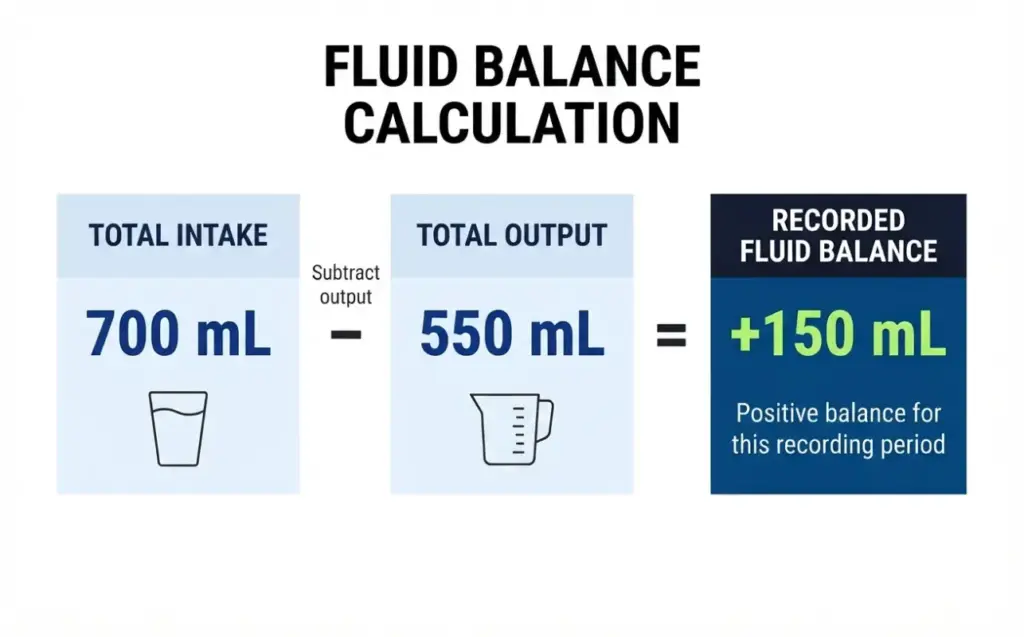
This figure shows the difference between recorded intake and output. Healthcare professionals consider it alongside other observations when assessing the patient’s overall condition.
What Do Positive and Negative Fluid Balance Mean?
Fluid balance calculations can produce positive, negative or zero results.
Positive Fluid Balance
A positive fluid balance means recorded intake is greater than recorded output.
For example:
1,800 mL intake − 1,400 mL output = +400 mL
This indicates that recorded intake exceeded recorded output by 400 mL during that period.
Negative Fluid Balance
A negative fluid balance means recorded output is greater than recorded intake.
For example:
1,200 mL intake − 1,600 mL output = −400 mL
A positive or negative result must be considered in the context of the patient’s condition, prescribed care and other clinical findings.
NICE guidance on IV fluid assessment and monitoring recommends considering fluid balance charts alongside clinical observations, relevant blood tests and other information when assessing adults receiving IV fluids in hospital.
Common Fluid Balance Chart Mistakes to Avoid
Accurate fluid balance recording helps healthcare professionals monitor patients effectively. However, small mistakes can affect the accuracy of the chart. Here are some common errors and how to avoid them.

- Recording the full drink instead of the amount consumed: If a patient receives 200 mL of water but drinks only 150 mL, record 150 mL as their intake. Always measure what the patient actually consumes.
- Forgetting to record urine output: Record urine measurements as soon as possible after collection. This helps keep the chart accurate and reduces the chance of missing important information.
- Mixing litres and millilitres: Fluid balance charts usually record measurements in millilitres (mL). For example, 0.5 litres equals 500 mL. Convert measurements into the required unit before recording them.
- Making calculation errors: Add fluid intake and output separately before calculating the balance. Double-check your totals, especially at the end of a shift.
- Guessing missing measurements: If a fluid amount was not measured, follow your workplace’s approved recording procedure. Record estimated amounts only when an approved method allows it, and clearly identify them as estimates.
- Recording the same fluid twice: Check previous entries before adding new measurements. For example, make sure IV fluids have not already been recorded by another staff member.
A systematic review published in BMJ Open Quality identified incomplete documentation and calculation errors as challenges affecting fluid balance charting.
A useful habit is to check the chart regularly throughout your shift. Recording measurements promptly, reviewing entries and checking calculations can help maintain accurate fluid balance records.
When Should Care Staff Report Fluid Balance Concerns?
Accurate recording helps healthcare teams recognise changes that may need attention.
Report unexpected changes in fluid intake or output, missing measurements and concerns about the patient’s condition to the responsible registered professional.
Examples include unusually reduced urine output, a significant change in drinking patterns or difficulty obtaining required measurements.
Observations such as dizziness or changes in mobility may also help staff identify when additional falls prevention measures are needed.
Follow the patient’s monitoring plan and your organisation’s escalation procedures, including any specified reporting thresholds.
Clear communication and accurate record-keeping are among the essential skills for nursing assistants working in patient care.
If a concern requires earlier review, communicate it promptly rather than leaving it until the end of the shift.
Developing Your Patient Monitoring Skills
Fluid balance recording is one of several practical activities involved in supporting patient care.
For those interested in developing broader nursing support knowledge, Apex Learning’s Level 3 Diploma in Nursing Assistant Complete Training offers flexible online learning covering patient care, communication, nutrition and related healthcare topics.
For learners interested in developing recognised healthcare support competencies, the TQUK Level 3 Diploma in Healthcare Support (RQF) offers a regulated qualification pathway covering wider healthcare responsibilities.
The course offers a CPD QS-accredited certificate following successful completion, supporting continuing professional development alongside workplace learning.
For learners interested in developing recognised healthcare support competencies, the TQUK Level 3 Diploma in Healthcare Support (RQF) provides a regulated qualification pathway covering broader healthcare responsibilities.
Experienced care professionals considering supervisory or management responsibilities may also be interested in developing leadership skills in adult care through a regulated Level 5 qualification.
Conclusion
Completing a fluid balance chart correctly involves measuring intake and output, recording each entry accurately and checking the final calculation.
Clear documentation supports patient monitoring and helps healthcare professionals recognise changes that may require further assessment.
By following the recording steps and your workplace procedures, you can contribute to accurate, reliable fluid balance records.
Frequently Asked Questions
How Often Should a Fluid Balance Chart Be Updated?
Record measurements promptly according to the patient’s monitoring plan. Some charts require regular running totals, while others specify different observation intervals. Follow your organisation’s instructions.
Who Is Responsible for Completing a Fluid Balance Chart?
Registered nurses, nursing associates and appropriately trained healthcare support staff may contribute to fluid balance recording, depending on their responsibilities and local policy. Clinical decisions remain with appropriately qualified professionals.
How Do You Record a Partially Consumed Drink?
Measure the amount remaining and subtract it from the original volume. For example, if a patient drinks 120 mL from a 200 mL cup, record 120 mL as their intake.
What Should You Do If a Fluid Balance Entry Is Missing?
Follow the organisation’s documentation-correction procedure and inform the responsible staff member. Any late entry should accurately reflect the information available and be documented according to local policy.
Is a Fluid Balance Chart the Same as a Hydration Chart?
Not always. A hydration chart may focus mainly on drinks consumed, while a fluid balance chart records relevant intake and measurable output to calculate the difference between them. The exact format depends on the care setting.
 " alt="Nursing Associate Apprenticeship: NHS Entry Guide" />
 " alt="2026 Nursing Associate Salary: Band 4 Pay Explained" />