



As the UK education landscape continues to evolve, the role of the Teaching Assistant (TA) has never been more vital. With classrooms becoming increasingly diverse and inclusive learning a national priority, teaching assistants are no longer just classroom helpers; they are educators, mentors, and support specialists.
But with so many online training options, certifications, and qualifications available today, one key question remains:
Is teaching assistant training really worth it in 2025?
The short answer is an emphatic yes.
However, to understand why, let’s take a closer look at what modern TA training offers, how it aligns with the UK’s educational needs, and what benefits it brings to your professional development and career progression.

1. Understanding the Role of a Teaching Assistant
A teaching assistant supports classroom teachers in planning, organising, and delivering lessons, while also providing one-to-one or small group support to students. Their role is both academic and pastoral, helping pupils understand learning materials, encouraging engagement, and fostering confidence.
In today’s classrooms, teaching assistants are also essential for:
- Supporting students with Special Educational Needs (SEN) or disabilities
- Managing behaviour and promoting a positive learning environment
- Preparing learning resources and activities
- Assisting with administrative tasks
- Providing emotional and social support to pupils
A well-trained TA enhances not only the learning experience of students but also the overall efficiency of teachers, allowing for more focused and effective teaching.
2. Why the Teaching Assistant Profession Is Evolving in 2025
The UK education sector in 2025 faces new challenges, rising student numbers, complex learning needs, and an increasing emphasis on personalised education. This has elevated the importance of skilled support staff within schools.
Several key trends are shaping the future of the TA role:
- Inclusion as a priority: There is a growing demand for assistants trained in SEN, autism, ADHD, and dyslexia support.
- Digital classrooms: Technology integration has expanded TA responsibilities to include supporting online and hybrid learning environments.
- Behavioural and emotional well-being: Schools rely on TAs for one-to-one mentoring, emotional regulation support, and safeguarding awareness.
With these changes, formal training is no longer optional; it’s what separates capable assistants from exceptional ones.
3. Why Formal Training Matters
While enthusiasm and compassion remain the heart of the profession, formal training gives teaching assistants the framework to translate passion into impact.
Here’s why accredited training makes a difference:
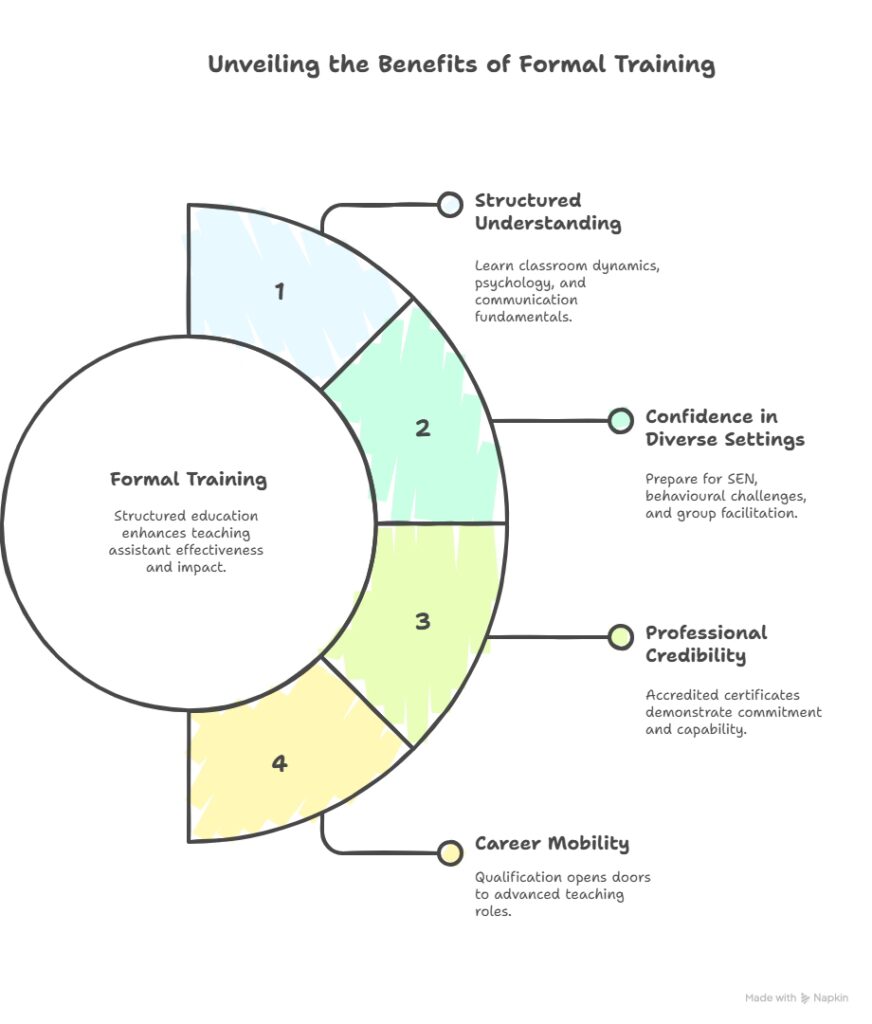
- Structured understanding: You learn the fundamentals of classroom dynamics, learning psychology, and effective communication.
- Confidence in diverse settings: Training prepares you for SEN environments, behavioural challenges, and group facilitation.
- Professional credibility: Accredited certificates demonstrate your commitment and capability to schools and employers.
- Career mobility: A recognised qualification is often a gateway to advanced roles such as Higher Level Teaching Assistant (HLTA) or SEN Coordinator.
Without structured training, TAs risk being limited to basic classroom support, whereas trained assistants become integral members of the teaching team.
4. The Tangible Benefits of Teaching Assistant Training
Formal TA training delivers a blend of career, professional, and personal benefits.
Career-wise, it increases employability in a competitive job market. Schools prefer candidates who already understand safeguarding, learning support, and inclusive teaching.
Professionally, it equips you with strategies to support pupils with complex needs, adapt to varied classroom environments, and collaborate effectively with teachers.
Personally, it builds confidence, patience, and emotional intelligence, qualities that define truly great educators.
Key benefits include:
- Mastery of classroom management and behaviour techniques
- Understanding of SEN frameworks and inclusive practices
- Stronger communication with students, teachers, and parents
- Knowledge of child safeguarding, health, and well-being
- Better job security and long-term career satisfaction
In 2025, schools are prioritising well-trained support staff more than ever, making this investment genuinely worthwhile.
5. Skills You Gain Through Modern TA Courses
Enrolling in a comprehensive TA course provides both practical skills and career advantages. Benefits include increased employability, confidence in supporting SEN students, and knowledge of inclusive practices. They blend theory with practical understanding, offering a well-rounded learning experience.
Core skills covered typically include:
- Behaviour Management: Effective techniques for maintaining classroom harmony.
- SEN Strategies: Tailored approaches for supporting students with autism, ADHD, and dyslexia.
- Learning Support: Differentiated instruction to meet diverse learning styles.
- Safeguarding and Child Protection: Recognising signs of vulnerability and ensuring pupil safety.
- Professional Development: Reflective practice, communication, and teamwork.
These skills don’t just prepare you for employment—they prepare you for longevity in education.
6. Career Progression and Salary Outlook
The pathway from an entry-level teaching assistant to an advanced educational role is both achievable and rewarding.
Role | Average UK Salary (2025) |
Teaching Assistant (TA) | £16,000 – £25,000 |
SEN Teaching Assistant | £18,000 – £26,000 |
Learning Support Assistant | £18,000 – £27,000 |
Higher Level Teaching Assistant (HLTA) | £24,000 – £30,000 |
Formal training accelerates career progression, allowing you to move beyond basic duties and into positions of trust and leadership.
7. How Training Enhances Employability
Employers increasingly seek candidates who bring both compassion and competence. Having a formal qualification signals both.
A trained TA can:
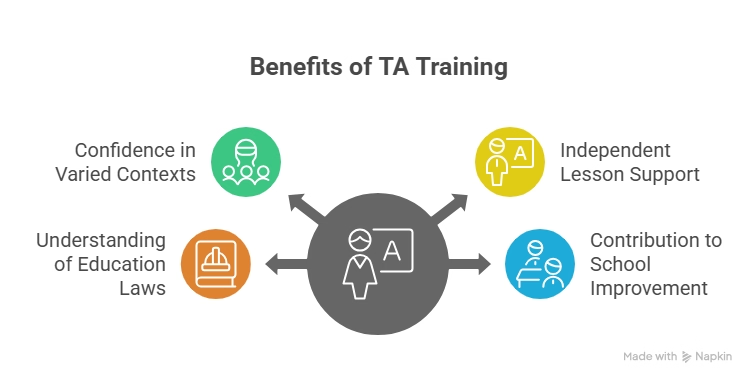
- Work confidently in varied classroom contexts
- Support lesson delivery without constant supervision
- Understand key education legislation and safeguarding practices
- Contribute meaningfully to school improvement plans
In an era where education standards and student needs are evolving rapidly, completing a Teaching Assistant Complete Course ensures you gain the knowledge and practical skills to stand out as a reliable asset to any institution.
8. Flexibility and Accessibility of Online TA Training
One of the greatest advantages of modern training is accessibility.
With online and hybrid courses, individuals can study at their own pace while balancing personal or professional commitments.
Most online TA courses now offer:
- Self-paced modules accessible 24/7
- Interactive content such as videos, quizzes, and case studies
- Downloadable resources for revision and lesson planning
- Tutor support and assessments for real-world application
This flexibility means you can gain a recognised qualification without stepping away from your current job or family responsibilities.
9. Choosing the Right Teaching Assistant Course in 2025-2026
Not all courses are created equal, and with so many available online, choosing the right one matters.
When evaluating a course, consider:
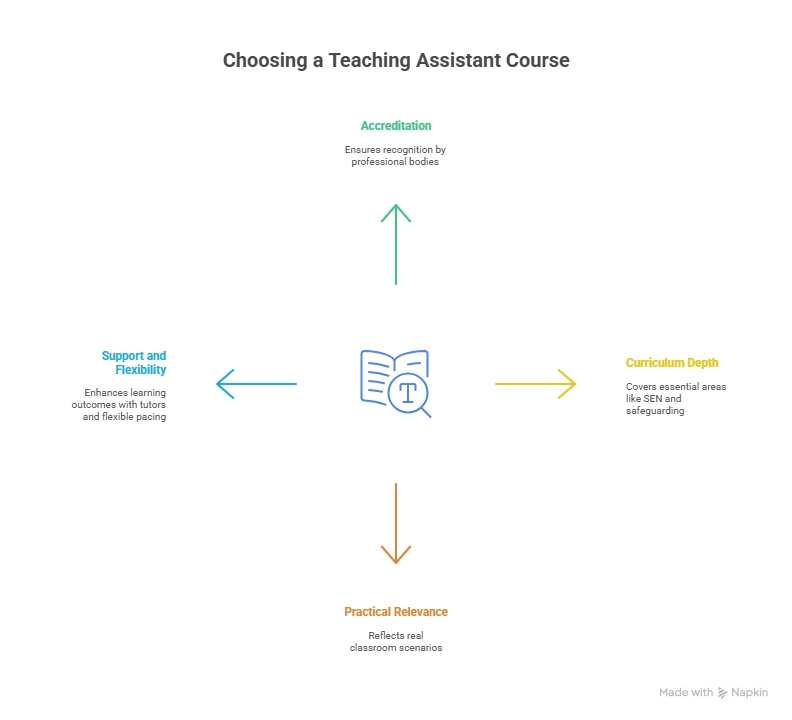
- Accreditation: Look for programs recognised by CPD or equivalent professional bodies.
- Curriculum depth: Ensure it covers SEN, safeguarding, behaviour management, and child development.
- Practical relevance: Prioritise modules that reflect real classroom scenarios.
- Support and flexibility: Access to tutors, career guidance, and flexible pacing enhances learning outcomes.
Opting for a comprehensive program like the Teaching Assistant Complete Course, which integrates theory, practical exercises, and assessments, can position you ahead of other candidates in a competitive market.
10. The Verdict: Is Teaching Assistant Training Worth It in 2025-2026?
Absolutely.
Teaching assistant training is more than a qualification; it’s a career foundation.
In 2025, UK schools are placing renewed emphasis on inclusive education, pupil wellbeing, and specialist learning support. This shift has transformed the TA role into a professional pathway with structure, recognition, and progression opportunities.
Formal training equips you with:
- The knowledge to understand diverse learners
- The confidence to contribute effectively
- The credentials to advance your career
So yes, enrolling in the Teaching Assistant Complete Course and undertaking comprehensive teaching assistant training is not only worth it, it’s essential if you aim to thrive in the evolving education sector.
Final Thought:
In 2025, teaching assistants stand at the heart of inclusive, modern education. The right training not only shapes your career, it shapes the classroom experience for every child you support.
FAQs
1. Is becoming a teaching assistant a stable career in 2025?
Yes. The UK’s demand for qualified classroom support staff continues to rise, especially as schools focus on inclusion, SEN, and mental wellbeing. Teaching assistant roles offer consistent employment across primary, secondary, and early years education.
2. Do I need formal training to work as a teaching assistant?
While you can enter some roles without prior qualifications, formal training greatly enhances your prospects. It provides essential knowledge in safeguarding, SEN, and classroom practice, skills that are increasingly expected by employers.
3. Can I become a teaching assistant without prior experience?
Absolutely. Many people enter the profession from non-educational backgrounds. Starting with an introductory online course is a great way to gain confidence, understand the fundamentals, and make your CV stand out.
4. What’s the biggest benefit of taking a TA course?
Beyond employability, training gives you real classroom competence, understanding how children learn, behave, and respond to support. It transforms enthusiasm into structured effectiveness, making you a true partner in education.
5. How long does it take to complete a teaching assistant course?
Most flexible online TA programs can be completed within a few months, depending on your pace of study. Some advanced or combined courses may take longer, especially those covering SEN or leadership modules.
6. What career paths can I explore after becoming a TA?
Once qualified, you can progress to roles such as Higher Level Teaching Assistant (HLTA), SEN Specialist, Learning Mentor, or even move into teacher training. Experience and ongoing professional development will open doors to leadership roles in education.
7. Is teaching assistant work rewarding beyond pay?
Definitely. The emotional satisfaction of helping a child succeed, witnessing their growth, and being part of a supportive educational community makes the role profoundly fulfilling. Many TAs describe it as a career with purpose and impact.
 " alt="The 6 Principles of Safeguarding: Protect Before Harm Happens" />
 " alt="Personal Development Goals: 5 Meaningful Examples That Work" />
 " alt="TILE in Manual Handling: Meaning, Checklist & Safer Lifting Guide" />