

Blog 6 minutes read

Motorcycle Diagnostic Tools: What Every Learner Needs to Know

Learn the essential motorcycle diagnostic tools, from OBD-II scanners to multimeters, and discover how a CPD-accredited Motorbike Repairing and Maintenance Diploma can help you master them and boost your career in the UK.

IT

Isla Thompson

Published September 11, 2025

Motorcycle Diagnostic Tool
arrow

Introduction

Modern motorcycles are more advanced than ever, featuring complex ECU systems, fuel injection technology, and advanced ABS braking systems. If you’re serious about learning bike maintenance, understanding motorcycle diagnostic tools is essential. These tools help you quickly find faults, make repairs efficiently, and keep bikes roadworthy.

Whether you’re training through a Motorbike Repairing and Maintenance Diploma or already working in a garage, knowing how to use diagnostic tools is one of the most valuable skills you can master.

Why Diagnostic Tools Matter

Motorcycle diagnostic tools are essential for any modern technician because they save time, reduce guesswork, and ensure safe, accurate repairs. These tools allow you to read fault codes from the ECU, identify wiring and ignition issues, test battery health, and check sensors, fuel systems, and emissions. They are also crucial for ensuring MOT compliance and keeping bikes roadworthy. Employers across the UK value technicians who can use diagnostic equipment confidently, as it improves efficiency and accuracy in the workshop. Mastering these tools not only makes you a better mechanic but also gives you a significant career advantage.

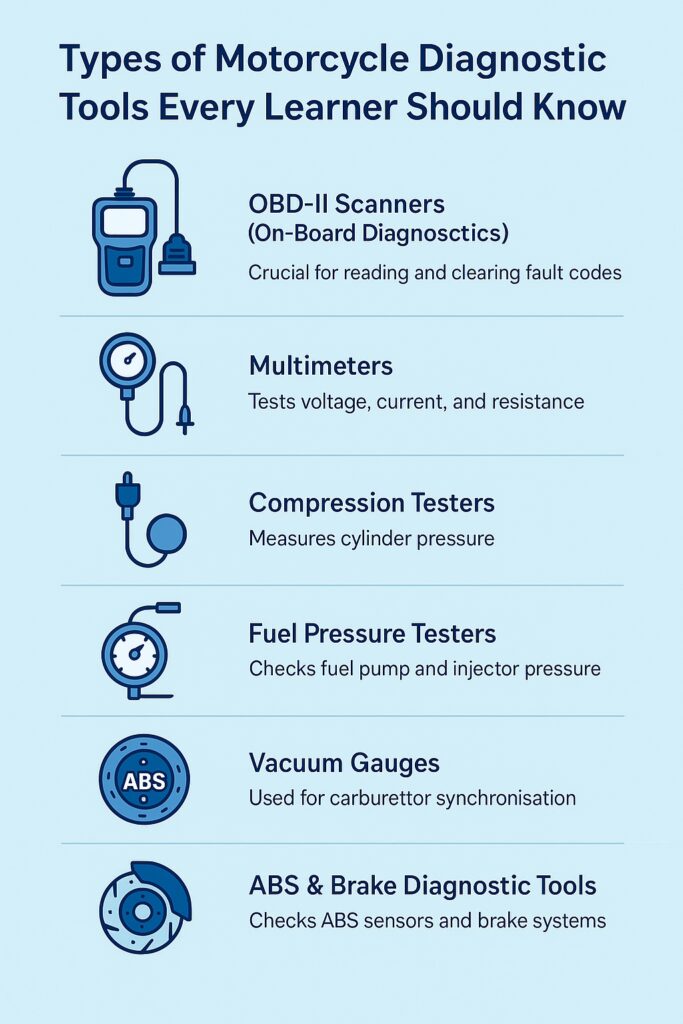
Types of Motorcycle Diagnostic Tools Every Learner Should Know

If you want to start your career as a motorcycle mechanic, learning how to use diagnostic tools is essential. Here are the key tools every learner should know:

  • OBD-II Scanners (On-Board Diagnostics)
    These scanners are crucial for reading and clearing fault codes on modern bikes. Many garages use handheld or Bluetooth OBD-II readers that connect to apps, making it easy to diagnose ECU-related problems quickly.
  • Multimeters
    A multimeter is one of the most versatile tools in a mechanic’s kit. It tests voltage, current, and resistance, helping you diagnose wiring faults, flat batteries, or faulty sensors with precision.
  • Compression Testers
    These measure cylinder pressure to check engine health. They help identify worn piston rings, leaky valves, or head gasket issues before they become major problems.
  • Fuel Pressure Testers
    Vital for ensuring that the fuel pump and injectors are delivering the correct pressure. Incorrect pressure can cause poor engine performance or starting issues.
  • Vacuum Gauges
    Used for carburettor synchronisation, ensuring smooth and balanced engine operation. Essential for older bikes or those with carburetted systems.
  • ABS & Brake Diagnostic Tools
    These are needed to check ABS sensors, reset error codes, and bleed systems electronically, keeping braking systems safe and MOT-compliant.

Mastering these diagnostic tools not only improves repair accuracy but also boosts employability. A CPD-accredited motorbike mechanic course will teach you how to use them step by step, building confidence for real-world repairs.

Learning to Use Diagnostic Tools in Your Training

A high-quality CPD-accredited motorbike mechanic course doesn’t just teach theory — it gives you hands-on training with the tools you’ll actually use in the workshop. You’ll learn how to operate OBD-II scanners, multimeters, compression testers, and other essential diagnostic equipment safely and effectively.

Throughout the course, you’ll be guided on how to interpret fault codes, troubleshoot wiring and engine issues, and carry out professional-level repairs to UK industry standards.

If you choose an online motorcycle technician course, you’ll benefit from interactive video demonstrations, downloadable guides, and 24/7 tutor support. This ensures you build confidence step by step, so when you move on to real-world practice, you already know exactly what to do.

By the time you complete your Motorbike Repairing and Maintenance Diploma, you’ll be fully prepared to work in garages, dealerships, or even start your own repair service with confidence and competence.

Career Benefits

Mastering diagnostic tools opens up opportunities such as:

Role

Average UK Salary

Motorcycle Mechanic

£18,000 – £25,000

Service Technician

£20,000 – £28,000

Electrical Systems Technician

£20,000 – £27,000

Engine Specialist

£22,000 – £30,000

💡 Key Insight: Investing time in learning and mastering motorcycle diagnostic tools not only improves your technical skills but also increases your earning potential and opens doors to higher-paying roles across the UK motor industry.

Fast-Track Options

If you’re looking for a faster and more convenient way to master motorcycle diagnostics, consider enrolling in an online motorcycle technician course such as the Motorbike Repairing and Maintenance Diploma. With flexible, self-paced learning, you can complete your training in as little as 3–6 months, depending on your dedication and availability.

By choosing this accelerated route, you’ll gain hands-on experience with diagnostic tools, learn how to interpret fault codes, and build the confidence to perform real-world repairs — all in a timeframe that suits your personal and professional goals. Whether you want to secure a job in a garage quickly or lay the groundwork for launching your own repair service, the opportunities in the UK motorcycle industry are growing and waiting for skilled technicians like you.

Conclusion

Motorcycle diagnostic tools are no longer optional — they’re a must-have skill for anyone serious about becoming a technician. By enrolling in a motorcycle repair training course, you’ll learn to use OBD-II scanners, multimeters, compression testers, and more, preparing you for work in UK garages, dealerships, and MOT centres.

👉 Ready to get hands-on with diagnostic tools? Enrol in this motorbike repair course today and gain the skills that make you job-ready and employer-preferred.

FAQs

  • What are motorcycle diagnostic tools?
    Motorcycle diagnostic tools are devices like OBD-II scanners, multimeters, and compression testers that help identify faults, measure engine health, and ensure bikes meet MOT standards.
  • Do I need diagnostic tools to repair a motorcycle?
    Yes — modern motorcycles have ECUs, sensors, and fuel injection systems that require proper diagnostic checks. Tools like multimeters and code readers make troubleshooting faster and safer.
  • Can I learn to use these tools online?
    Absolutely. A CPD-accredited motorbike mechanic course teaches you how to use OBD-II scanners, electrical testers, and fuel pressure tools through interactive lessons and tutor support.
  • Are these tools expensive?
    Basic diagnostic tools like multimeters are affordable, and many online courses include recommendations for cost-effective starter kits. Professional-grade scanners may be pricier but are essential for advanced technicians.
  • Which tool should I buy first?
    Start with a digital multimeter — it’s versatile and used for most basic diagnostic checks, including wiring, battery voltage, and continuity testing.
  • Will knowing diagnostics improve my job prospects?

       Yes. Employers prefer candidates who can confidently use diagnostic tools. It proves you are job-ready and can save garage time and money by performing accurate repairs.

Our Blogs

Latest blog posts

The 6 Principles of Safeguarding: Protect Before Harm Happens" alt="The 6 Principles of Safeguarding: Protect Before Harm Happens" />

Would you know what to do if someone showed signs of abuse or neglect? Learn the 6 Principles of Safeguarding in simple words and discover how to recognise risks, report concerns, prevent harm, and protect vulnerable people with safer, more confident decisions.

Personal Development Goals: 5 Practical Examples That Work" alt="Personal Development Goals: 5 Meaningful Examples That Work" />

Want to become more focused, confident, and organised? This guide explains 5 personal development goals that can help you improve time management, communication, emotional intelligence, skill-building, and your daily routine.

TILE in Manual Handling: Meaning, Checklist & Safer Lifting Guide" alt="TILE in Manual Handling: Meaning, Checklist & Safer Lifting Guide" />

Struggling to understand TILE in Manual Handling? This guide breaks down the meaning, checklist and safer lifting steps so you can spot risks before injuries happen.