





Introduction
In today’s globalised economy, international relations (IR) is no longer a niche field reserved for diplomats or policy analysts—it’s a thriving and diverse career path that spans sectors such as international law, global business, intelligence, development, and human rights.
With global challenges such as climate change, conflict, migration, and economic instability becoming more complex, the demand for skilled professionals who can navigate cross-border politics, negotiate agreements, analyse risk, and influence policy is on the rise.
Whether you’re a recent international relations graduate, a postgraduate in global affairs, or a mid-career professional considering a transition into international work, the career opportunities in IR are vast and well-compensated.
From high-level diplomatic roles and international law firms to policy advisors in the United Nations, NGOs, and multinational corporations, IR professionals play a critical role in shaping global outcomes—often with impressive financial rewards.
In this guide, we’ll explore the Top 15 Highest Paying Jobs in International Relations for 2025, complete with UK-based salary insights, core responsibilities, and career entry points—to help you chart a path in one of the most globally influential sectors of the modern era.
Recommended Courses to Start a High-Income Career
Many of the highest-paying roles require recognised training. These online courses provide practical skills to help you move into high-demand careers faster.
High demand • Practical skills • Flexible online study
Why Choose a Career in International Relations?
A career in international relations offers far more than just a passport to global work—it’s a gateway to influencing international policy, promoting peace, protecting human rights, and driving sustainable development on a global scale. In an era defined by global interdependence, employers across governments, NGOs, multinational corporations, and international organisations are seeking individuals who understand the complexities of cross-cultural negotiation, geopolitical risk, and global strategy. What makes international relations especially rewarding is the blend of intellectual challenge and social impact, often paired with high salaries, travel opportunities, and access to influential global networks. Whether you’re passionate about solving humanitarian crises, influencing climate diplomacy, or negotiating multinational business deals, international relations gives you the tools and platform to shape the world—and be well-compensated for it.
Highest Paying Jobs in International Relations 2025 -2026
Rank | Job Title | Salary (2025 Estimate) |
1 | International Lawyer | £115K – £220K+ |
2 | Ambassador / Diplomat | £130K – £210K |
3 | Senior Foreign Service Officer | £105K – £170K |
4 | Lobbyist | £90K – £160K+ |
5 | Economist | £85K – £140K |
6 | Regulatory Affairs Manager | £82K – £135K |
7 | Int’l Development Consultant | £80K – £130K |
8 | Political Affairs Officer | £75K – £125K |
9 | Foreign Service Officer | £70K – £110K |
10 | Int’l Trade Compliance Officer | £68K – £105K |
11 | PR Director | £65K – £100K |
12 | Intelligence Analyst | £63K – £95K |
13 | Public Affairs Consultant | £60K – £92K |
14 | Human Rights Officer | £55K – £90K |
15 | Immigration Specialist | £50K – £85K |
1. International Lawyer
Salary: £115,000 – £220,000+
International lawyers are among the highest-paid professionals in the field of international relations in 2025. Their work involves navigating the complex legal frameworks that govern international treaties, human rights, cross-border trade, diplomatic agreements, and multinational corporate compliance. These legal professionals advise states, global institutions, NGOs, and multinational corporations on matters such as dispute resolution, trade sanctions, extradition, asylum rights, and war crimes.
Their expertise is critical in today’s globalised and increasingly regulated world, where geopolitical tensions and international negotiations are at the forefront of business and diplomacy. International lawyers often work with the United Nations, World Trade Organisation (WTO), European Court of Human Rights, or in top-tier global law firms based in London, Brussels, or Geneva. Fluency in multiple languages—especially French, Spanish, Arabic, or Mandarin—is often essential due to the cross-jurisdictional nature of the role.
To become an international lawyer, you typically need an undergraduate law degree (LLB) followed by a Juris Doctor (JD) or a Master’s in International Law, especially if transitioning from another jurisdiction. Passing the bar exam in your practising country is also mandatory, along with substantial knowledge of international legal frameworks and diplomacy.
Given their highly specialised legal knowledge and their ability to influence cross-border decisions, international lawyers are rewarded with some of the highest salaries in the sector, often exceeding £200,000 with experience. It’s a competitive, demanding role—but one that offers prestige, purpose, and global influence in return.


2. Diplomat / Foreign Service Officer
Salary: £80,000 – £150,000+
Diplomats, also known as Foreign Service Officers, are key representatives of their home country’s interests abroad. In 2025, this role remains one of the most prestigious and high-paying jobs in international relations, especially for those posted in high-stakes regions or multilateral institutions like the United Nations, NATO, or European Union.
Diplomats manage political negotiations, maintain bilateral and multilateral relations, support economic partnerships, and assist citizens during international crises. They play a vital role in peacekeeping efforts, trade negotiations, human rights advocacy, and international security. Their postings range from embassies and consulates to permanent missions, often rotating every few years across global capitals.
To become a diplomat in the UK, candidates usually need a Bachelor’s or Master’s degree in International Relations, Politics, or Law, followed by successful completion of the Fast Stream Diplomatic Service assessment. Essential skills include exceptional communication, cultural sensitivity, proficiency in foreign languages, and a deep understanding of global affairs and national policy objectives.
While entry-level diplomatic positions start around £35,000–£40,000, senior diplomatic posts—such as Ambassadors or Permanent Representatives—can earn upwards of £150,000 annually. In some postings, diplomats also receive housing, education, travel, and hardship allowances, significantly boosting the total compensation package.
As global affairs become more dynamic and multi-polar, the demand for skilled diplomats continues to rise. This makes diplomacy not just a well-compensated career, but also a high-impact pathway for those passionate about shaping international dialogue and policy.
3. Political Risk Analyst
Salary: £70,000 – £140,000+
Political Risk Analysts play a crucial role in advising multinational corporations, governments, investment firms, and NGOs on the political climate of foreign markets. In 2025-2026, as global instability, elections, wars, and policy shifts affect trade and investment, these professionals are in high demand for their ability to forecast geopolitical events and minimise organisational risk.
Their core responsibilities include evaluating country stability, tracking legislative and regulatory developments, analysing political movements, and creating risk assessments that guide decisions on foreign direct investment, supply chain strategies, and expansion planning. Political Risk Analysts often work for consultancies, financial institutions, or global corporations with high exposure to foreign markets.
To enter this field, most employers look for a Master’s in International Relations, Political Science, Economics, or Area Studies, along with proficiency in one or more foreign languages. Analytical writing, data interpretation, geopolitical awareness, and strong communication skills are essential. Many analysts also have regional expertise—for example, in the Middle East, Sub-Saharan Africa, or Eastern Europe.
Junior analysts typically earn £40,000–£60,000 per year, but those with 5+ years of experience or who lead regional analysis portfolios can command over £100,000 annually. Top-tier firms such as Control Risks, Eurasia Group, and Stratfor offer competitive salaries and opportunities for international travel and publishing.
With global uncertainty on the rise, political risk analysis is a strategic and high-paying career path for those who want to be at the intersection of business intelligence and international affairs.
4. Diplomat / Foreign Service Officer
Salary: £55,000 – £145,000+
Diplomats—also known as Foreign Service Officers—represent their home countries abroad by managing international relations, protecting citizens, promoting trade and peace, and negotiating treaties. In 2025, with global cooperation being more vital than ever, diplomacy remains one of the most prestigious and well-compensated career paths in international relations.
Diplomats are posted to embassies, consulates, and missions worldwide. Their responsibilities range from conflict resolution and visa services to economic development and public diplomacy. Depending on the posting, a diplomat may specialise in political affairs, economics, consular services, public diplomacy, or international security.
To become a diplomat in the UK, you typically need a degree in International Relations, Politics, History, or Law, and pass the highly competitive Civil Service Fast Stream (Diplomatic Service pathway). Success requires a blend of academic ability, communication skills, cultural sensitivity, and adaptability. Proficiency in foreign languages is also a strong asset and often a requirement.
Entry-level salaries for UK diplomats begin at around £30,000 to £35,000, but mid-career officers can earn upwards of £55,000 to £85,000. Senior diplomats and ambassadors earn over £100,000, often with additional housing, hardship, and overseas allowances, depending on the location.
Diplomacy offers global travel, job security, and the chance to influence international policy—making it a top choice for those passionate about serving their country while engaging in world affairs at the highest level.
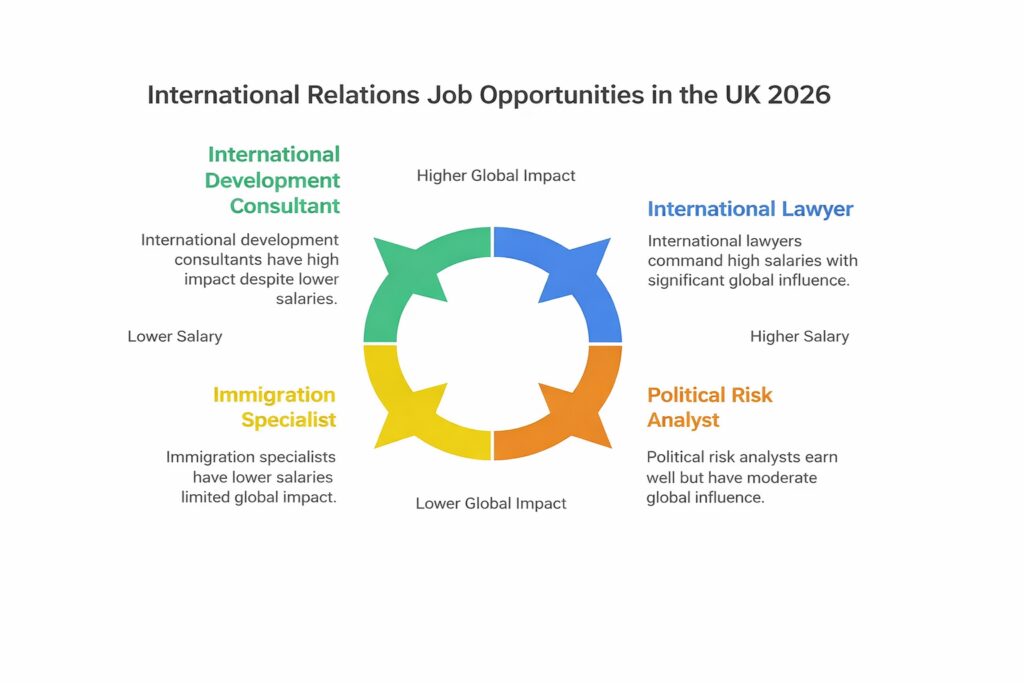
5. International Development Consultant
Salary: £50,000 – £130,000
International Development Consultants play a vital role in helping governments, NGOs, and international organisations design, implement, and evaluate projects aimed at improving economic, social, and environmental outcomes in developing regions. From post-conflict recovery to climate resilience and education access, these professionals operate at the intersection of policy, strategy, and humanitarian impact.
In 2025, global demand for international development consultants is rising as countries strive to meet the UN Sustainable Development Goals (SDGs). Consultants are hired by major entities like the United Nations, World Bank, IMF, DFID (UK), and private firms to work on projects ranging from poverty alleviation to infrastructure development.
A typical day might include conducting needs assessments, stakeholder interviews, policy analysis, impact evaluations, and reporting. Consultants often travel extensively and must adapt to diverse cultural and political contexts.
To enter the field, most professionals hold a Master’s in International Development, Public Policy, or Economics, paired with field experience through internships, NGOs, or Peace Corps-type programmes. Fluency in additional languages and cross-cultural competence are major advantages.
Entry-level salaries begin around £35,000–£45,000, but seasoned consultants can earn between £80,000 and £130,000+, particularly with large international organisations or when contracted as freelance experts.
This career suits those driven by purpose, policy, and problem-solving—offering both intellectual challenge and global impact while remaining financially rewarding.
6. Intelligence Analyst
Intelligence Analysts are essential in safeguarding national security by collecting, interpreting, and assessing data related to global threats, terrorism, cyberattacks, and geopolitical risks. In 2025-2026, with the rise of sophisticated cyber warfare and transnational threats, intelligence analysts remain in high demand across government agencies, defence contractors, and private security firms.
These professionals evaluate classified and open-source information, generate actionable intelligence reports, and assist policymakers in making informed decisions. They may specialise in areas such as counterterrorism, cybersecurity, military intelligence, or economic espionage.
To qualify as an intelligence analyst, candidates typically require a Bachelor’s degree in International Relations, Security Studies, Computer Science, or a related field. Advanced degrees and certifications in cybersecurity or data analysis can boost career prospects. Proficiency in data analytics software and foreign languages is often highly valued.
Entry-level salaries start around £30,000 to £40,000, while experienced analysts can earn upwards of £70,000 to £95,000, especially those working for agencies like MI5, MI6, or GCHQ. In addition to competitive pay, analysts may receive security clearance and access to advanced training opportunities.
For individuals interested in combining critical thinking, technology, and global affairs, a career as an intelligence analyst offers both financial rewards and the chance to contribute to national and international security efforts.
7. International Trade Compliance Officer
Salary: £45,000 – £90,000+
International Trade Compliance Officers ensure that companies and organisations comply with complex international trade laws, regulations, and sanctions. As global trade expands and regulations become more intricate, these professionals play a critical role in helping businesses navigate tariffs, export controls, customs requirements, and anti-bribery laws to avoid costly penalties and maintain good standing in global markets.
In 2025, trade compliance officers are in demand within multinational corporations, law firms, government agencies, and consultancy firms focused on global supply chains and import/export operations. Their work involves auditing trade practices, advising on regulatory changes, and liaising with customs and governmental authorities.
Candidates typically need a Bachelor’s degree in International Business, Law, or International Relations, with specialised training or certification in trade compliance (such as the International Import-Export Institute (IIEI) or Certified Trade Compliance Specialist (CTCS)). Strong analytical skills, attention to detail, and up-to-date knowledge of trade agreements such as Brexit-related UK-EU protocols are essential.
Entry-level salaries usually start at around £30,000 to £40,000, with experienced compliance officers earning between £60,000 and £90,000 or more, especially in industries like aerospace, pharmaceuticals, and technology.
International Trade Compliance offers a rewarding career for those interested in the legal and regulatory side of global business, combining policy knowledge, risk management, and international law in a dynamic environment.
8. International Policy Analyst
Salary: £40,000 – £85,000
International Policy Analysts play a crucial role in shaping the policies of governments, NGOs, and international organisations by researching, interpreting, and advising on global political, economic, and social issues. In 2025, these analysts are increasingly sought after to evaluate complex challenges like climate change, migration, security threats, and trade disputes.
Their day-to-day tasks include gathering data, monitoring international developments, writing policy briefs, and providing strategic recommendations to help policymakers make informed decisions. They often specialise in areas such as human rights, environmental policy, economic development, or security studies.
To pursue this career, a Bachelor’s degree in International Relations, Political Science, or Public Policy is essential. Many employers prefer candidates with a Master’s degree and relevant experience or internships with international agencies like the United Nations, the World Bank, or think tanks. Strong analytical, research, and communication skills, along with proficiency in multiple languages, enhance employability.
Salaries typically start around £30,000 to £40,000 for junior analysts, with experienced policy analysts earning between £60,000 and £85,000. Senior analysts working for prestigious organisations or governments may earn even higher salaries.
International Policy Analysis offers a rewarding career path for those passionate about influencing global affairs and driving positive change, while enjoying a competitive salary and opportunities to work on pressing international challenges.
9. Public Relations Specialist (International Focus)
Salary: £35,000 – £75,000+
Public Relations (PR) Specialists with an international focus are responsible for managing and enhancing the public image of organisations operating across borders. In 2025, the rise of global communication platforms and the increasing importance of reputation management in international business and diplomacy have boosted demand for skilled PR professionals.
These specialists craft strategic communication campaigns, handle media relations, monitor public opinion, and manage crisis communication for governments, NGOs, multinational corporations, and international agencies. Their work ensures positive engagement with diverse audiences, from global stakeholders to local communities.
A typical PR specialist’s background includes a Bachelor’s degree in Public Relations, Communications, Journalism, or International Relations. Experience in media relations, content creation, and digital marketing is highly valued, along with strong intercultural communication skills and fluency in foreign languages.
Starting salaries for junior PR specialists range from £25,000 to £35,000, while senior roles, especially in large global organisations, can command salaries upwards of £60,000 to £75,000 or more. Positions in sectors such as international development, diplomacy, and global corporate affairs tend to offer higher compensation.
For those passionate about storytelling, managing public perception, and influencing international audiences, a career as a Public Relations Specialist offers a dynamic and financially rewarding path within international relations.
10. Immigration Specialist
Salary: £30,000 – £65,000+
Immigration Specialists play a vital role in managing the complex process of immigration, helping individuals and organisations navigate visa regulations, residency applications, and compliance with immigration laws. In 2025, increased global mobility and evolving immigration policies have made this role essential in governments, law firms, and multinational corporations.
These professionals review applications, advise clients on legal requirements, and ensure that immigration procedures meet all regulatory standards. They often collaborate with lawyers, government agencies, and employers to facilitate smooth immigration processes for foreign workers, students, refugees, and investors.
To enter this career, a Bachelor’s degree in International Relations, Law, Political Science, or a related field is typically required. Professional certifications from immigration authorities and training in specific country laws further enhance career prospects. Experience working with immigration systems or legal frameworks is highly advantageous.
Entry-level salaries for immigration specialists start at approximately £25,000 to £35,000, with experienced professionals earning between £45,000 and £65,000 annually. Senior immigration consultants or specialists working in private practice or for government departments may command higher salaries.
For those interested in law, policy, and helping individuals achieve their international goals, a career as an Immigration Specialist offers meaningful work combined with steady demand and competitive compensation.
11. International Human Rights Advocate
Salary: £40,000 – £85,000+
International Human Rights Advocates are dedicated professionals who work tirelessly to protect, promote, and enforce fundamental human rights worldwide. Their efforts address pressing global issues such as refugee protection, gender equality, freedom of expression, and combating human trafficking. These advocates often collaborate with international organisations like the United Nations Human Rights Council (UNHRC), non-governmental organisations (NGOs), legal institutions, and governments to influence policy, monitor violations, and bring perpetrators to justice.
In 2025, the role of human rights advocates has gained even greater importance due to rising political instability, displacement crises, and increasing awareness of social justice issues worldwide. These professionals conduct research, draft policy recommendations, represent victims in legal cases, and advocate for legislative reforms that align with international human rights standards.
To pursue a career in this field, most advocates hold a Bachelor’s or Master’s degree in Law, International Relations, Human Rights, or Political Science. Experience gained through internships, volunteer work, or fellowships with international NGOs or human rights bodies is highly valued. Legal training is particularly important for those working in litigation or advocacy roles.
Salaries for international human rights advocates typically start at around £35,000 for entry-level positions and can rise above £85,000 for experienced professionals working in leading international organisations or specialised legal roles. Given the emotionally challenging and sometimes high-risk nature of this work, it is a career best suited for those passionate about justice, equity, and global humanitarian efforts, offering both professional fulfilment and competitive compensation.
12. International Aid Coordinator
Salary: £35,000 – £75,000+
International Aid Coordinators play a vital role in planning, managing, and delivering humanitarian assistance to populations affected by natural disasters, conflict, or poverty. Their work involves coordinating the logistics of aid delivery, managing budgets, liaising with governments and NGOs, and ensuring that resources effectively meet the needs of vulnerable communities.
In 2025, the demand for skilled aid coordinators is growing as global crises such as climate change-induced disasters, refugee influxes, and pandemics require efficient and scalable responses. Aid coordinators work with organisations such as Doctors Without Borders, the Red Cross, the United Nations Office for the Coordination of Humanitarian Affairs (OCHA), and government agencies responsible for foreign aid.
Successful coordinators must be adept at project management, problem-solving, and communication, often operating in challenging environments with limited resources. Cultural sensitivity and an understanding of geopolitical contexts are essential to navigate complex local dynamics and build trust with communities.
A career in international aid typically requires a Bachelor’s degree in Development Studies, Public Health, International Relations, or a related field, often complemented by field experience through internships or volunteer service. Advanced degrees or specialised certifications can enhance prospects.
Starting salaries for international aid coordinators usually range from £30,000 to £40,000, with experienced professionals earning upwards of £75,000, particularly when leading large-scale programmes or working in high-risk zones. This career path offers a unique combination of humanitarian impact, travel opportunities, and competitive remuneration for those committed to global development.
13. International Trade Negotiator
Salary: £55,000 – £120,000+
International Trade Negotiators are specialists who facilitate trade agreements and resolve commercial disputes between countries or corporations. Their work is critical to enabling smooth cross-border trade, improving market access, and ensuring compliance with international trade laws. In 2025, with shifting trade policies and new global economic alliances forming, skilled negotiators are in high demand to navigate complex trade environments.
These professionals analyse economic and political trends, draft contracts, and represent their governments or companies in bilateral or multilateral negotiations. Their expertise covers areas such as tariffs, quotas, intellectual property rights, and dispute resolution mechanisms under organisations like the World Trade Organization (WTO).
Typically, international trade negotiators hold degrees in Economics, Law, International Business, or International Relations, often supplemented by specialised training in trade law or diplomatic negotiation techniques. Strong analytical skills, fluency in foreign languages, and a deep understanding of international markets are essential.
Salaries for trade negotiators can start around £55,000 at junior levels and rise to over £120,000 for senior negotiators, especially those working in government trade departments or global corporations. In addition to a competitive salary, the role often includes international travel and opportunities to influence global economic policy.
For professionals passionate about economics, law, and international diplomacy, this career offers a dynamic, challenging, and financially rewarding path at the heart of global commerce.
14. Global Communications Manager neer
Salary: £45,000 – £95,000+
Global Communications Managers oversee an organisation’s messaging and public relations across diverse international markets. In 2025, their role is pivotal as businesses, governments, and NGOs increasingly operate on a global scale where managing reputation, crisis communication, and cultural nuances is essential for success.
These managers develop and implement strategic communication plans that align with organisational goals, tailor messages to different regional audiences, and coordinate with media outlets, digital platforms, and internal stakeholders. Their work ensures consistent branding, effective public engagement, and rapid response to issues that might affect global reputation.
To succeed, Global Communications Managers need strong skills in marketing, intercultural communication, digital media, and crisis management. A Bachelor’s degree in Communications, Marketing, Public Relations, or International Relations is typically required, often paired with extensive experience in multinational organisations or agencies.
Salary ranges start from £45,000 for mid-level managers and can exceed £95,000 for senior roles leading global communications in major corporations or international institutions. The position often offers travel opportunities and a chance to influence public perception on a large scale.
This career is ideal for those who enjoy crafting narratives, managing stakeholder relationships, and working at the intersection of media and global affairs—offering a blend of creativity, strategy, and strong financial rewards.
15. International Environmental Policy Specialist
Salary: £40,000 – £85,000+
International Environmental Policy Specialists focus on developing and implementing policies addressing global environmental challenges such as climate change, biodiversity loss, and sustainable development. In 2025, with climate action and environmental governance high on the international agenda, their expertise is increasingly vital to governments, NGOs, and multinational organisations.
These specialists analyse scientific data, assess the impact of environmental policies, and work closely with policymakers to draft regulations and agreements, such as those under the Paris Agreement or the Convention on Biological Diversity. They also contribute to international negotiations, environmental impact assessments, and public education campaigns.
A typical background includes a Bachelor’s or Master’s degree in Environmental Science, Public Policy, International Relations, or a related field, often with additional training in environmental law or sustainability. Strong analytical abilities, negotiation skills, and cross-cultural competence are essential for success.
Starting salaries usually range from £40,000, with experienced specialists earning up to £85,000 or more, especially in senior advisory roles within government agencies or international organisations like the United Nations Environment Programme (UNEP).
For professionals passionate about environmental issues and global collaboration, this career offers a meaningful way to influence sustainable policies worldwide, combining intellectual challenge with competitive compensation.
Conclusion
The field of international relations offers a diverse range of rewarding career paths that combine global impact with competitive salaries. As the world becomes more interconnected, the need for skilled professionals who can navigate complex diplomatic, economic, legal, and social challenges continues to grow. From high-stakes roles like International Lawyers and Diplomats to specialised positions such as Environmental Policy Specialists and International Aid Coordinators, the opportunities in this sector are both vast and varied.
Pursuing a career in international relations not only allows you to influence global policies and foster cooperation between nations but also offers steady growth prospects and attractive compensation packages. While educational qualifications such as a bachelor’s or master’s degree in international relations or related fields form the foundation, additional certifications, language skills, and hands-on experience can significantly enhance your employability and earning potential.
The rising complexity of global issues—ranging from trade disputes and security threats to climate change and human rights advocacy—ensures that professionals in international relations remain in high demand. Whether you are interested in diplomacy, policy analysis, trade negotiation, or humanitarian work, a career in this field offers the chance to make a meaningful difference while enjoying professional growth.
If you are passionate about understanding the world’s challenges and contributing to solutions on an international scale, international relations is a compelling career choice with promising salaries and a dynamic work environment. By developing a strong educational background and gaining relevant experience, you can position yourself for success in this impactful and evolving field.
FAQs
Q: What is the highest-paying international relations job in 2025-2026?
A: International Lawyer, earning over £220,000/year at senior levels.
Q: Is a degree in international relations worth it?
A: Yes. It opens the door to globally impactful, well-paid jobs in diplomacy, law, development, and governance.
Q: Which skills are essential in international relations?
A: Analytical thinking, cross-cultural communication, negotiation, foreign languages, and policy expertise.
Q: Can I work abroad with an IR degree?
A: Absolutely. Most top-tier IR roles (UN, embassies, global NGOs) are internationally based or hybrid.
Q: What qualifications do I need for a career in international relations?
A: Most international relations careers require at least a bachelor’s degree in international relations, political science, law, or related fields. Advanced roles often require a master’s degree or professional certifications, plus relevant internships or experience.
Q: Are language skills important in international relations jobs?
A: Yes, proficiency in one or more foreign languages is highly valued. It enhances communication, cultural understanding, and employability, especially for diplomatic and policy roles.
Q: What industries hire international relations professionals?
A: Key industries include government agencies, international organisations (e.g., UN, WTO), NGOs, multinational corporations, think tanks, law firms, and consultancy agencies.
Q: How competitive are jobs in international relations?
A: International relations roles can be competitive due to their global impact and attractive salaries. Building a strong academic background, networking, and gaining practical experience improve your chances.
Q: Can I switch careers into international relations later in life?
A: Yes. Many professionals transition into international relations from law, business, or public policy backgrounds, especially by pursuing relevant graduate degrees or certifications.
Q: What are the future job prospects in international relations?
A: Job growth is expected to remain steady, with increased demand for expertise in diplomacy, cybersecurity, trade negotiation, and global development driven by evolving geopolitical landscapes.
 " alt="The 6 Principles of Safeguarding: Protect Before Harm Happens" />
 " alt="Personal Development Goals: 5 Meaningful Examples That Work" />
 " alt="TILE in Manual Handling: Meaning, Checklist & Safer Lifting Guide" />