

If you’ve recently completed a Level 3 Health and Social Care Diploma or are thinking about starting one, you might be wondering if it can take you beyond entry-level roles and towards further study — or even a degree. The good news is that it absolutely can. A recognised Level 3 Diploma is not just a qualification to help you secure your first job in care; it’s a foundation for long-term career growth.
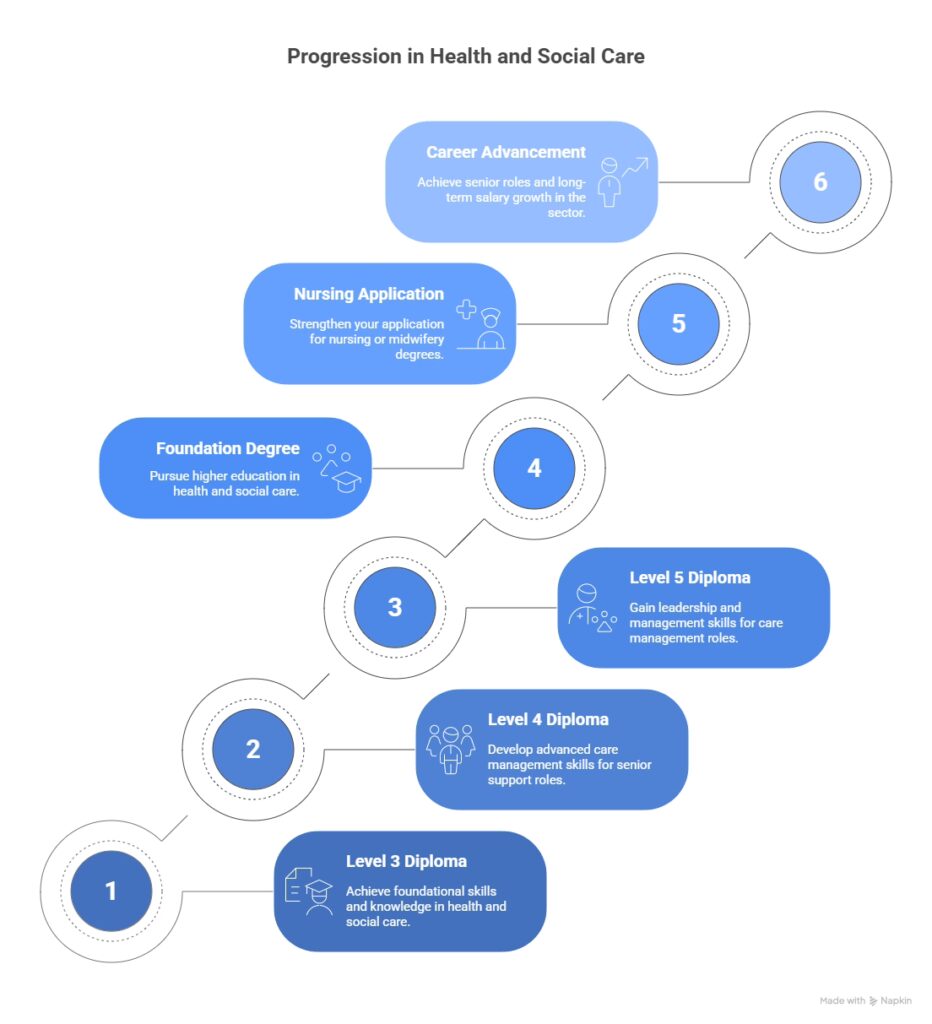
This diploma equips you with essential knowledge in safeguarding, infection control, UK care legislation, and person-centred care, all of which universities and employers look for. Many learners use it as a launchpad to progress to Level 4 and Level 5 Diplomas, apply for foundation degrees, or strengthen their UCAS applications for nursing and midwifery programmes. Completing your Level 3 puts you firmly on the path to higher NHS pay bands and leadership opportunities.
How a Level 3 Health and Social Care Diploma Opens Doors
Completing a CPD-accredited Level 3 Health and Social Care Diploma demonstrates to UK employers and universities that you already possess the essential skills needed for success. It shows you understand safeguarding, infection prevention, and person-centred care, are familiar with UK care legislation and CQC standards, and can keep accurate care plans and patient records. You’ll also prove you have strong communication and teamwork skills, both critical in NHS and private care roles.
💡 Why this matters: These competencies reduce training time, improve your job readiness, and make your application for Level 4 and Level 5 Diplomas, foundation degrees, or nursing programmes far more competitive. For anyone looking to progress quickly in the health and social care sector, this diploma is the perfect starting point.
Progression Routes After a Level 3 Diploma
- Completing a Level 3 Health and Social Care Diploma is just the beginning of your learning journey. Once you achieve this qualification, you can take several progression routes to advance your career and education:
- Level 4 Diploma in Health and Social Care – ideal for learners who want to move into senior support worker or team leader roles and develop advanced care management skills. Explore the Level 4 Health and Social Care Diploma
- Level 5 Diploma in Leadership and Management for Adult Care – recognised by the Care Quality Commission (CQC) as the benchmark qualification for care managers and deputy managers. Progress to Level 5 Leadership and Management for Adult Care
- Foundation Degrees or BA (Hons) Health & Social Care – many UK universities accept Level 3 Health and Social Care Diplomas as part of their entry criteria, giving you a clear route to higher education.
- Nursing and Midwifery Applications – combining your diploma with relevant work experience can strengthen your UCAS application for nursing or midwifery degrees.
- UCAS Tariff Points – some regulated Level 3 Diplomas carry UCAS points, which can help you meet university entry requirements.
Why Further Study is Worth It
Pursuing higher qualifications after completing your Level 3 Health and Social Care Diploma can significantly boost your career prospects. Progressing to Level 4 or Level 5 Diplomas helps you access higher NHS pay bands, often moving you into Band 4 or 5 roles with better salaries.
Further study also prepares you for supervisory and management positions in care homes, domiciliary services, and NHS trusts, giving you greater responsibility and influence. In addition, gaining advanced qualifications improves job security and strengthens your professional credibility, making you stand out to employers in the competitive UK health and social care sector.
According to NHS Careers, candidates who combine formal qualifications with work experience are more likely to achieve senior roles and long-term salary growth, making further study an excellent investment in your future.
How a Health and Social Care Diploma Unlocks Your Future
A Level 3 Diploma is more than just a qualification — it’s proof of your commitment to high-quality care. UK employers, NHS recruiters, and universities value applicants who have already demonstrated knowledge of safeguarding, infection control, GDPR compliance, and patient-centred care. These are core competencies that reduce training time and make you an attractive candidate for both NHS Band 2 and Band 3 roles and higher education programmes.
Progression Routes After Level 3
Beyond formal diplomas, you can also broaden your expertise with specialist short courses in areas such as dementia care, autism awareness, medication administration, and end-of-life support. These targeted CPD modules show employers and admissions officers that you are committed to continuous professional development — a quality highly valued in healthcare and education settings.
Employer Benefits of Further Study
When you progress to Level 4 or Level 5, you not only improve your own prospects but also add value to your workplace. Care providers benefit from having staff who can lead teams, ensure CQC compliance, manage audits, and deliver higher-quality care. This often results in career fast-tracking, where employers sponsor or subsidise further training because they see you as a long-term asset.
After Fast-Track Your Journey
Thanks to modern e-learning platforms, your entire progression can happen online without compromising quality. Interactive modules, downloadable resources, and tutor support mean you can build your qualifications around your shifts or personal commitments. This flexibility allows you to balance work, study, and family life while still advancing towards supervisory or managerial roles.
Before CTA
The UK’s health and social care sector continues to grow, with Skills for Care reporting over 490,000 new workers needed by 2035 to meet rising demand. By completing a Level 3 Diploma now and planning your pathway to higher qualifications, you are positioning yourself at the forefront of this expanding job market — ensuring career stability, competitive pay, and multiple progression routes for years to come.
Fast-Track Your NHS Career
One of the biggest advantages of online learning is that it allows you to study at your own pace — without putting your life or work on hold. With flexible online modules, you can complete your Level 3 Diploma in Health and Social Care in as little as 3–6 months, depending on how much time you dedicate each week.
Once completed, you can immediately progress to Level 4 or Level 5 qualifications, building on your knowledge while gaining valuable hands-on experience in the workplace. This combination of study and real-world application is one of the fastest ways to boost your CV and make yourself more attractive to employers.
By following this fast-track route, you can earn while you learn, progress into higher NHS pay bands, and move confidently into supervisory, team leader, or care manager roles much sooner than with traditional study routes.
Conclusion
Yes — a Health and Social Care Diploma can absolutely lead to further study and even degrees. It gives you the essential knowledge in safeguarding, infection control, and UK care standards while proving to employers and universities that you are ready to succeed. This qualification is a recognised first step into NHS Band 2–3 roles and a gateway to Level 4 and Level 5 Diplomas, foundation degrees, and nursing or social work degrees.
By taking advantage of online, self-paced learning, you can complete your Level 3 in 3–6 months, gain valuable experience, and move quickly towards supervisory roles and higher NHS pay bands.
🚀 Take action now: Enrol in the Level 3 Diploma in Health and Social Care today and unlock your free Level 5 Leadership & Management course — available for a limited time to accelerate your career journey.
FAQs
Can I do Level 4 without Level 3?
Most learners complete Level 3 first, but some providers allow direct entry into Level 4 if you have relevant experience. Level 3 is strongly recommended as it builds your core knowledge and confidence.
What comes after Level 3 Health and Social Care?
You can progress to a Level 4 Diploma, Level 5 Leadership & Management Diploma, or apply for foundation degrees and nursing programmes, depending on your career goals.
Does a Level 3 Diploma give UCAS points?
Yes — many regulated Level 3 Diplomas carry UCAS tariff points. You can check the exact points using the UCAS Tariff Calculator.
Can this diploma help me get a job in the NHS?
Absolutely. Many NHS support roles, such as Healthcare Assistant or Clinical Support Worker, list a Level 2 or Level 3 Health and Social Care qualification as a preferred entry requirement.
Will progressing to Level 4 or 5 increase my salary?
Yes. Higher qualifications can move you into Band 4–5 roles, with salaries typically ranging from £28,000 to £45,000+, especially if combined with experience.
Can I study while working full-time?
Yes — online CPD-accredited diplomas are fully self-paced, so you can fit your study around your work and family commitments.
" alt="The 6 Principles of Safeguarding: Protect Before Harm Happens" />
" alt="Personal Development Goals: 5 Meaningful Examples That Work" />
" alt="TILE in Manual Handling: Meaning, Checklist & Safer Lifting Guide" />