

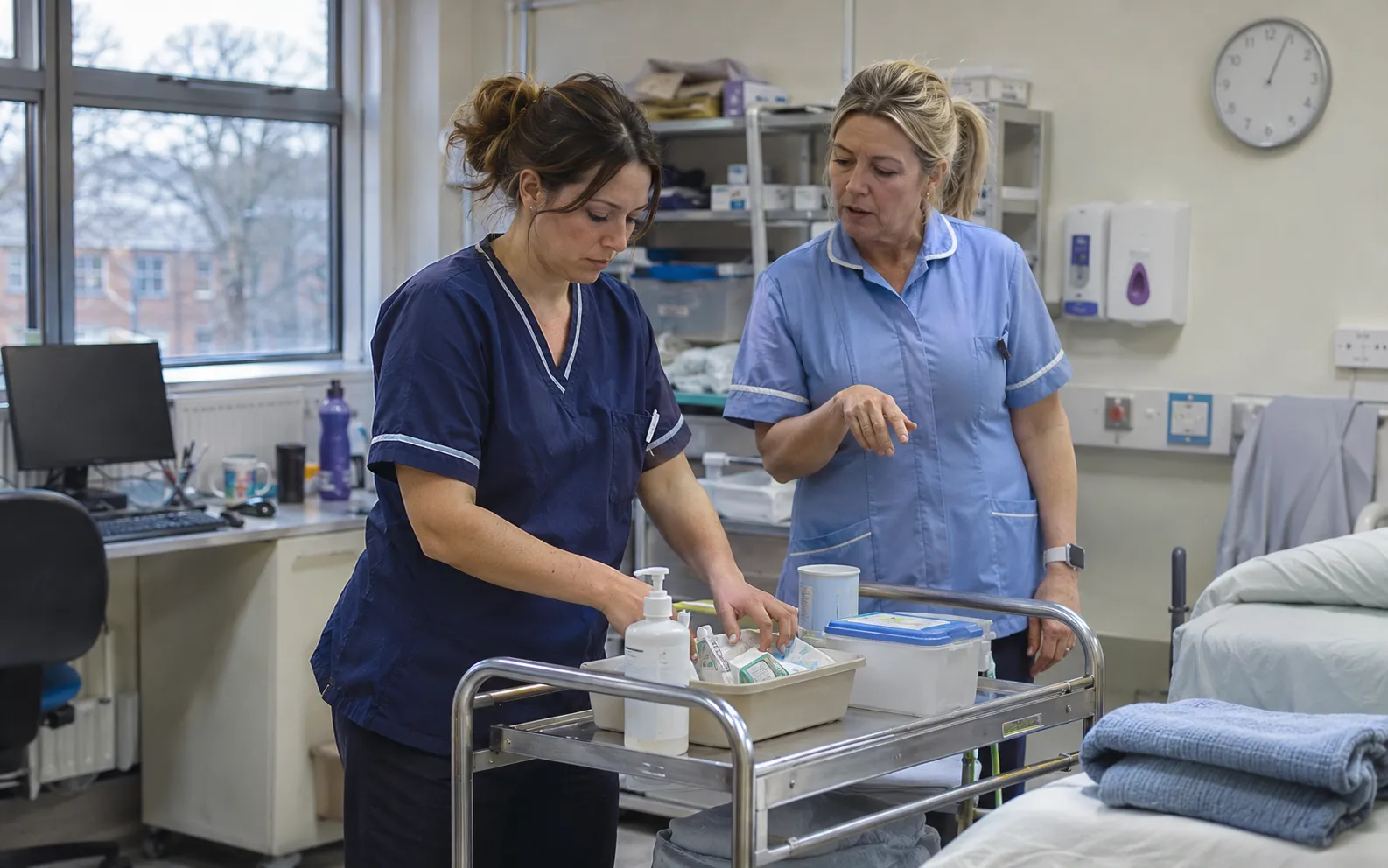

A nursing associate apprenticeship can be a practical route into nursing for people who want to develop their skills while working. Whether you are already a healthcare assistant or considering a new career, knowing where to start can make the application process much clearer.
The key is understanding the entry requirements, finding an employer willing to support your training and applying for the right opportunity.
This guide explains how nursing associate apprenticeships work in England, what qualifications you may need, where to find NHS vacancies and how to prepare your application.
Level 3 Diploma in Nursing Assistant Complete Training
Table of Contents
What Is a Nursing Associate Apprenticeship?
A nursing associate apprenticeship is a paid, work-based training programme in England that combines employment with Level 5 nursing associate education. Apprentices study through an approved education provider while developing practical skills in healthcare settings. Successful completion of the required programme and registration requirements provides a route towards becoming an NMC-registered nursing associate.
Nursing associates work alongside registered nurses and other healthcare professionals, providing care to people of different ages and backgrounds.
The Nursing and Midwifery Council (NMC) regulates nursing associates in England and approves the education programmes that prepare people for registration.
If you want a broader understanding of the profession before applying, Apex Learning’s guide to nursing associate roles, responsibilities and qualifications explains the career in more detail.
Nursing Associate Apprenticeship Entry Requirements
Before applying, check whether you meet the academic, employment and training requirements. These can differ between universities and employers.
Qualifications and GCSE Requirements
According to the National Careers Service, applicants for a nursing associate Level 5 higher apprenticeship will normally need:
- Two or more GCSEs at grades 9–4 (A*–C), including English and maths, or equivalent qualifications.
- The ability to undertake Level 5 academic study.
- A suitable apprenticeship opportunity with an employer.
Individual training providers may have additional admission requirements. Some may consider previous qualifications, professional experience or evidence of relevant learning.
If you do not hold the expected qualifications, check whether the employer or education provider accepts an equivalent or alternative route before ruling yourself out.
Work Experience and Employer Support
Healthcare experience can strengthen an application, particularly if you have worked as a healthcare assistant, care worker or healthcare support worker.
However, previous healthcare employment is not necessarily required for every externally advertised trainee position.
Employers may consider applicants who demonstrate strong communication skills, compassion, teamwork and a genuine interest in patient care.
Because an apprenticeship combines employment and education, you must have an employer supporting your training. This might be your existing employer or an organisation recruiting you into a trainee role.
People considering healthcare support work may also explore relevant foundational learning. However, additional qualifications should not be assumed to satisfy apprenticeship admission requirements without confirmation from the employer and training provider.
Additional Eligibility and Recruitment Checks
Depending on the position, applicants may also need to meet:
- Apprenticeship funding and eligibility conditions.
- Occupational health requirements.
- Appropriate Disclosure and Barring Service (DBS) checks.
- English language requirements set by the education provider.
- Any relevant right-to-work and employment conditions.
The 2026–27 apprenticeship funding rules explain the requirements for government-funded apprenticeship training in England.
Remember: Meeting the minimum entry requirements does not guarantee acceptance. Employers and education providers make their own recruitment and admission decisions within the applicable rules.
Who Can Apply for a Trainee Nursing Associate Apprenticeship?
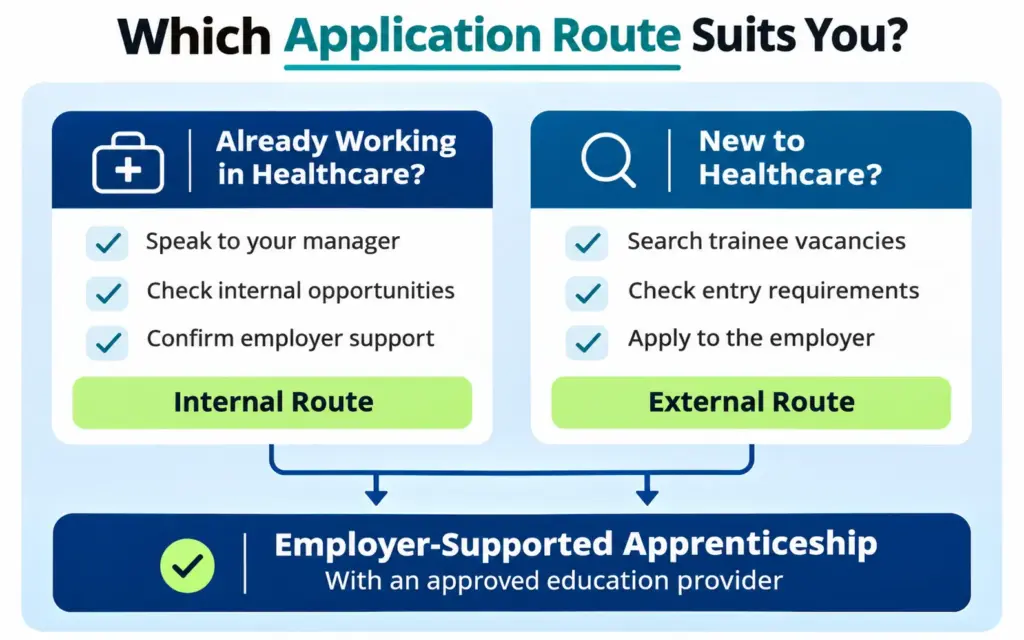
There are two common routes into nursing associate apprenticeship training, depending on whether you already work in healthcare.
If You Already Work in Healthcare
If you are employed as a healthcare assistant or healthcare support worker, your organisation may offer an internal development route.
Start by speaking with your line manager, HR department or learning and development team.
Ask whether your employer:
- Supports trainee nursing associate apprenticeships.
- Works with an NMC-approved education provider.
- Has upcoming internal recruitment opportunities.
- Can explain the selection and study arrangements.
Some employers have established apprenticeship programmes, while others recruit when suitable opportunities become available.
Your experience supporting patients, following care plans and communicating with colleagues may provide useful evidence during selection.
Relevant healthcare qualifications may also be worth exploring as separate professional learning opportunities. They do not independently qualify you as a nursing associate.
If You Are New to Healthcare
You can also investigate externally advertised trainee nursing associate opportunities.
Some employers recruit people from outside their existing workforce, although entry requirements depend on the individual vacancy.
If you lack healthcare experience, transferable skills from customer service, education, support work or other people-facing roles may be useful.
For example, a customer service employee might demonstrate experience communicating calmly, handling sensitive information and helping people with different needs.
Another possibility is to gain experience through healthcare support employment before applying for an apprenticeship.
The important point is to investigate the requirements of the opportunities available rather than assuming every employer expects the same background.
Where to Find NHS Nursing Associate Apprenticeship Vacancies
Finding a suitable vacancy is often the first practical challenge.
Nursing associate apprenticeships may be offered through NHS trusts, GP practices, primary care networks and other health or social care employers.
Search NHS Jobs and Apprenticeship Vacancies
Start with the following search terms:
- Trainee nursing associate
- Trainee nursing associate apprenticeship
- Nursing associate Level 5 apprenticeship
- TNA apprenticeship
- Healthcare support worker development programme
You can search for trainee nursing associate vacancies on NHS Jobs, and check Trac where NHS employers use it for recruitment.
You can also investigate vacancies through the government’s apprenticeship search service.
When reviewing an advertisement, check whether the position is specifically for a trainee nursing associate. A vacancy for a qualified nursing associate will normally require professional registration.
How to Find Apprenticeships Near You
If you are searching for a nursing associate apprenticeship near you, begin with your local NHS trusts and healthcare employers.
Use location filters and investigate:
- NHS hospitals and community healthcare services.
- GP practices and primary care networks.
- Relevant social care organisations.
- Local healthcare employers offering staff development programmes.
Check whether the opportunity is open to external applicants or only existing employees.

Vacancies are not necessarily advertised throughout the year. Setting up job alerts and checking recruitment pages regularly can help you identify suitable opportunities when they become available.
How to Apply for a Nursing Associate Apprenticeship
Once you have identified a suitable opportunity, take a structured approach to your application.
The exact recruitment process will vary by employer, but the following steps can help you prepare.
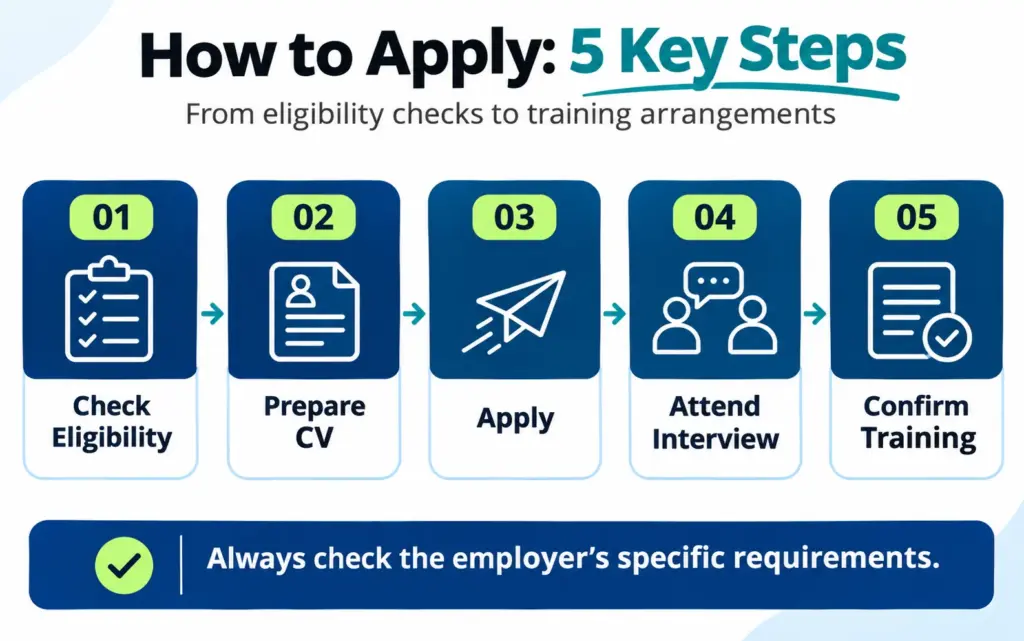
Step 1: Check Your Eligibility and Choose Your Application Route
Begin by reading the vacancy description and person specification carefully.
Confirm the required qualifications, experience, location, working arrangements and training commitments.
If you already work in healthcare, find out whether your employer has an internal application process.
If you are applying externally, follow the instructions provided in the advertised trainee vacancy.
Also check which education provider delivers the apprenticeship and whether its nursing associate programme is NMC-approved.
Step 2: Prepare Your CV and Supporting Statement
Your CV should clearly explain your education, employment history and relevant experience.
A supporting statement should demonstrate why you want to become a nursing associate and how you meet the employer’s requirements.
Rather than writing general statements such as I am a caring person who enjoys helping others, provide evidence.
Example of a supporting statement:
“While working as a healthcare support worker, I helped a patient who was anxious about an unfamiliar procedure. I listened to their concerns, explained what I could within my role and contacted the registered nurse for further support. This experience reinforced the importance of clear communication and working within professional responsibilities.”
This fictional example demonstrates communication, patient-centred care and teamwork without making exaggerated claims.
If you have limited healthcare experience, draw on relevant examples from other employment, volunteering or education.
You might also highlight transferable knowledge developed through relevant healthcare-related training.
However, your application should focus on genuine experience and the specific requirements of the advertised role.
Step 3: Submit Your Application Carefully
Before submitting, check that you have completed every required section.
Pay particular attention to:
- 1. Your employment and education history.
- 2. Evidence that you meet the essential criteria.
- 3. Relevant qualifications and professional experience.
- 4. References and other requested information.
- 5. The application deadline.
Follow the employer’s stated application process rather than assuming all NHS organisations use identical forms.
The government’s apprenticeship application guidance can help you understand how to search for and apply for apprenticeship opportunities.
Save a copy of your application. It will be useful when preparing for an interview.
Step 4: Prepare for the Interview and Selection Process
If shortlisted, you may be invited to an interview or another form of assessment.
Employers may explore your motivation, communication skills, understanding of patient care and readiness to combine employment with academic study.
Prepare examples covering:
- Working effectively with colleagues.
- Treating people with dignity and respect.
- Responding to difficult situations calmly.
- Understanding confidentiality and safeguarding.
- Recognising when to ask a senior colleague for support.
- Accepting feedback and developing your skills.
A useful approach is to explain the situation, what you needed to achieve, the action you took and the result.
Avoid memorising lengthy answers. Focus on communicating your experiences clearly and accurately.
Step 5: Confirm Employer Support and Training Arrangements
If you receive an offer, check the apprenticeship arrangements before accepting.
Ask about the education provider, study schedule, practical placements, supervision and employment conditions.
You should also understand what happens during training, including any required assessments and workplace learning.
An apprenticeship offer is a significant commitment, so make sure the arrangement suits your circumstances and that you understand the expectations.
Level 3 Diploma in Nursing Assistant | Online Course
How Long Does a Level 5 Nursing Associate Apprenticeship Take?
A nursing associate apprenticeship normally takes approximately two years.
The Level 5 nursing associate apprenticeship standard sets out the occupation’s knowledge, skills, behaviours and assessment requirements. Its revised version 2.0 applies to apprenticeship starts from 25 March 2026.
During training, apprentices combine academic education with supervised workplace practice.
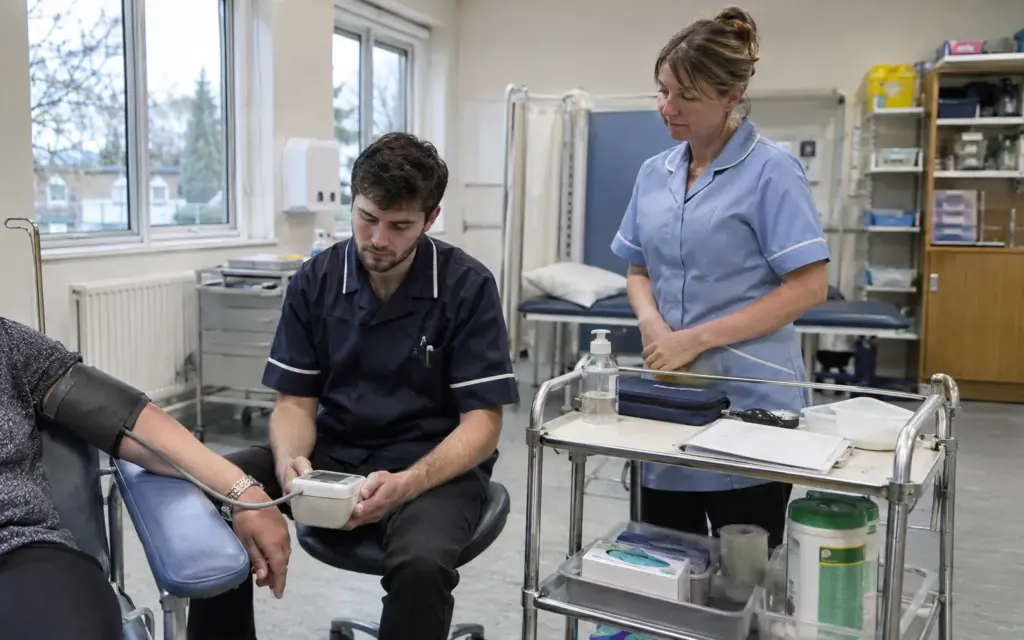
Learning may include classroom teaching, online study, clinical skills development, assessments and experience across relevant healthcare settings.
Although some providers arrange regular university study days, timetables and placement requirements vary.
Apprenticeship off-the-job training requirements are now based on the minimum hours specified for the relevant standard, rather than a universal 20% rule for new starters.
Your employer and education provider should explain the planned study and workplace commitments before training begins.
Are Nursing Associate Apprenticeships Paid?
Yes. A nursing associate apprenticeship is an employed training route, so apprentices receive wages while undertaking their programme.
Within the NHS, trainee nursing associate roles are often associated with Band 3, while qualified nursing associate positions are commonly associated with Band 4. Actual pay depends on the advertised role and employment arrangements.
Apprenticeship training funding is separate from wages paid by the employer.
For a more detailed explanation of earnings and progression, read Apex Learning’s guide to 2026 nursing associate salary and NHS Band 4 pay.
Can Healthcare Courses Help You Prepare for a Nursing Associate Apprenticeship?
Relevant healthcare education may help you develop background knowledge before applying for an apprenticeship.
For someone unfamiliar with clinical settings, studying topics such as patient communication, safeguarding, infection prevention and general care principles may provide a useful introduction.
Apex Learning offers Level 3 nursing assistant training for people interested in developing nursing support knowledge.
Its healthcare support and care-related courses may also be relevant to learners considering broader professional development.
However, these courses are not substitutes for an NMC-approved nursing associate programme.
An introductory course, CPD certificate or separate RQF qualification does not automatically satisfy apprenticeship entry requirements or provide professional registration.
Similarly, adult care leadership qualifications serve a different educational purpose from nursing associate training.
Sharing the same qualification level does not make two programmes professionally equivalent.
Before committing to training intended to lead to nursing associate registration, check the NMC’s approved programmes and confirm the entry requirements with the relevant employer and education provider.
Your Next Step Towards a Nursing Associate Apprenticeship
The best starting point is to check your eligibility and identify suitable opportunities.
If you already work in healthcare, ask your employer about apprenticeship-supported progression. If you are new to the sector, search for advertised trainee nursing associate vacancies and review the requirements carefully.
Relevant healthcare learning can help develop your knowledge, but the recognised route into the profession requires an NMC-approved programme.
With the right preparation and a clear understanding of the application process, you can take an informed next step towards nursing associate training.
Nursing Associate Apprenticeship FAQs
Can I Apply Without Previous Healthcare Experience?
Potentially, yes. Some employers advertise trainee nursing associate opportunities to external applicants. However, others prefer relevant healthcare experience or recruit existing staff. Always check the particular vacancy.
Do I Need an Employer Before Starting?
You need suitable employment and employer support to undertake the apprenticeship. If you are not already employed in healthcare, you can apply for advertised trainee positions that include apprenticeship training.
Can I Complete a Nursing Associate Apprenticeship Fully Online?
No. Although some academic teaching may be delivered online, nursing associate apprenticeships require supervised practical learning in healthcare settings. An entirely online course cannot replace the required approved professional training.
Can I Apply for a Nursing Associate Apprenticeship Without GCSEs?
Some education providers may consider recognised equivalent qualifications or alternative evidence of academic ability. However, English and maths requirements are common, and individual employers or universities may set additional conditions. Check the specific vacancy and training provider’s entry criteria before applying.
Can I Apply for a Nursing Associate Apprenticeship at Any Age?
Nursing associate apprenticeships are open to eligible adults as well as younger applicants. There is no general upper age limit for apprenticeships in England. You must meet the relevant apprenticeship funding, employment and education requirements, including the applicable minimum age rules.
Can I Become a Nursing Associate Through an Apprenticeship If I Already Work as a Healthcare Assistant?
Yes. Healthcare assistants and healthcare support workers may be able to progress through an employer-supported nursing associate apprenticeship. Speak with your line manager or workforce development team about available opportunities, selection requirements and whether your organisation supports an NMC-approved training programme.
What Questions Might I Be Asked at a Nursing Associate Apprenticeship Interview?
Interviewers may ask why you want to become a nursing associate, how you communicate with patients and how you handle challenging situations. You may also be asked about teamwork, confidentiality, safeguarding and professional boundaries. Prepare genuine examples from employment, education or volunteering that demonstrate relevant skills.
Can I Apply for More Than One Nursing Associate Apprenticeship Vacancy?
You can generally apply for multiple advertised apprenticeship vacancies, provided you meet their individual requirements. Follow each employer’s application instructions and tailor your supporting statement to the role. Check recruitment deadlines carefully and be transparent about any relevant commitments when discussing offers.
Do I Need to Apply Through a University or an NHS Employer?
For an apprenticeship, you need an employer that supports the training. Existing employees may apply through internal development programmes, while external applicants can apply for advertised trainee positions. The employer works with an approved education provider to arrange the apprenticeship. Applying directly to a university for a separate nursing associate programme is a different route.
 " alt="2026 Nursing Associate Salary: Band 4 Pay Explained" />
 " alt="Nursing Associate: NHS Pay, Duties & Career Path" />