



How much can a nursing associate earn in 2026? See NHS Band 4 salary rates, monthly take-home pay, London allowances and career progression opportunities in England.
The nursing associate salary in England ranges from £28,392 to £31,157 per year in 2026, based on the NHS Band 4 pay scale. That means a starting salary of approximately £2,366 per month before tax, pension contributions and other deductions.
However, your actual earnings can vary depending on your working hours, experience, location and shift patterns. Nursing associates working nights, weekends or in certain London areas may receive additional payments.
Whether you’re considering this career or already working in healthcare, knowing how NHS pay works can help you plan your next steps. Whether you’re considering this career or already working in healthcare, knowing how NHS pay works can help you plan your next steps. Getting familiar with the nursing associate role also provides useful context about responsibilities and career opportunities.
Table of Contents
Level 3 Diploma in Nursing Assistant Complete Training
How Much Does a Nursing Associate Earn in 2026?
Qualified nursing associates working under the NHS Agenda for Change system in England typically receive Band 4 pay, with an annual salary ranging from £28,392 to £31,157.
According to the official 2026/27 NHS pay scales, these rates have applied since 1 April 2026.
NHS Band 4 Nursing Associate Salary
Starting Band 4 Salary
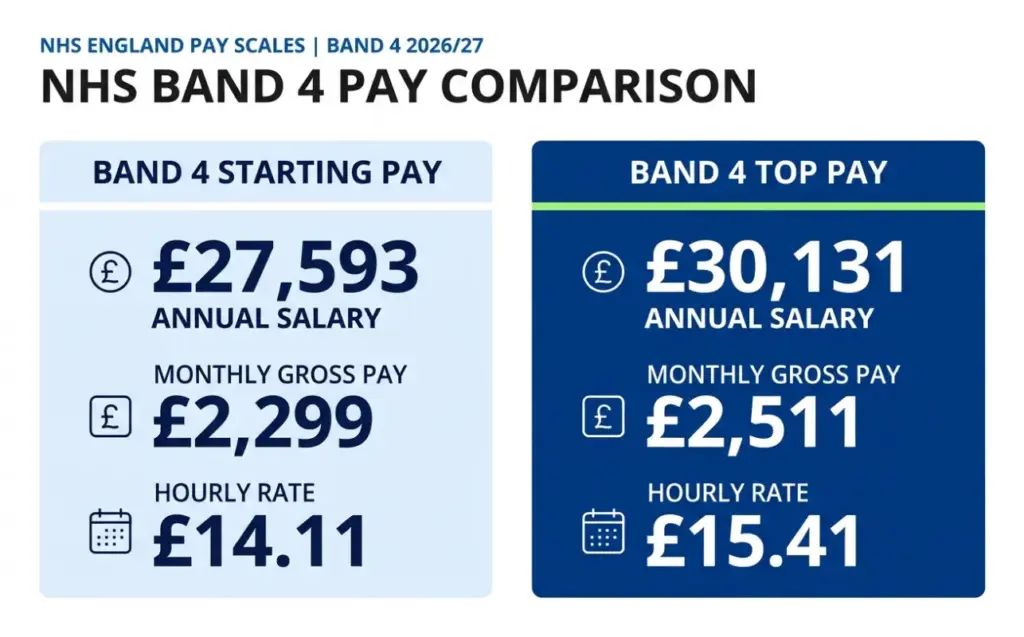
A newly qualified nursing associate starting at Band 4 typically earns £28,392 per year. This works out to approximately £2,366 per month before tax and other deductions, with a basic hourly rate of £14.52.
Top of Band 4 Salary
After meeting the relevant pay progression requirements, a nursing associate can move to the higher Band 4 pay point of £31,157 per year. This equals approximately £2,596.42 per month before deductions, with an hourly rate of £15.93.
These salaries are based on a standard NHS working week of 37.5 hours. Monthly figures are calculated by dividing annual basic pay by 12.
Nursing associates normally become eligible to progress to the top of Band 4 after three years, subject to NHS pay progression requirements. This represents an increase of £2,765 per year in basic salary.
Actual earnings may be higher for eligible employees receiving additional payments for night shifts, weekends or working in designated London areas.
What About Part-Time Nursing Associates?
Part-time nursing associates receive pay proportionate to their contracted hours.
For example, someone working 30 hours weekly instead of 37.5 hours receives 80% of the full-time basic salary. At the starting Band 4 rate, that equals approximately £22,713.60 per year before deductions or additional payments.
When comparing vacancies, check whether the advertised salary is the full-time equivalent (FTE) or the actual amount payable for the contracted hours.
What Is a Nursing Associate's Take-Home Pay?
Take-home pay is the money you actually receive after deductions from your gross salary. For nursing associates, the final amount depends on earnings, tax and other contributions.
The main deductions may include:
- Income Tax: Calculated according to your taxable earnings and tax code.
- National Insurance: Employee contributions based on your earnings and contribution category.
- NHS pension contributions: Deducted if you’re an active member of the NHS Pension Scheme.
- Student loan repayments: Applicable if your earnings exceed the repayment threshold for your loan.
For the 2026/27 tax year, the standard Personal Allowance is £12,570. Under the current Income Tax rates, most employees in England pay 20% tax on earnings above this allowance within the basic-rate band.
The standard employee National Insurance rate is 8% on earnings within the relevant contribution band for category A employees.
Example Monthly Take-Home Pay
Let’s consider a newly qualified nursing associate earning the starting Band 4 salary of £28,392 per year.
From this annual salary, approximately £3,164.40 would be deducted for Income Tax and £1,265.76 for National Insurance, assuming a standard tax code and category A contributions.
After these deductions, the nursing associate would have approximately £23,961.84 per year, equivalent to £1,996.82 per month.
This means a newly qualified nursing associate could receive around £1,997 per month before NHS pension contributions and any other deductions.
The example assumes no student loan repayments or additional earnings. Actual take-home pay will depend on individual circumstances.
Interested in Nursing Assistant Training?
For readers interested in understanding related support responsibilities, Apex Learning’s Level 3 Nursing Assistant training covers subjects including personal care, communication, safeguarding and infection prevention.
This CPD-accredited online course is separate from professional nursing associate qualification.
Explore Level 3 Nursing Assistant Training →Develop your knowledge with flexible online learning.
Do Nursing Associates Get Extra Pay for Nights and Weekends?
Yes. Nursing associates working qualifying night shifts, weekends and public holidays may receive additional payments on top of their basic salary.
Under the NHS unsocial-hours payment rules, eligible Band 4 employees receive different enhancements depending on when they work.

Saturday and Weekday Night Shifts
Eligible Saturday hours and qualifying weekday night hours attract an additional 30% of basic hourly pay.
For example, a nursing associate earning the starting Band 4 hourly rate of £14.52 would receive approximately £18.88 per qualifying hour, including the enhancement.
Sunday and Public Holiday Shifts
Qualifying Sunday and public-holiday hours attract an additional 60% of basic hourly pay.
At the starting hourly rate of £14.52, this works out to approximately £23.23 per qualifying hour, including the enhancement.
These extra payments can increase monthly earnings, particularly for nursing associates who regularly work shifts outside standard weekday hours.
However, actual payments depend on qualifying hours and employment conditions. Some nursing associates work regular daytime schedules, while others provide care across evenings, nights and weekends.
Hospital nursing teams may carry out regular patient safety checks throughout different shifts. Additional pay depends on the hours worked and employment conditions, rather than the care activity itself. Additional pay depends on when eligible hours are worked rather than the specific clinical activities performed.
Do Nursing Associates Earn More in London?
Yes. Nursing associates working in eligible NHS positions in London and certain nearby areas can receive higher salaries through the High Cost Area Supplement (HCAS), commonly known as London weighting.
This additional payment reflects the higher living costs associated with designated locations.
The amount varies depending on whether the workplace is in Inner London, Outer London or a designated fringe area.
Inner London Nursing Associate Salary
In 2026/27, a Band 4 nursing associate working in an eligible Inner London position can earn £34,186 per year at the starting pay point.
At the top of Band 4, the annual salary rises to £37,389.
Outer London Nursing Associate Salary
In Outer London, eligible Band 4 nursing associates receive a starting annual salary of £33,262.
Those at the top of Band 4 can earn £36,027 per year.
London Fringe Nursing Associate Salary
Nursing associates working in designated London fringe areas can receive £29,812 annually at the starting pay point.
At the top of Band 4, the salary increases to £32,715 per year.
For comparison, the national Band 4 basic salary outside these supplementary pay areas ranges from £28,392 to £31,157 annually.
These figures are based on the official NHS 2026/27 pay scales and already include the applicable High Cost Area Supplement.
For example, a newly qualified nursing associate starting an eligible Band 4 position in Inner London could earn £34,186 annually, compared with £28,392 at the national basic rate.
The actual salary depends on the workplace’s designated area and employment arrangements. When comparing opportunities, it’s also worth considering everyday expenses such as accommodation, transport and commuting costs.
How Does Nursing Associate Salary Progress Through NHS Bands?
The NHS Agenda for Change system provides structured pay bands, allowing employees to see how their basic salary may progress.
Moving From the Starting Salary to the Top of Band 4
Band 4 has two main pay points:
- Entry point: £28,392 annually.
- Top pay point: £31,157 annually.
Employees normally become eligible for progression to the top point after three years, subject to the applicable NHS pay progression requirements.
The difference is £2,765 per year, representing an increase in basic salary without moving to another pay band.
Band 3 vs Band 4 vs Band 5 Salary
For healthcare support workers planning their next career move, comparing NHS pay bands can help them see how earnings may change with different roles and responsibilities.
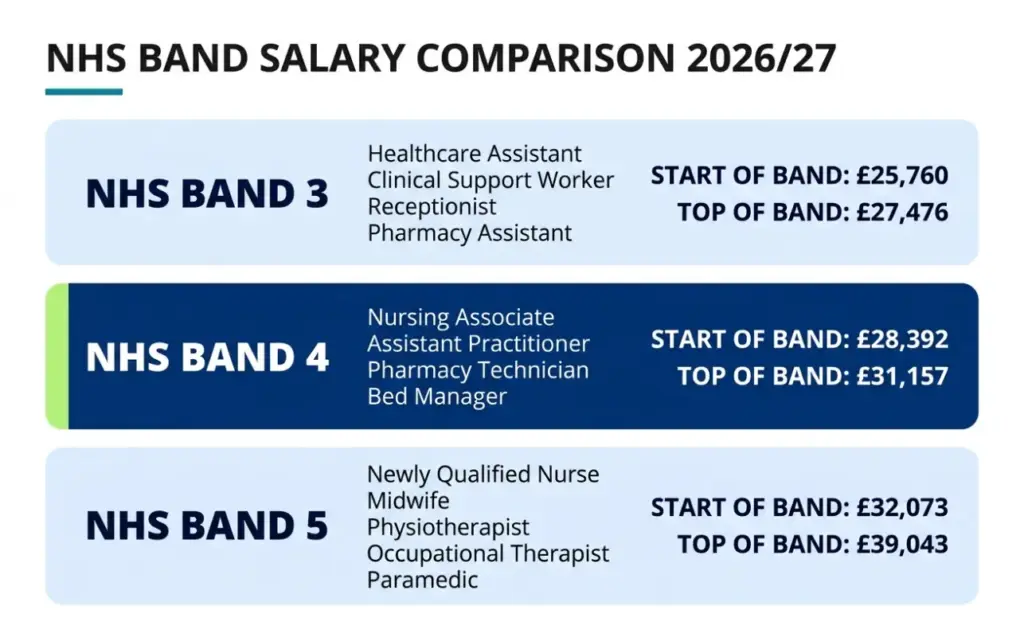
The NHS uses the Agenda for Change pay system, which sets salary ranges for different positions. According to the 2026/27 NHS pay scales, the annual basic salaries for Bands 3, 4 and 5 are as follows.
Band 3 – Healthcare Support Roles
Band 3 salaries range from £25,760 to £27,476 per year. This band includes various healthcare support positions, such as experienced healthcare assistants who provide patient care under appropriate supervision.
Healthcare support workers considering their next career step may also benefit from comparing healthcare assistant pay in the UK with nursing associate earnings.
Band 4 – Nursing Associates
Qualified nursing associates typically work at Band 4, earning between £28,392 and £31,157 annually. They take on broader clinical responsibilities within their professional scope of practice while working alongside registered nurses and other healthcare professionals.
Band 5 – Registered Nurses
Registered nursing positions commonly start at Band 5, with annual basic salaries ranging from £32,073 to £39,043. Registered nurses have a wider professional scope of practice and additional responsibilities for assessing, planning and coordinating patient care.
Healthcare workers interested in developing broader nursing care knowledge can consider supplementary online learning alongside researching the approved qualifications required for registered nursing.
For nursing associates interested in progressing to registered nursing, moving into a Band 5 role involves completing an appropriate NMC-approved nursing programme and meeting professional registration requirements.
Do Trainee Nursing Associates Receive Band 4 Pay?
Trainee nursing associates may receive different salaries from qualified Band 4 employees.
Their earnings depend on the employer, training arrangement and employment contract. Some NHS trainee positions are paid at Band 3, although arrangements vary between employers.
For people entering healthcare support work, starting a nursing assistant career can provide relevant experience before considering further professional training.
Trainees combine academic education with practical workplace learning as they work towards meeting professional requirements.
The Nursing and Midwifery Council (NMC) confirms that the nursing associate profession is regulated in England and that new entrants must complete an NMC-approved nursing associate programme.
Once qualified and registered, individuals can apply for nursing associate positions advertised at Band 4.
For those considering this route, training through a nursing associate apprenticeship provides a structured way to combine workplace experience with academic study.
Can Additional Training Support Career Development?
Developing practical healthcare knowledge can be useful for people currently working in support roles or considering further professional education.

Healthcare support workers interested in developing nursing assistant skills can build supplementary knowledge of patient care, communication, safeguarding and infection control through Apex Learning’s online training.
For example, Apex Learning’s Level 3 Diploma in Nursing Assistant Complete Training offers CPD-accredited online learning covering patient care, communication, safeguarding, infection control and nutrition.
The course supports supplementary healthcare learning. Professional nursing associate registration requires completing an NMC-approved programme and meeting the relevant registration requirements.
Does the Type of Nursing Associate Job Affect Salary?
Nursing associates work in hospitals, community healthcare, GP practices and other patient care settings.
Some nursing associates also work in mental health services, where developing mental health nursing knowledge can support their wider awareness of patient care needs.
Within NHS Agenda for Change employment, basic pay is determined by the job’s band and relevant employment conditions. Differences in working hours, location and shift patterns can affect total earnings.
The work itself may also vary between settings.
For example, nursing associates may support recording fluid intake and output as part of monitoring a patient’s condition. Depending on their training, competence and delegated responsibilities, they may also help with supporting patients who need catheter care.
Patient safety is another important part of healthcare work. This can include identifying mobility difficulties and taking appropriate steps towards reducing the risk of falls.
In some settings, nursing associates may contribute to screening for malnutrition risk as part of supporting patients’ nutritional care. They may also assist with everyday care needs, including supporting patients with oral hygiene.
Healthcare support workers looking to strengthen their essential care skills can also consider supplementary learning covering fundamental patient care principles.
Although responsibilities vary, performing individual clinical tasks does not automatically change a nursing associate’s NHS pay band.
Salaries outside the NHS may follow different arrangements, so checking the advertised pay and contract details remains important.
Final Thoughts on Nursing Associate Pay in 2026
A qualified NHS nursing associate in England can earn £28,392–£31,157 annually at Band 4, with the potential for additional payments depending on location and working patterns.
Knowing the difference between basic salary, take-home pay and allowances makes it easier to compare jobs and plan your professional development.
Whether you’re entering healthcare or considering your next career step, a clear picture of nursing associate earnings can help you make a well-informed decision.
Frequently Asked Questions About Nursing Associate Salary
What Is a Nursing Associate Salary in the UK?
In 2026, a qualified nursing associate working at NHS Band 4 in England earns between £28,392 and £31,157 per year. This is approximately £2,366–£2,596 per month before tax and other deductions. Eligible London supplements and additional shift payments can increase earnings.
What Pay Band Is a Nursing Associate?
Qualified NHS nursing associates typically work at Band 4 under the Agenda for Change pay system. Newly qualified staff generally start at £28,392 annually, with the opportunity to progress to £31,157 after meeting the relevant pay progression requirements.
Is a Nursing Associate a Band 5?
Nursing associates generally work at Band 4, while registered nursing positions commonly begin at Band 5. In England, Band 5 salaries range from £32,073 to £39,043 in 2026/27. Moving into a registered nursing role requires the appropriate qualifications and professional registration.
Is a Nursing Associate Higher Than a Nurse?
No. Nursing associates and registered nurses are separate regulated professions with different responsibilities. Nursing associates support patient care and work alongside registered nurses, who have a broader professional scope of practice. Both play important roles within healthcare teams.
Can a Nursing Associate Become a Nurse?
Yes. Nursing associates can progress towards becoming registered nurses by completing an appropriate NMC-approved nursing programme and meeting registration requirements. Previous nursing associate education may count towards further study, depending on the programme and education provider.
Is Becoming a Nursing Associate Worth It?
Becoming a nursing associate can be a rewarding career choice for people interested in patient care and professional development. The role offers structured NHS Band 4 pay, opportunities to gain clinical experience and potential progression towards registered nursing. Whether it suits you depends on your career goals, interests and preferred working environment.
 " alt="Nursing Associate Apprenticeship: NHS Entry Guide" />
 " alt="Nursing Associate: NHS Pay, Duties & Career Path" />