



A person misses three appointments. The care team records them as unwilling to engage. But nobody checks whether the appointment letters were accessible or whether the person could arrange transport.
Situations like this show why identifying barriers in health and social care matters. The problem is not always an individual’s willingness to receive support. Sometimes, the way services operate makes accessing that support unnecessarily difficult.
For care managers, recognising these barriers means looking beyond individual circumstances. It involves examining communication, accessibility, staff practices and organisational procedures to understand what prevents people from receiving appropriate care.
What Are Barriers in Health and Social Care?
Barriers in health and social care are factors that prevent or make it difficult for individuals to access services, communicate their needs, participate in decisions or receive appropriate support. They can involve physical environments, communication difficulties, personal circumstances, financial pressures or organisational practices that create unequal access to care.
For example, someone with hearing loss might struggle to follow an appointment conducted without suitable communication support. The hearing loss itself does not make the appointment inaccessible; the absence of appropriate support creates the barrier.
Barriers can also overlap. A person may experience mobility difficulties, limited transport and inaccessible appointment information simultaneously.
Recognising these connections helps care professionals distinguish individual support needs from problems that services can reasonably address.

Types of Barriers in Health and Social Care
Understanding the different types of barriers in health and social care helps teams identify where access or communication may be failing.
There is no single universal classification. However, several common categories help explain the difficulties people experience.
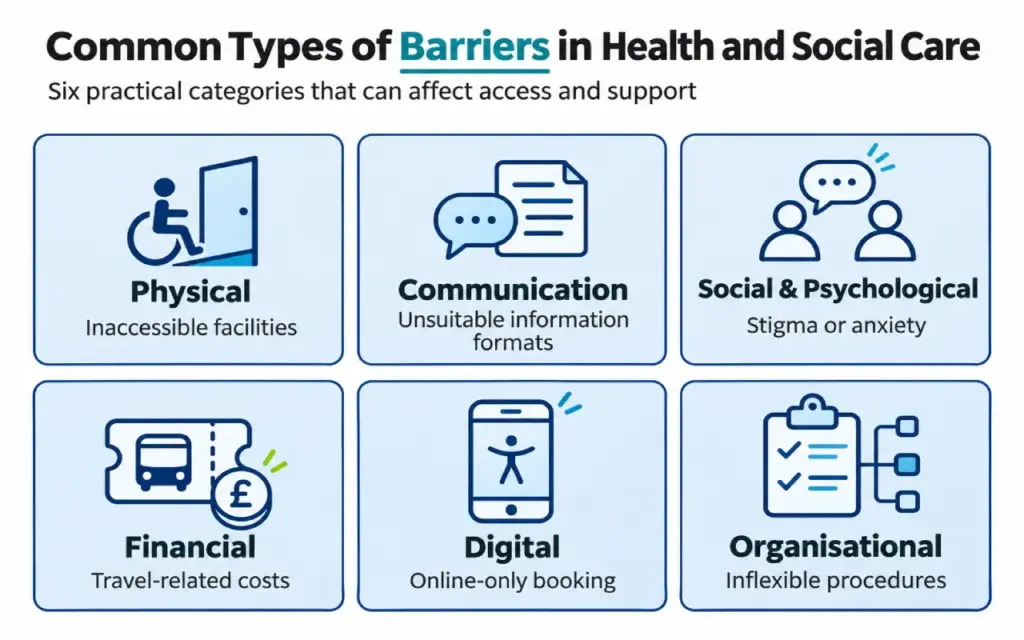
Physical and Environmental Barriers
Physical barriers involve environments or facilities that make accessing care difficult.
Examples include:
- Buildings without suitable step-free access.
- Examination rooms that cannot accommodate mobility equipment.
- Inaccessible toilets or waiting areas.
- Difficult transport connections to care facilities.
A wheelchair user may reach a clinic but still struggle to access an examination room. Providing an accessible entrance alone would not resolve the entire problem.
Managers should consider whether facilities, equipment and service arrangements meet people’s actual accessibility needs.
Communication and Information Barriers
Communication barriers arise when people cannot easily exchange, receive or understand information.
They may involve hearing or visual impairments, language differences, unfamiliar terminology or information provided in unsuitable formats.
For example, sending standard printed instructions to someone who requires large print or another accessible format may prevent them from understanding important care information.
Care workers need appropriate communication skills in health and social care, but good listening alone cannot replace necessary interpreting services, communication aids or accessible materials.
Social, Cultural and Psychological Barriers
Social and cultural barriers may involve discrimination, isolation, stigma or services that do not adequately respect individual preferences.
Psychological barriers can include anxiety, previous negative experiences or concerns about discussing sensitive needs.
Someone who experienced dismissive treatment might feel uncomfortable seeking further support.
Managers should encourage respectful conversations and avoid assumptions about people’s beliefs, abilities or preferences.
Financial and Digital Barriers
Financial difficulties can affect whether people can reach or use services, even when the care itself is available without direct charges.
Transport expenses, childcare arrangements and other access-related costs may create difficulties.
Digital barriers can arise when booking systems, appointment information or consultations depend on technology that someone cannot access or use.
For instance, an online-only booking system may disadvantage a person without reliable internet access or suitable digital support.
Organisational and Systemic Barriers
Organisational barriers develop through service procedures, staffing arrangements or poor coordination.
Examples include inflexible appointment times, confusing referral processes, inconsistent communication between teams and delays in arranging support.
These problems may be less visible than physical barriers, but they can directly affect someone’s experience.
| Barrier Type | Example | Possible Service Response |
|---|---|---|
| Physical | Inaccessible examination room | Arrange suitable facilities |
| Communication | Information in an unsuitable format | Provide accessible information |
| Psychological | Anxiety about appointments | Offer supportive communication |
| Financial | Difficulty covering travel expenses | Explain available assistance where applicable |
| Digital | Online-only appointment booking | Provide an accessible alternative |
| Organisational | Communication needs missed during referral | Improve information-sharing procedures |
For those developing broader care knowledge, Apex Learning’s Level 3 & 5 Diploma in Health and Social Care covers topics including communication, equality, safeguarding and care planning. It offers CPD-accredited learning rather than automatically providing a regulated occupational qualification.

Barriers Care Managers Often Overlook
Some of the most important barriers are not immediately visible. They emerge from routine decisions that staff may consider normal.
Assuming the Individual Is the Problem
A person repeatedly misses appointments. Staff describe them as disengaged.
However, the underlying issue could involve inaccessible transport, unsuitable appointment times or information the person cannot understand.
Before reaching conclusions, managers should investigate whether the service has contributed to the difficulty.
This does not mean every missed appointment results from organisational failure. It means the reason should be established rather than assumed.
Recording Needs Without Meeting Them
A care plan might correctly identify someone’s communication preferences, yet staff continue providing information in an unsuitable format.
The requirement has been recorded, but the barrier remains.

Effective care planning and record-keeping should support decisions and actions throughout the person’s care.
Managers need to check whether relevant information reaches the appropriate staff and whether agreed support is actually delivered.
Policies That Do Not Work in Practice
A service may have an accessibility policy while its everyday procedures still create difficulties.
For example, a clinic might offer alternative appointment arrangements in principle, but staff may not know how to organise them.
Similarly, a digital booking system could make appointments easier for some users while excluding others.
Managers should compare written procedures with the experience of people receiving care. A policy is useful only when it leads to appropriate action.
Not Listening to People Receiving Care
Feedback can reveal problems that routine staff reviews miss.
A resident might report difficulty understanding medication explanations. A family member may raise concerns about inaccessible correspondence.
These concerns deserve appropriate investigation rather than being treated as isolated complaints.
Managers should also consider whether feedback methods themselves are accessible. A written questionnaire, for instance, may not suit everyone.
How Do Barriers Affect Quality of Care?
Barriers to accessing health and social care can affect much more than attendance.
They may delay support, limit someone’s understanding of treatment choices or reduce their ability to participate in decisions. Poor accessibility can also undermine dignity, independence and confidence.
Consider an older person who receives an appointment letter they cannot read. They miss the appointment, struggle to rearrange it online and eventually disengage from the process.
Several barriers have combined, even though each might initially appear minor.
Person-centred care requires professionals to consider how these difficulties affect the individual.
The NICE shared decision-making guidance recommends supporting people to understand their options, express preferences and participate in decisions about treatment or care.
This makes accessible communication and meaningful involvement important parts of care quality, not simply administrative improvements.

How Can Managers Reduce Barriers in Health and Social Care?
Reducing barriers requires more than recognising problems. Managers need practical processes for identifying difficulties, responding appropriately and checking whether changes improve people’s experiences.
Identify Barriers Through Feedback and Observation
Start by examining how people experience the service.
Ask whether individuals can access appointments, understand information and communicate their needs.
Useful approaches include reviewing complaints, observing service processes and speaking with staff about recurring difficulties.
Look for patterns rather than relying only on individual incidents.
For example, repeated complaints about appointment letters might indicate that information formats need reviewing.
However, managers should investigate the reasons before deciding on a solution.
Put Appropriate Adjustments Into Practice
Different barriers require different responses.
A person with visual impairment may need accessible written information. Someone with mobility difficulties might require suitable facilities or equipment.
NHS England’s Accessible Information Standard sets out six essential implementation steps:
↪ Ask about communication and information needs.
↪ Record those needs appropriately.
↪ Flag them so relevant staff can recognise them.
↪ Share relevant information through appropriate processes.
↪ Act to meet identified requirements.
↪ Review needs and update records when necessary.
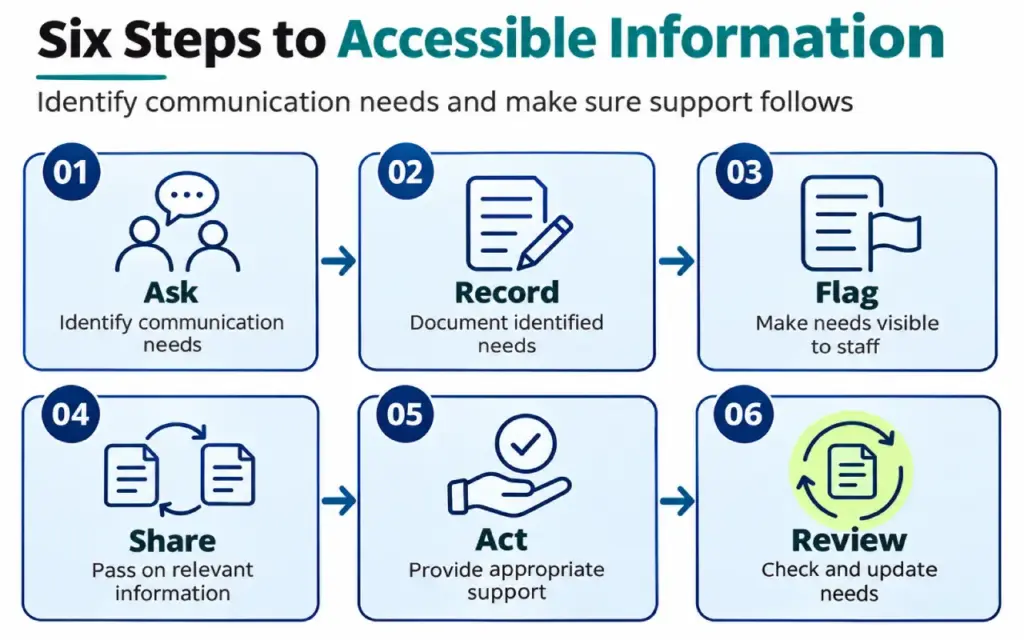
The standard applies to relevant NHS and publicly funded adult social care services in England.
For managers, the important lesson is that identifying a need is only the beginning. The service must follow through with appropriate support.
Make Responsibilities Clear Across the Team
Even well-designed adjustments can fail when nobody takes responsibility for implementing them.
Managers should establish who identifies barriers, who arranges support and who checks whether it has been provided.
Staff also need suitable information, supervision and opportunities to raise concerns.
Some changes, such as building alterations or commissioning arrangements, may require decisions beyond a frontline manager’s authority. These issues should be escalated appropriately rather than left unresolved.
Apex Learning’s Level 4 Diploma in Health and Social Care Management covers areas including care leadership, policies, responsibilities and service management. It may support professional knowledge development, but completing the course does not automatically meet regulated care-manager qualification requirements.
Check Whether Improvements Have Worked
Introducing a change does not necessarily mean the barrier has been removed.
Managers should review outcomes and seek feedback from the people affected.
| Identified Problem | Management Response | What to Review |
|---|---|---|
| Inaccessible appointment letters | Arrange suitable information formats | Can individuals access the information? |
| Repeated complaints about booking | Investigate booking procedures | Have access difficulties reduced? |
| Communication needs missed during handovers | Improve relevant information sharing | Is support delivered consistently? |
| Unsuitable appointment arrangements | Consider reasonable alternatives | Can the individual attend or participate? |
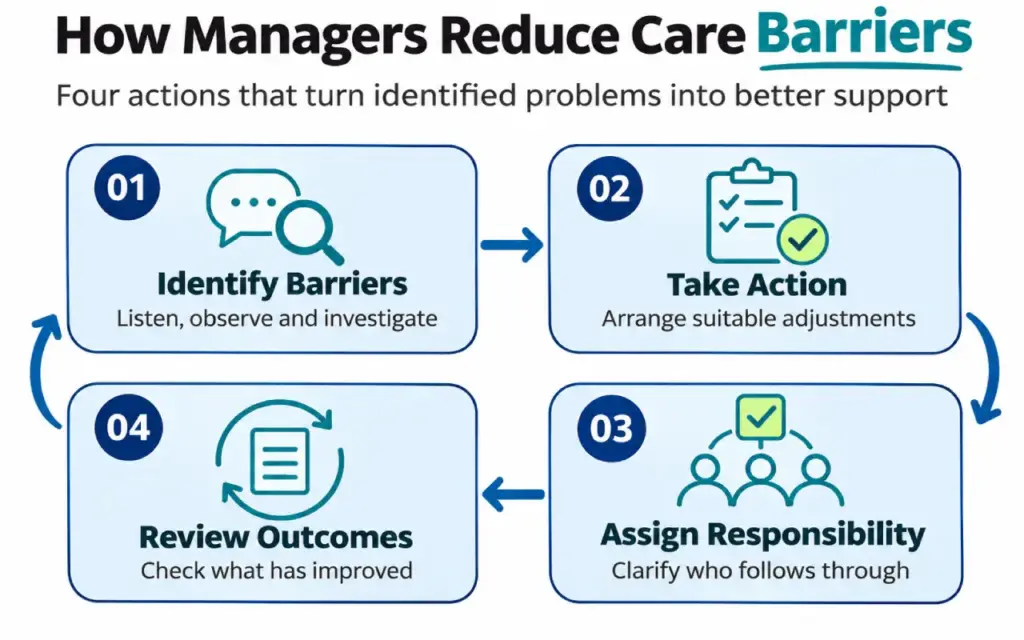
Reviewing these questions helps managers identify whether further action is needed.
Where a serious safety concern is identified, staff should follow appropriate reporting and escalation procedures without waiting for a routine review.
UK Legal and Professional Responsibilities
Reducing barriers is not solely a matter of good practice. Specific legal and regulatory duties apply, depending on the organisation and jurisdiction.
Under the Equality Act 2010, service providers in Great Britain have an anticipatory duty to make reasonable adjustments for disabled people. Providers must proactively consider potential barriers rather than waiting for an individual to encounter them.
In England, the Care Quality Commission (CQC) regulates relevant health and adult social care services.
Two requirements are particularly relevant:
↪ Regulation 9: The CQC’s person-centred care requirements require registered providers to consider individual needs and preferences and support participation in care decisions.
↪ Regulation 17: The CQC’s good governance requirements require effective systems for assessing quality, managing risks and acting on feedback.
CQC regulation applies in England. Scotland, Wales and Northern Ireland have their own regulatory arrangements, and Northern Ireland also has a separate disability discrimination framework.
Managers should therefore follow the requirements relevant to their organisation, service and location.
Conclusion
Barriers in health and social care are not always obvious, and identifying them is only part of the solution.
For managers, the real test is whether people’s experiences lead to meaningful improvements. Reviewing service procedures, listening to concerns and checking that adjustments work can help make care more accessible and responsive.
The aim is not simply to maintain good policies, but to ensure people can receive and participate in the care they need.
Frequently Asked Questions
What are the seven barriers in health and social care?
There is no single official list of seven barriers. Common categories include physical, communication, financial, cultural, psychological, digital and organisational barriers. Some educational frameworks group these differently.
What are examples of barriers in health and social care?
Examples include inaccessible buildings, language difficulties, unsuitable information formats, transport problems and inflexible appointment systems. These barriers can prevent individuals from accessing or participating fully in care.
What is the most common barrier to healthcare?
No single barrier is the most common across every population and service. The main difficulties vary according to individual needs, geographic location, accessibility and the type of care required.
How can communication barriers be reduced in care?
Communication barriers can be reduced through accessible information, suitable interpreting or communication support, clear explanations and checking understanding. Staff should respond to each person’s identified needs.
Why is it important to identify barriers in health and social care?
Identifying barriers helps services recognise problems affecting access, dignity, safety and participation. Early recognition also allows staff and managers to consider appropriate adjustments before difficulties continue or worsen.
What is the manager’s role in reducing barriers?
Managers should investigate access difficulties, support appropriate adjustments, clarify staff responsibilities and review outcomes. They should also escalate concerns that require senior management, specialist or external action.

 " alt="The 6 Principles of Safeguarding: Protect Before Harm Happens" />
 " alt="Personal Development Goals: 5 Meaningful Examples That Work" />